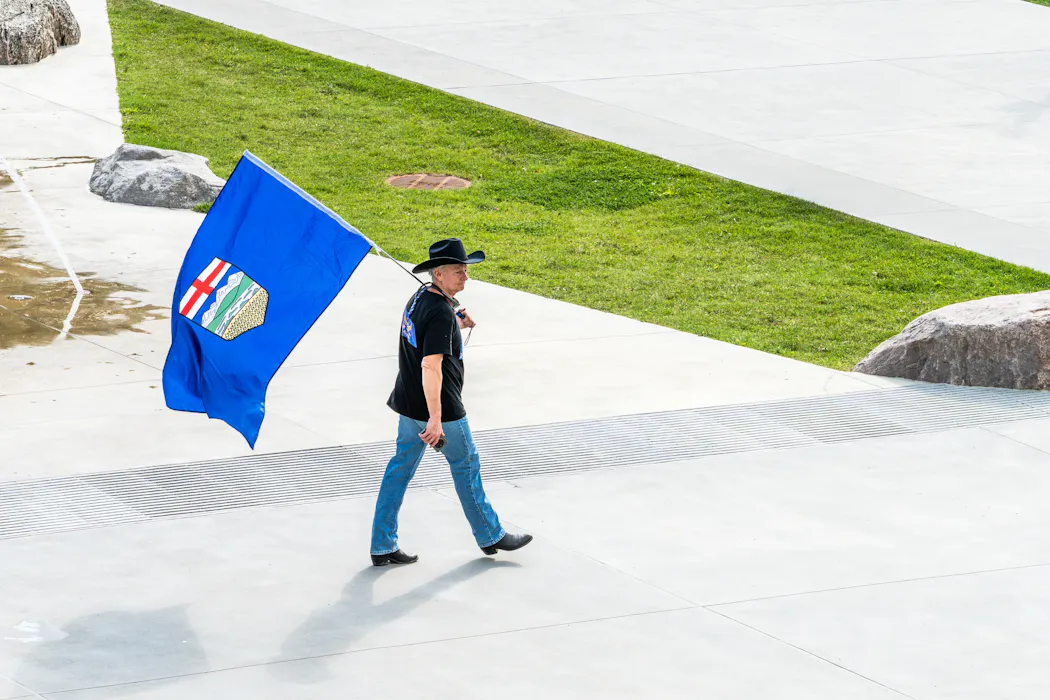
In the western Canadian province of Alberta, a political battle is playing out on people’s front lawns. Separatists are flying the royal blue Alberta flag, others the red and white maple leaf of Canada to show their support for a united Canada.
It’s all because a populist right-wing political movement wants Alberta to break away from the rest of the country. On October 19, Albertans will vote on whether to have a binding referendum on independence.
“Public opinion polls show quite consistently over the last two years that about 70% to 75% of Albertans want to remain in Canada,” explains Jared Wesley, a professor of political science at the University of Alberta to The Conversation Weekly podcast. “So there’s a lot of confusion around the process and why we’re holding this vote in the first place.”
Separatist sentiment is driven in part by a longstanding sense of western alienation from eastern Canada, fuelled by grievances that the province puts more into the federal budget than it gets back. But the current wave of separatism in Alberta also has links to protests against Covid vaccine mandates and conspiracy theories. While most separatists want Alberta to become its own country, some even want the province to be the 51st US state.
Donald Trump’s aggressive trade war with Canada and his attacks on Canadian Prime Minister Mark Carney loom large over the poll. Some Albertans who may otherwise have voted in favour of independence to send a message to Ottawa, Wesley says, “are really withholding that support because they worry about what message that sends to the United States.”
Read more:
Albertans disapprove of Donald Trump — and his brand is weakening separatism, too
The referendum was called by the Alberta premier, Danielle Smith, leader of the province’s United Conservative Party. Despite her support for Alberta remaining in Canada, Smith faced pressure from separatists within her party to hold a referendum. Wesley says Smith’s decision bears similarities with the decision taken by then UK prime minister David Cameron to hold the 2016 Brexit referendum on leaving the European Union:
“More or less, David Cameron called the bluff of his internal Brexiteers that were putting pressure on him, and called a nationwide referendum thinking that he would win it. A lot of the same pressures are at play for Danielle Smith.”
There are ten questions on the ballot, ranging from whether to introduce stricter rules on access to public services for immigrants, to proposals for judicial and constitutional reform. The final question reads:
“Should Alberta remain a province of Canada, or should the government of Alberta commence the legal process required under the Canadian Constitution to hold a binding provincial referendum on whether or not Alberta should separate from Canada?”
Wesley says turnout will be key to how the referendum plays out:
“Very few polls show a reasonable prospect for this first referendum passing. However, in a low turnout situation, the distance between remain and continue the conversation … narrows considerably.”
Disclosure statement
Jared Wesley receives funding from the Social Sciences and Humanities Research Council.
Credits
This episode of The Conversation Weekly was written and produced by Gemma Ware and Grace Jennings-Edquist. Mixing by Dan Semo and theme music by Neeta Sarl.
Newsclips in this episode from cpac, BBC and Global News.
Listen to The Conversation Weekly via any of the apps listed above, download it directly via our RSS feed or find out how else to listen here. A transcript of this episode is available via the Apple Podcasts or Spotify apps.
