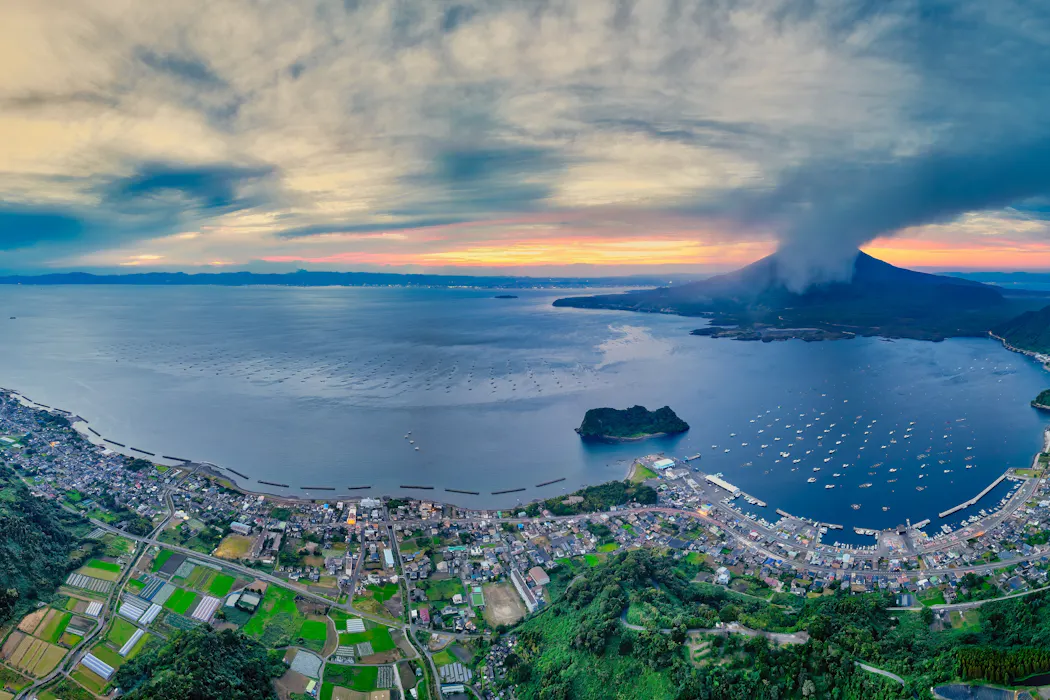
When a massive environmental disaster strikes, do societies simply collapse and disappear? Or do people find a way to adapt, rebuild and recover?
As a researcher studying ancient societies and their environments, these aren’t just academic questions to me – they can also offer useful perspectives on our own climate-threatened future.
To understand how human communities handle cataclysmic shocks, my colleagues and I looked back 7,300 years. We investigated what happened to the prehistoric Jōmon hunter-gatherer populations after they were hit by the Kikai-Akahoya eruption in Japan – the largest volcanic eruption since the end of the last ice age.
This enormous underwater volcanic eruption was utterly devastating, blasting out of the seabed without warning, battering the Japanese islands with powerful earthquakes and massive tsunamis. The eruption pumped volcanic ash high up into the atmosphere which then rained down and blanketed the landscape in metre-deep layers of toxic dust.
This volcanic ash choked coastlines, destroyed inland rivers and killed off lush forests for decades. Near the epicentre of the eruption, the environmental destruction lasted for centuries, utterly destroying local food systems. For the Jōmon hunter-gather people who relied on harvesting natural resources in the wild, this had catastrophic and enduring shocks on their food security.
For a long time, archaeologists have debated what happened to communities during the aftermath. Some have argued that it led to a total apocalypse where all human life abruptly ended. Others have insisted on total continuity, suggesting people just pushed through.
Our new research moves past this rigid, binary debate. By tracking population levels across different regions of Japan before and after the blast, we uncovered a much more complex and fascinating story.
We initially assumed that thicker ash meant higher population declines. The data partially backed this up, showing major loss of life near the eruption. But our research has revealed some real surprises.
Forager populations closest to the epicentre were actually already declining before the volcano ever blew. So the disaster compounded preexisting vulnerabilities among these small groups of people who survived by moving around a lot to gather sufficient resources, such as plants, nuts and wild game.
In contrast, population levels actually boomed after the eruption in certain areas quite close to the destruction. Survivors didn’t just sit there and perish; they migrated away from the worst-hit zones into safer regions.
Inland survivors quickly moved to coastal areas where marine ecosystems recovered faster, shifting their entire economy to survive. The Jōmon people appear to have reacted and also adapted quite rapidly.
Paradoxically, populations living far away from the volcano (where people should have been safe) stagnated or declined after the eruption. This was probably due to a volcanic winter, where ash clouds blocked the sunlight, reducing plant growth and also animal numbers on which the Jōmon hunter-gatherers relied on for their main food supplies.
Surviving the apocalypse
What do these prehistoric responses mean for us today?
The core insight of our research is the vital role of human agency. True resilience isn’t about perfectly maintaining the status quo or seamlessly continuing as if nothing happened. Rather than causing total collapse, this ancient disaster triggered a complex mix of migration, adaptation and recovery.
Survivors chose to move. They forged entirely new social networks, innovated new economies, and found creative, resourceful ways to thrive in a permanently altered world.
By studying these ancient disasters, we generate a more dynamic vision for modern resilience. Survival is not a fixed state. The lessons of the Jōmon people remind us that our future in the face of climate shocks and other disasters won’t only be decided by environmental conditions, but also by our collective social actions and capacity for making decisions.

Peter Jordan receives funding from the Swedish Research Council (VR) and European Research Council (ERC)