It has been said that a society should be judged not by how it treats its outstanding citizens but by how it treats people who break the law.
I research prisons and am interested in what incarceration reveals about the relationship between the state and the people in its care.
By this standard, the UK and Denmark tell very different stories. In 2025, Denmark’s prison population stood at around 69 people per 100,000 residents, compared with about 170 per 100,000 in the UK – roughly two and a half times higher.
One way to understand this difference is through welfare. With its wide range of universal welfare state services such as heavily subsidised daycare, free healthcare, free education and high standards of public services, Denmark’s criminal justice system has traditionally placed greater emphasis on rehabilitation and reintegration. Prisoners retain the right to vote, maintain closer contact with family and are generally encouraged to participate in ordinary social life where possible.
Health Gap / Sundhedskløften is a collaborative series from The Conversation UK and Denmark’s Videnskab.dk exploring what the two countries can learn from each other when it comes to health and wellbeing.
From cycling and alcohol to inequality, healthcare and everyday habits, the series looks beyond hospitals and medical treatment to explore how culture, politics and society shape the way people live – and how healthy they are.
The UK, while still a welfare state, is more uneven in its provision. And these social differences are reflected in criminal justice policy. This results in higher incarceration rates in the UK, as well as more challenging prison conditions and a stronger emphasis on punishment and deterrence.
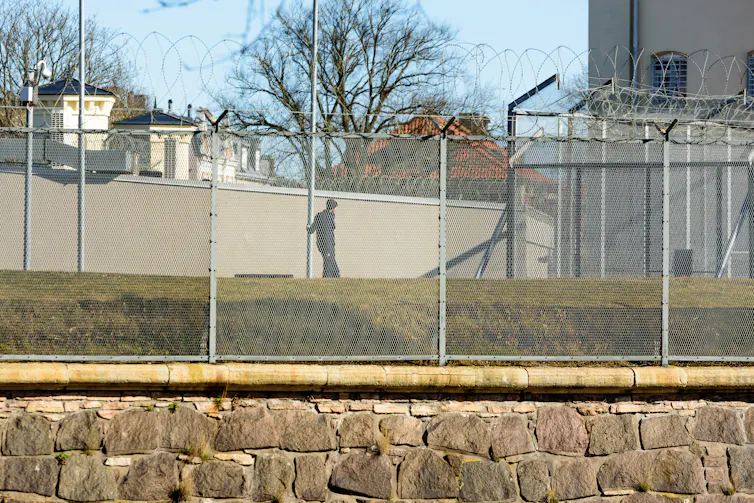
Indeed, my previous research, comparing prisons in England and Wales with another Nordic country, Norway, found that imprisonment in the UK is often experienced as unpredictable and austere. Norway’s system, meanwhile – which is closer to the Danish system – felt more structured and respectful.
Pexels/Mike van Schoonderwalt, CC BY
Yet this difference in approach is only relatively recent. After the second world war, both countries used open prisons widely, spearheaded humane and progressive politics and had low imprisonment rates.
From the 1980s onwards, however, the UK increasingly moved towards a more punitive approach to criminal justice. Under Margaret Thatcher’s government and subsequent administrations, prison populations grew substantially while conditions in many prisons deteriorated.
The question is: which works best? Tough on crime policies that dramatically increase the prison population, or welfare-based decision making with an emphasis on rehabilitation?
Punishment in practice
On the surface, the outcomes can look surprisingly similar. Around 30% of prisoners released in Denmark go on to reoffend, compared with 29% in England and Wales. But that comparison changes when you look more closely.
For those serving short sentences of under a year, reoffending is around 34% in Denmark. Whereas this figure almost doubles for the UK, with roughly 66% of prisoners going on to reoffend.
The disruption caused by short-term imprisonment – loss of housing, employment, relationships and social stability – is particularly severe in the UK, where prisoners often leave custody with limited support.
Yet Denmark should not be romanticised. Danish prisons may be safer, more humane and more “survivable” than many prisons in the UK, but they also contain notable problems.
In Denmark, prisons have faced criticism over the use of pre-trial isolation, lack of care for women in custody, and the treatment of gang-affiliated prisoners.
In January 2026, the death of a prisoner in North Jutland triggered large protests from prisoners and their families – amid concerns that serious health issues were not properly addressed. The prisoner was reportedly experiencing intense abdominal and stomach pain in the days leading up to this death. With claims from inmates that he repeatedly sought medical attention before dying in his cell.
Denmark’s prison service has also lost around 30% of its staff over the past decade, with prisons running at or above capacity.
The UK system has faced similar problems in recent years. Around 3,000 prison officers leave their roles every year in England and Wales, contributing to a constant cycle of recruitment and turnover. Combined with overcrowding, lack of rehabilitative initiatives and rising violence, it leaves many prisons stretched thin.
Reshaping realities
These pressures are reshaping daily life inside. In Denmark, open prisons – once seen as central to the rehabilitative approach – are changing. Increasingly, low-risk prisoners serve their sentences in the community under electronic tag, meaning open prisons now tend to be filled with more vulnerable and complex cases.
Drugs can be an issue. Staff are also often young and still training, meaning that maintaining order can be a challenge.
In both countries, high-security prisoners can spend up to 22 hours a day in their cells due to staff shortages and restricted regimes. It’s a reminder that very different systems can produce similarly harsh conditions under pressure.
Bjørn*, a prisoner I spoke with during my fieldwork in a high-security prison in Denmark, was often transferred between prisons where he was kept in strict conditions because he was considered a “difficult” prisoner.
Reflecting on his previous sentence, he said: “I was angry with the authorities when I went in. When I got out, I hated them”. His experience illustrates how punishment that relies heavily on containment can create prisons that are more volatile for both staff and prisoners.
Trust in rehabilitation
But as my research also found, in Denmark, imprisonment is often seen in more conditional terms.
As, Noah* – another of of the prisoners I spoke with – put it, it’s almost like a “contract” between the individual and the state, where efforts to change are meant to be met with a real chance of release. In other words, Danes have high expectations of their state, even when it punishes them.
That reflects the wider level of trust in public institutions found in Denmark: around 60% of Danes say they trust their government, compared with about 33% in the UK.
In England and Wales, prisoners and staff alike describe a system shaped by overcrowding, staff shortages and instability, with fewer opportunities for rehabilitation.
In this sense, the comparison between Denmark and the UK is not a straightforward story of “humane” versus “punitive” systems. But something more complicated about trust, expectations and pressure.
That said, the Danish Government has recently launched a new strategy for punishment with longer sentences alongside more rehabilitative initiatives. These proposals have been met with concern as to whether a more rehabilitative model can survive when resources are stretched.
In the end, though, the differences between Denmark and the UK are not fixed. Because prison systems are not just shaped by national philosophies on punishment, but also by the political choices that determine whether rehabilitation is adequately funded and supported.
*Prisoners’ names have been changed
This series was commissioned as part of a partnership between Videnskab.dk and The Conversation, where articles are published in English and Danish.

Julie Laursen receives funding from Independent Research Fund Denmark.