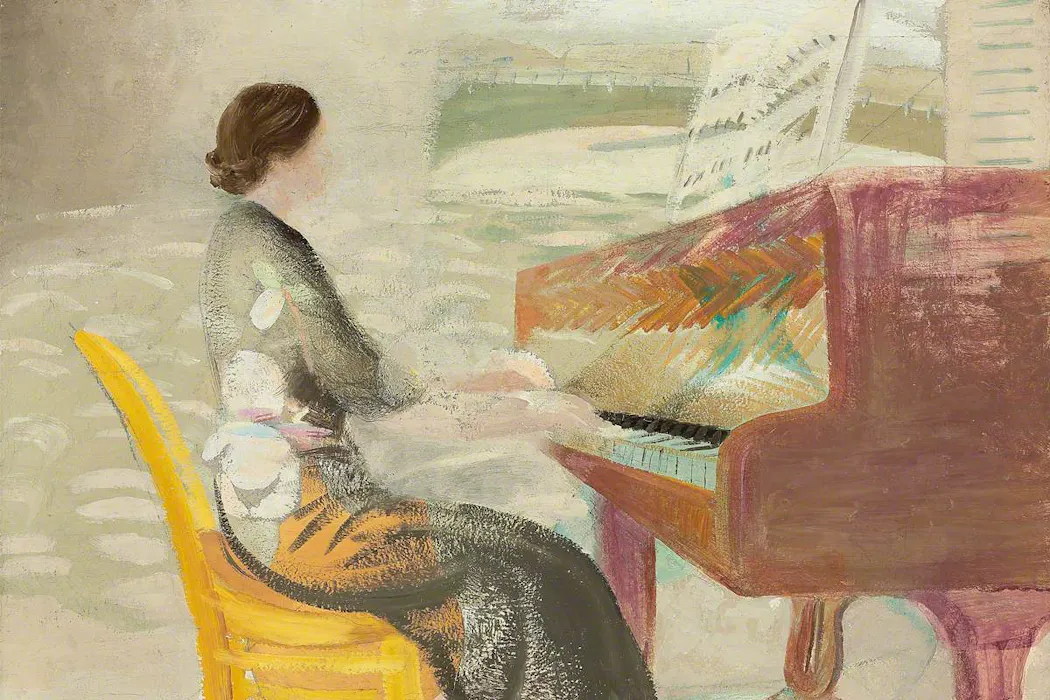
A partita is a musical composition, often for a soloist. As Livia, the protagonist of Barbara Kingsolver’s new book, explains to Sigurd, as they begin an all-consuming romance, it’s “made up of a lot of parts with different paces and moods. […] The parts are all different, and the artist’s work is to make them all add up to something that feels whole.”
Livia is just 20 at Indiana University, far from home, on a prestigious music scholarship. Distracted by the pursuit of excellence and the perfect love, she does not yet know that her life will be a partita, one she must make whole.
The contrasting parts of Livia’s life include three romantic relationships, an extraordinary piano talent, two bodily traumas, a fraught relationship with a violent, unloving mother, several losses, unspoken truths, loyal friends, and her brother’s suicide. The grief of losing her brother stifles Livia for decades. She focuses on piano virtuosity that takes her ever further from understanding herself – that is, until she is forced home.
Named for elements of musical compositions, the chapters of Partita alternate between formative events from Livia’s adolescence and early adulthood, and the narrative present when Livia is in her mid-40s, clearing her hoarder mother’s house after her death. Here, she talks with sister-in-law Mickie, an English literature teacher, about the purpose of art.
For Mickie, art’s function is “to help you like your life better”. However, for Livia it’s different. Livia had recently forbidden one of her piano pupils, a wilful teenage girl, from playing the country music hit Go Rest High on that Mountain by Vince Gill at a formal recital, though the girl wanted to play the song in her late father’s memory. Livia argues there is inherent value in reading or playing classics, making the effort to understand complex works. Art, for Livia, enables the individual to learn and grow. It enriches their life, rather than simply reflecting it.
The conversation contrasts with an early episode. Livia has to work harder than her peers at university to gain her instructors’ respect, suppressing her rural Tennessee accent and hiding gaps in her education. Livia soon distinguishes herself with her talent and drive to play pieces such as the notoriously difficult Gaspard de la Nuit, which even composer Maurice Ravel couldn’t play.
She becomes acutely aware of the stark class divergences, exacerbated when she meets Sigurd, a campus union organiser. The novel conveys the complexity of socioeconomics of pursuing higher education for many: describing university scholarships, seasonal labour, healthcare and insurance, rent and financial instability.
Conversations with Sigurd lead to a crisis – why undergo the anxiety of mastering such complex music, Livia asks herself, when only “a handful of peers in our society of the ridiculous” would understand her achievement?
This crisis occurs in the novel’s sarabande section, the third section. A sarabande is calm, reflective, or emotionally intense. This reflection on art sits next to her conversation with Mickie, which occurs in Prelude IV, the central prelude in the text. Brought together, they indicate that art – Livia’s piano playing – will be what she needs to combine the elements of her partita into a coherent whole.
Until her partita can be understood, Livia is seeking something. The “overture” chapter, a form of prologue, implies this is understanding her brother’s suicide, a formative event when she was 11 years old and he 18. However, completeness is only achieved at the end of the text in the “al fine” chapter. This chapter is named for the common italian music instruction that comes at the end of a piece, which has the musical function of instructing the performer to play a section again and stop when they reach the word “fine”. In this sense, in the “al fine” chapter Livia needs to revisit past events and play through them, rather than repressing them.
She needs to rearrange the bitter hurt, regret, anger at untold secrets, withheld affection, physical pain and grief. With music at the heart of the text, Livia is guided to a completeness that feels satisfying and true.
Multi-bestseller and award-winning author Barbara Kingsolver is also a pianist, as she notes in the novel’s acknowledgement note. Kingsolver describes attending piano lessons and then the DePauw University School of Music, noting: “In rural, working-class places like the one where I grew up, classical music and fine arts are mostly out of reach.”
The novel is an acknowledgement of the piano teachers in those communities, who – like Livia – have complex emotional histories, remarkable talent, and elaborate socioeconomic and family circumstances. The inclusion of a listening list of classical pieces referred to in the novel and the pages they are mentioned is a gesture, a way of sharing that music with the reader, including them in a world that may feel out of reach.
Partita has received rave reviews, and these are well deserved. It has been called “a virtuoso storytelling achievement that’s packed with musical insights accessible to those with little musical knowledge”. But it is also a fascinating character study of women’s lives and relationships, and of changing American generations and traditions. It is sharp, compelling and rich, and its narrative of healing is subtle and convincing.
This article features references to books that have been included for editorial reasons, and may contain links to bookshop.org. If you click on one of the links and go on to buy something, The Conversation UK may earn a commission.

Jenni Ramone does not work for, consult, own shares in or receive funding from any company or organisation that would benefit from this article, and has disclosed no relevant affiliations beyond their academic appointment.