Extreme temperatures, droughts and wildfires lead to water scarcity and the search for alternative sources of water to secure supplies. With increasing pressures from climate change, Europe’s water stress – not having enough clean freshwater to meet demands – is becoming more intense and more frequent.
But one valuable water source is often overlooked: wastewater.
While some Middle Eastern countries like Qatar reuse approximately 90% of their wastewater, Europe’s reuse of wastewater is often very low. Just 0.6% of wastewater gets recycled in Sweden, yet 15 of 21 counties already face a high risk of water scarcity.
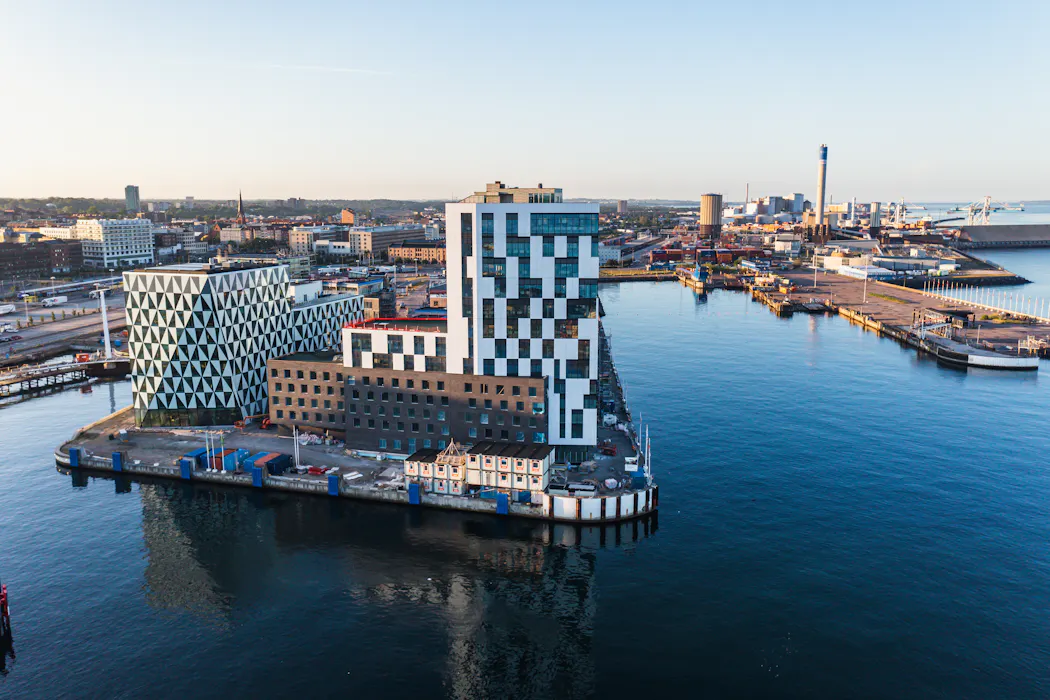
In one of those 15 counties, a new district in the city of Helsingborg in southern Sweden is successfully recycling wastewater. In Oceanhamnen, wastewater is collected through three separate pipelines: one for toilet wastewater (blackwater), one for greywater (wastewater from bathtubs and showers, sinks, laundry and dishwashers), and a third pipeline which takes food waste from the kitchen sink directly into biogas production.
The principle of separating blackwater from greywater is called source separation. Historically, it has mostly existed in single households or small neighbourhoods. Now, this technique is being tested in cities like Helsingborg.
According to RecoLab, the company treating Oceanhamnen’s wastewater at the world’s largest source-separated sanitation plant, source separation makes it easier to recover the different resources.
One of these resources is the water itself. Greywater is more diluted than blackwater and does not contain human excrement, so it’s easier to recycle. If reused close to where it was generated, pipes transporting greywater in and out of treatment only need to be short.
Greywater can be treated to a high quality with conventional technologies, such as activated sludge processes. But more nature-oriented, low-effort treatments, such as filtering water through wetlands are often preferred by the public, because they seem less invasive.
Some recycled wastewater can be used to irrigate farmland or replace freshwater in water-intensive industrial processes such as paper manufacturing. This avoids unnecessarily using drinking water.
In Oceanhamnen, treated greywater is clean enough for toilet flushing or irrigation. The city plans to use it in a new public swimming pool, if the desired bathing water quality can be reached.

Mickes Photos/Shutterstock
Wastewater can be a source of energy. Heat can be recovered from drained shower water. Although heat recovery is not yet a part of the buildings in Oceanhamnen, this process is happening at the plant to preheat water flowing through the treatment chain.
Blackwater and food waste are excellent raw materials for biogas production, as performed at RecoLab. Compared to mixed wastewater, blackwater and food waste can produce around 80% more methane, the main component of biogas.
Blackwater is rich in nutrients such as nitrogen and phosphorus. It can be used to make organic fertiliser, providing a less energy-intensive alternative to the production of mineral fertilisers.
Mixed sewage sludge is already used as an organic fertiliser in many countries. Over 50% of nitrogen in mixed wastewater, however, is usually lost to the atmosphere during treatment. But source separation makes use of about 80% of the available nitrogen, making blackwater a more efficient solution. The fertilisers produced from blackwater at RecoLab are chemically identical to commercial mineral fertilisers and compatible with current farming equipment.
Separating urine from faeces could bring additional benefits. Urine contains the larger fraction of the nutrients nitrogen, phosphorous and potassium. These nutrients are already in the right form for plant uptake. Urine can be collected via urine-diverting toilets then used as liquid fertiliser or dried to concentrate the nutrients before being applied to crops.
But there are challenges to reusing wastewater in agriculture: from the lack of legal frameworks to acceptable prices, logistics and public perception.
Read more:
Recycling sewage is a sensible way to improve water security – but would you swallow it?
Wastewater’s reputation problem
Public scepticism of wastewater isn’t always deserved. Even though treated wastewater can be clean enough for many purposes, it is easily condemned as unhygienic. Nobody wants pathogens like Legionella or E. coli ending up in our food through irrigation or fertiliser.
While legal regulations mostly apply to mixed wastewater, the World Health Organization outlines how to safely use source-separated wastewater in agriculture. According to these guidelines, greywater generally has a lower number of pathogens than blackwater and can be used for irrigation with simple risk management measures such as proper cleaning of equipment to avoid any contact with blackwater.
Before being spread on fields, pathogens in blackwater must be inactivated during sanitisation treatments that usually involve storage for at least one year, composting in special reactors or heat treatment. Chemicals, for example urea, can be added to kill pathogens more quickly. Urine naturally contains urea, but faeces doesn’t so extra urea must be added when faeces is treated separately.
Wastewater also contains residues of pharmaceuticals such as paracetamol and personal care products (such as cosmetics or lotions) which are difficult to remove, yet we don’t want them on crops or in our food.
Concentrating blackwater for use as fertiliser risks increasing pharmaceutical concentrations. At RecoLab, blackwater is treated to remove heavy metals, pharmaceuticals and microplastics before nutrient recovery to avoid concentrating these contaminants.
Urine-based fertilisers face similar problems but they could be easier to treat using filtration because urine is 95% water.
Unlike pathogens and metals, which are well regulated in mixed sewage sludge, pharmaceuticals do not have any legal maximum concentrations yet. They are also hard to measure, which makes it challenging to properly monitor their levels and control the risks.
Greywater is not pharmaceutical-free: it often contains residues of products such as anti-inflammatory creams or antifungal shampoos. Other substances like UV filters in sunscreen, fragrances or detergents can disrupt the reproduction of aquatic organisms. Specialised treatments (such as ozone, activated carbon or membrane filtration) are recommended to remove these substances before greywater is reused in agriculture.
The greywater from Oceanhamnen is filtered through a fine membrane – a nanofilter – to reduce residues of pharmaceuticals and personal care products. Source separation has made the removal of these substances more energy efficient.
Recycling wastewater won’t solve water scarcity entirely. Other sources like rainwater or sea water can be reused, depending on the scenario. And alternative approaches like the source separation used in Oceanhamnen could lead to the development of more efficient treatments that make water reuse and resource recovery much easier to scale.

Isabell Fritz receives funding from The Swedish Research Council (Vetenskapsrådet) and Formas – a Swedish Research Council for Sustainable Development.
Ashley Hall is employed by Sweden Water Research, which recieves a portion of its funding from Nordvästra Skånes Vatten och Avlopp, who operates RecoLab.