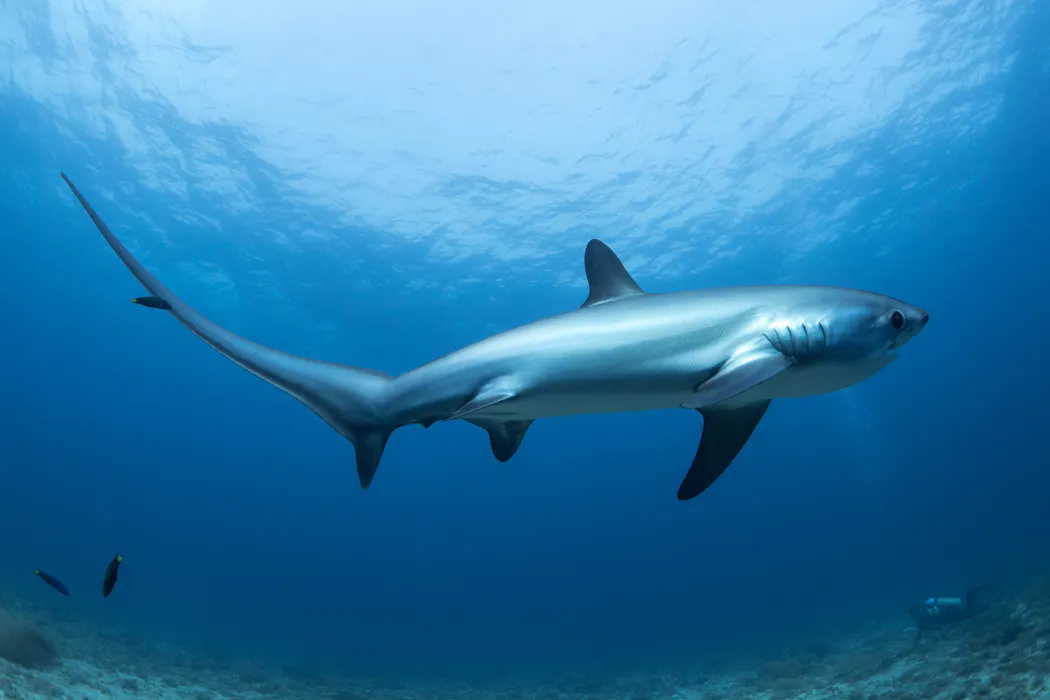
I spent six days on a small fishing boat in the middle of the English Channel in July trying to catch a thresher shark. The weather was fickle, even at the height of summer.
My colleague, ecologist Lucy Hawkes, and I were with two anglers who probably hold more experience of Channel thresher sharks than anyone alive. Between us, we caught nothing.
Fourteen trips later, after countless more hours at sea, the anglers caught a thresher shark and it was electronically tagged – a first in England and the northeast Atlantic.
Thresher sharks can grow up to 5.8m long and they use their long whip-like tail to hunt in packs by herding shoals of fish together. Tags can shed light on their long migrations across coastal areas and open oceans.
The joy, excitement and elation we felt was tenfold for the anglers who have fished these animals for years. Together we eagerly await news from our thresher shark; about this time next year the tag will detach, float to the sea surface and transmit, perhaps revealing new and unexpected insights to us all.
Many of the anglers our teams work with are fanatical about their fish: where they go, why, and how that has changed over decades. This is a kind of expertise scientists and governments don’t always know how to recognise or have easy access to.
Our partnership with anglers is now central to how we’re working to improve conservation of pelagic sharks (those that live in the open ocean), thanks to a new £1.2 million grant from Natural England as part of its flagship species recovery programme.
This project focuses on blue sharks, porbeagles and tope sharks, using satellite tracking and other techniques to better understand how, when and why these animals use English waters. The vulnerable conservation status of these animals, whose numbers are all thought to be decreasing, points to their imperiled state. Together with anglers, we hope our efforts will help these species recover.
It could be tempting to cast conservationists and anglers as opposing camps. But false assumptions about what we each know and value can keep conservation scientists and anglers apart. We’re closing that gap by following the movements and behaviour of sharks together, spending time side-by-side on boats and quaysides, acknowledging each community’s expertise and trading stories of these amazing animals.
To me, anglers are the quintessential naturalists. I’ve yet to meet one who doesn’t intimately know the seasonal arrival time of their favoured species, their size ranges and the nuances of their feeding behaviour at their preferred fishing spots. Anglers know how many days they’ve spent fishing, and the ratio of blank days to good ones.
Scientists like me love that kind of insight – but one barrier has been the challenge of recording it in a form anyone else can use. That’s starting to change. Once we started treating this information as data rather than anecdote, the partnership became obvious. Our collaboration with the Pat Smith database (a long-running record of shark catches dating back to 1953 and now recorded online) has helped us make significant progress already.
Read more:
Stop freaking out about sharks in British waters – let’s welcome them
Different tools, different view
Scientists and anglers aren’t just looking at the same animal from different angles. They’re using different tradecraft.
Sharks live in a dynamic world, shifting with the tides, seasons and years. Satellite tracking tags, models and sampling programmes are powerful. But these conservation science tools only provide snapshots of their lives. These approaches struggle to grapple with the environmental context at the scale an individual animal responds to. For example, a cold summer that changes the seasonal appearance of blue sharks, the slow years-long shift in when a species turns up, or differences in seasonal arrival of male and female porbeagle sharks.
That’s exactly the scale anglers see. There are between 2 to 3 million anglers around the UK who spend thousands of hours on rivers and coastlines. Repeated year after year on the same stretches of coast, this builds a long view: how a system has changed, by how much, over what area, and how the animals within it have responded – often in ways too subtle or gradual to show up in traditional surveys. Because this knowledge is held in anglers’ observations and memories, and not in structured records that science tends to rely upon, it can easily be overlooked, or considered anecdotes rather than evidence.
Combining marine expertise
Put anglers and conservation scientists together, and you get sharper insight into how to manage the marine world sustainably. Crucially, both communities want the same thing: sustainable shark populations for the long term. Where they can differ is in how they think that should be balanced, from strict no-targeting protection, through to responsible, well-managed use.
Even within that spectrum, views vary. For some, fishing is a trade, and the priority is landing the catch; for others, minimising harm is prioritised, even while accepting that any capture has some effect. Neither position is straightforward – both navigate the trade-off between using a resource and protecting it.
In my view, successful conservation of sharks will be achieved through a shared appreciation of where each community is coming from, and a willingness to learn from each other – so we get the best welfare for animals that get caught and then released, healthier populations and habitats, and ultimately better outcomes for people who depend on them.
That means listening, being honest about where understanding is still limited, and resisting the pull toward generalisations about others. Science as a mindset – learning about our natural world through structured observation – can help people find common ground while remaining open to the answers surprising them.
Over the next three years, we’ll work with anglers across England on species we’re all passionate about. We already know this partnership works: our efforts with anglers across the UK has shown how these sharks behave after release from a line. That’s insight scientists couldn’t gather alone. It’s why the future of shark conservation runs through harbours and jetties as much as laboratories.
This story was produced in partnership with the Guardian’s Seascape strand where you can read more about the University of Exeter’s shark project.

With thanks to my team’s collaborators at the Angling Trust (https://anglingtrust.net/), Pat Smith Database (https://www.patsmithdatabase.com/) and the Marine Biological Association (https://www.mba.ac.uk/).