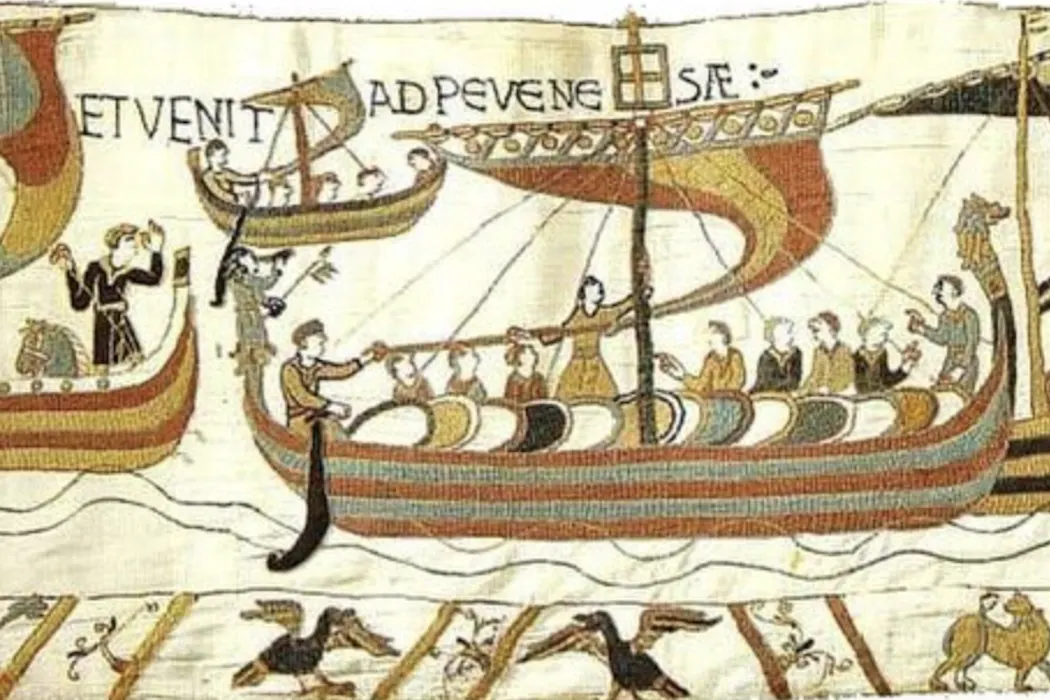

Just three women appear in the main body of the Bayeux tapestry: Edith of Wessex, shown grieving at the deathbed of her husband Edward the Confessor; the mysterious and much-debated shrouded figure named Ælfgyva; and a woman fleeing a burning building with her child. Missing from the tapestry is the one woman who played a key part in the success of William the Conqueror’s campaign: his wife of 30 years, Matilda of Flanders, co-ruler of England and Normandy.
In the 18th century, scholar Father Bernard of Montfaucon recorded the rumour that Matilda herself had sewn the Bayeux Tapestry for her husband. It was known as Queen Matilda’s (or Maud’s) tapestry until the 19th century when other theories found favour. A replica (now at Reading Museum), made by a team from the Leek School of Art Embroidery between 1885 and 1886, also made it clear that multiple embroiderers were likely involved.
The wealthy Matilda may not be portrayed in person on the tapestry, but in commissioning and gifting her husband a ship called the Mora – the largest and swiftest of his invasion fleet – she was instrumental in ensuring the success of his campaign.
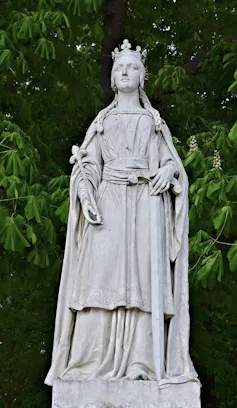
JLPC / Wikipedia, CC BY

Matilda was born around 1030 to parents Baldwin V, count of Flanders (d. 1067) and Adela, a royal princess of France (d. 1076), descended from Ottonian emperors, a prominent dynasty of Saxons who ruled between the 9th century and 1024. These were powerful and wealthy people, whose standing and lineage far outstripped that of William, an illegitimate son of the Duke of Normandy who faced rebellion and criticism.
A powerful ally like Flanders and ties to the neighbouring French royal court helped William to establish security, and despite Pope Leo IX forbidding the marriage in 1049, the couple married in the early 1050s. A new pope, Nicholas II, removed the ban in 1059 on the condition that both partners founded a monastery.
Matilda and the Norman Conquest
As Duchess of Normandy, Matilda used her wealth to patronise various projects, and appeased Pope Nicholas through the foundation of Sainte-Trinité Abbey (Holy Trinity), also known as Abbaye aux Dames, a Benedictine nunnery in Caen.

Pradigue / Wikipedia, CC BY

In parallel, William founded St Stephen’s for men, but progress there was much slower. Matilda strove to dedicate Sainte-Trinité before the conquest started in June 1066, even giving Cecilia, one of her four (possibly five) daughters with William, as a child oblate (destined to be a nun) on the same day. As well as demonstrating her piety and power, these measures were timed to ensure divine favour and church support for the conquest of England.
As well as courting church favour, it was of course, Matilda’s ship that took William to England. The Mora is a centrepiece of the Bayeux tapestry, with a gold cross and banner clearly depicting God’s favour, and featured the figure of a golden child blowing a horn. It is shown as the largest in the fleet, containing the most people. In the 12th century, a list of ships was compiled probably at the monastery of Fécamp describing the Mora as follows:
In honour of the Duke, Mathilda, later queen, had a ship built called the Mora with which the Duke crossed the sea… She had fitted a golden child who pointed with his right hand to England and who with his left hand pressed an ivory horn against his lips. For this reason the Duke gave the county of Kent to Mathilda.
(Actually, William granted Kent to his half-brother, Odo of Bayeux. Matilda received other lands, including two holdings recorded in Domesday Book – Hambledon and Little Marlowe in Buckinghamshire.)
It was unusual for a human figure to be represented like this, as animals or mythical beasts were preferred to decorate ships. When William left for England, Matilda was pregnant with what later turned out to be a daughter, Adela of Blois (d.1137), the mother of Stephen, King of England (1135-54).
Historian Elisabeth van Houts argued that the golden child represented the future of the dynasty in the shape of their unborn child. And in an excellent new biography The Queenship of Mathilda of Flanders: Embodying Conquest, Laura Gathagan argues that the ship and its golden child physically embodied Matilda’s contribution to the Conquest.
Matilda co-ruler of England and Normandy
Matilda’s solo coronation in 1068 (William had already been swiftly crowned in 1066 immediately after his victory), when she was once again visibly pregnant, demonstrated how William needed the visible rituals associated with her royal and imperial blood and dynasty to bolster his power in England.
Matilda continued to act as his lieutenant in Normandy on several occasions during his campaigning in England. She was connected to 137 charters, and was also a regent for William in England from 1081-82, even presiding as a judge, which historian Laura Gathagan argues was a new extension of queenly power in England.
As a result of the Conquest, Matilda became a major landowner in England and used this wealth to enrich various religious institutions, both in England and on the continent. At her death in 1083, the monk Orderic Vitalis told how William struggled against “constant storms” that rose up against him until his death in 1087. He also wrote of Matilda’s magnificent funeral at Sainte-Trinité Abbey attended by important bishops, abbots and monks as well as hosts of the poor.
The epitaph on her tombstone highlighted her powerful lineage and family, and emphasised that it was her wealth and toils that provided many lands for the convent and comforted the poor.
Arguably, without Matilda’s financial backing, powerful family ties and skills as a co-ruler, William may never have achieved any of his lofty ambitions. In teaching the Norman Conquest, the central portrayal of the Mora in the Bayeux tapestry provides a crucial opportunity to use material culture and tell Matilda’s story.
It also challenges us to reconsider what the original chroniclers and history books omitted to tell us about: the contribution of the women of the Conquest, hidden in plain sight.
This article features references to books that have been included for editorial reasons, and may contain links to bookshop.org; if you click on one of the links and go on to buy something, The Conversation UK may earn a commission.

Natasha R. Hodgson is employed by Nottingham Trent University and acts as a volunteer history consultant for the charity End Sexism in Schools, participating in the History sub-group. She is a co-founder with teachers of the not-for-profit, open access teaching resource teachingmedievalwomen.org.