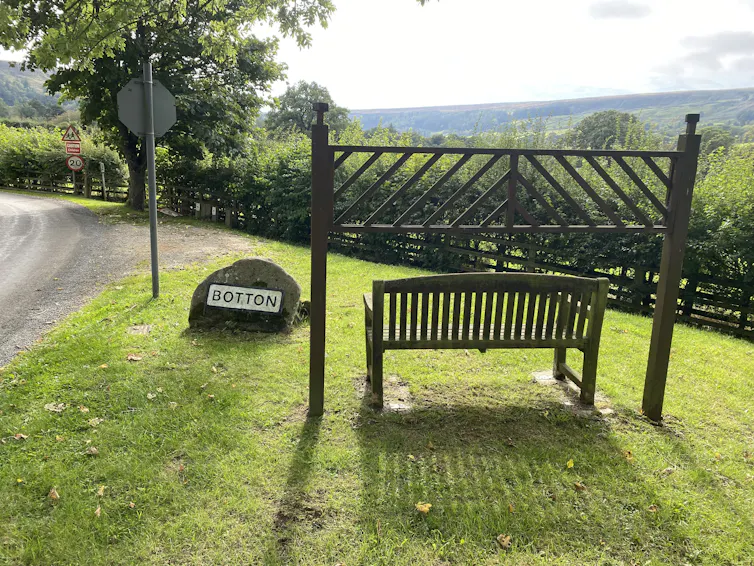
Within an hour of arriving in Botton, a small, picturesque village in the UK’s North Yorkshire moors, I was standing in a farm field shovelling hay.
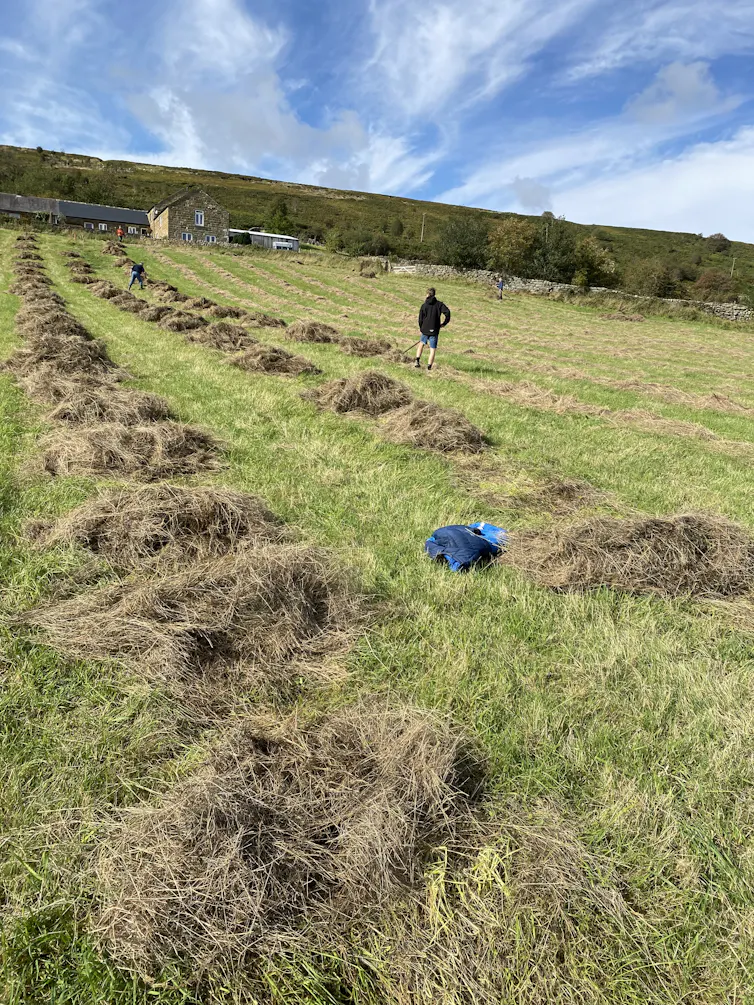
Alongside me were my friend Max*, his father, a co-worker named Richard, two volunteers and several learning-disabled residents of the Esk Valley Camphill Community. We spent the next few hours on a conservation project, moving hay, stopping regularly to lean on our tools and talk, and at one point gathering on a picnic bench beside the cars for a tea and biscuit break.
Officially Richard was “providing care” and the learning-disabled residents of the community (often referred to as villagers) were “receiving care”, with volunteers helping the co-workers along the way. On the ground, though, I could already see that the structure of the community served to sideline this distinction rather than reinforce it.
I had driven into the North Yorkshire moors expecting something resembling a care institution. This was something else.
Thomas Moore
While I was there, I would observe two radically different interpretations of social care side by side.
On the side where I stayed: care as long-term communal life, in which support grows out of relationships rather than being delivered through them.
On the other: care as professional service delivery. My time here would completely change the way I thought about social care.
The Insights section is committed to high-quality longform journalism. Our editors work with academics from many different backgrounds who are tackling a wide range of societal and scientific challenges.
The Esk Valley Camphill Community, based at Botton Village, is part of the Camphill movement – an international network of communities built on the belief that people with and without learning disabilities can live and work together as genuine community members, rather than as service users and service providers.
The Camphill community in Botton was founded in 1955 by Karl König, the Austrian paediatrician who had established the Camphill movement in rural Scotland 16 years earlier, inspired by the educational philosophy of Rudolf Steiner.
The land at Botton was acquired from W.F. Macmillan and his family (the publishing family behind Macmillan Publishers, as well as local landowners and philanthropists). One of the family members, Alistair Macmillan, had a learning disability and later lived in Botton as a resident.
Over the following decades it grew into a community of around three to 400 people at its peak. Today, around 120 residents continue this way of life across 19 households, now operating as Esk Valley Camphill Community, one of two organisations based in the village, alongside the Camphill Village Trust.
My friend Max
I had known Max since we were children. We went to the same primary school, then the same secondary school, and then (the usual thing) our lives gradually went their separate ways. When his father invited me to visit him for the day, I agreed without quite knowing what I was agreeing to.
Max had tried different forms of support after school: a special needs school instead of sixth form and a service-based care arrangement that had struggled to accommodate him. Some of it worked better than others, but none of it seemed to fit him particularly well. Like many people with learning disabilities, his needs weren’t well met by standard service-based care.
That is why it was Max himself who surprised me most that day. I had always known him as intensely sociable, the kind of person who greeted everyone he passed, genuinely and entirely without edge. What I found in Esk Valley felt different though. He moved through the community with a settled ease I hadn’t seen in him before, introducing me to people as we walked, explaining who worked where, updating me on the latest community news.
As he showed me around, I didn’t get more than a few seconds’ break between enthusiastic comments, news and updates. Before he was part of Esk Valley, leaving the house unsupervised had often been difficult. Here, he had become part of an intentional community: a place where people choose to build a shared life together, not just live near each other. This had given him a rhythm and structure that allowed his individuality to flourish and his independence to grow.
At some point in the afternoon, during a pause in an otherwise ordinary conversation, he said something that stayed with me.
It’s been the best two years of my life. Much better than anything before.
I nodded and carried on. But long after I had returned home at the end of the day, I found myself returning to those words. What had this place managed that others hadn’t? And why did Esk Valley feel so unlike most models of care?
Becoming part of the community
I am a philosophy PhD researcher at the University of Sheffield, working on the question of what it means to be a person and how individuality and community relate. After visiting Max, I became fascinated by the Esk Valley community. When an opportunity came up to volunteer for three months in a non-academic organisation as part of a researcher employability project, the choice felt obvious.
For three months I lived in one of the community’s 19 houses, shared meals with the household and took part in community life. Each house is home to two or three co-workers, a similar number of villagers and usually one volunteer. What gives the community its texture, though, is the structure of daily life.
Thomas Moore
Life in Esk Valley follows a shared daily rhythm: communal breakfast in each household at around 7.30am, a morning workshop from 9am until noon, then back to the houses for lunch until 1.30pm, a second workshop in the afternoon, and communal dinner around 6.30pm.
Importantly, people don’t only eat meals in the household they live in. People rotate between houses for lunches and dinners throughout the week, meaning that roughly half your meals are eaten in other households. It is a simple arrangement, but its effect runs through everything. It stops the 19 houses from becoming 19 separate nuclear units. Instead, a web of daily relationships runs across the whole village because people are sitting down together at other people’s tables, several times a week, as a matter of routine.
The workshops themselves cover a wide range of work: there is a garden workshop, a wood workshop, a craft workshop, a cooking club and a forestry team, among others.
Most weeks during my stay I worked four half-days in the garden workshop, enough time to become part of its rhythms. I had expected the experience in Esk Valley to inform my research. I hadn’t expected it to fundamentally change how I thought about social care and community life.
Esk Valley Community/Ikuko Tsuchiya
The moments that changed my thinking were rarely dramatic. They were usually small interactions that quietly revealed assumptions I hadn’t realised I was carrying.
One of the first came during my first working day. Claire, one of the co-workers who was living in the same shared house I was, casually asked Linda (who was officially someone “receiving care” in the village) to show me how the transport arrangements worked. Linda took charge enthusiastically, walking me over to what villagers called the transport depot: a small hay shed where cars arrived each morning and afternoon to take people between the village and Homefield Garden, a collection of fields the community owned nearby. She showed me where people gathered and explained how the whole system operated. She knew every detail of it.
What interests me now is my own reaction at the time. I remember feeling mildly surprised that Linda had been given this responsibility. I now realise this was because I had arrived with an assumption I hadn’t consciously examined: that in care organisations, responsibilities belonged to staff providing care.
Without thinking about it, I had sorted the world into two columns. “Explaining how things work” sat in the staff column. “Having things explained to me” sat in the resident column. Yet here was someone officially classified as receiving support quietly helping to ensure the smooth running of village life and doing it perfectly well.
The longer I stayed, the more I noticed people slipping between categories that mainstream social care often treats as fixed. People receiving support were also providing it. People being cared for were also contributing to the care of others. Responsibilities were shared in ways that felt, at first, unfamiliar, and then, gradually, completely obvious.
Britain’s social care system faces well-documented pressures. By the end of my first few weeks in Esk Valley, I had started to wonder whether there was a deeper problem sitting beneath all of those – the largely unquestioned assumption that social care is a service to be provided by people formally employed to supply it.
That question became sharper the more I compared Esk Valley with the logic underlying mainstream social care.
A broken system and another new prime minister
Social care is in crisis. Roughly one in ten posts in adult social care is unfilled at any given time, pay is low, and burnout and stress are widely recognised as problems.
Turnover is very high, around 23.7% in 2025, declining from a high of 31.4% in 2020 primarily due to a large rise in international recruitment.
Care workers, who would ideally develop close relationships with the people they support, leave before those relationships have had time to develop into anything. The people they support start again with someone new. As a 2022 report for the Health and Social Care Select Committee put it:
The National Health Service and the social care sector are facing the greatest workforce crisis in their history … The situation is regrettably worse in social care. One in three care workers left their job in 2020–21, a serious setback to the continuity of care which is so essential to those who receive social care. In December 2021, Care England reported that 95% of care providers were struggling to recruit staff, and 75% were struggling to retain their existing staff. Care workers often find themselves in underpaid roles which do not reflect the value to society of the service they provide.
The crisis has not gone unaddressed for want of political attention. There have been 22 attempts to reform adult social care in England over the past 30 years, and none has succeeded. Commissions have been established, proposals published and timelines set – and then, repeatedly, the moment has passed, usually because of arguments about how reform would be paid for.
Now, the new prime minister, Andy Burnham, has vowed to put whatever political capital he has into fixing what he calls a broken system saying that carers “should be the best paid people in society, not the worst”.
What if we stopped treating care like a service?
But something slightly different was nagging at me as I settled into life in Esk Valley. The crisis I kept reading about was real and care workers are certainly underpaid. Many people would agree that the scale of the crisis should merit a radical rethink of social care. Yet mainstream debates about social care increasingly seemed to me to be a debate about how to fix a system whose assumptions remained largely unquestioned.
There has been little serious questioning of the idea that care should be organised around shifts, that strong professional boundaries rather than friendships should separate carer from cared-for, or that the quality of care is fully or best measurable through standardised outcomes.
Most people probably share these assumptions implicitly without noticing them.
-
Professional carers support people with learning disabilities.
-
Support is arranged by agencies, managed by co-ordinators and delivered according to care plans.
This model has become common sense. But it is also, historically speaking, very new.
Until relatively recently, care for people with disabilities and support needs was primarily organised through families, local communities, charities and religious institutions, rather than through professionalised care services.
The idea that care should be organised as a specialised professional service, delivered by paid staff and governed through formal systems of regulation and inspection, emerged comparatively recently, during the 20th century, and particularly from the late 20th century onwards. In England, this shift coincided with the growing marketisation of social care, including the expansion of outsourced provision, contractual commissioning and individualised funding arrangements.
What we now think of as standard social care is, in large part, the product of that marketisation. It is not the only way care has ever been organised, in fact it is a historical aberration. Yet it is now the way we have gradually come to naturally assume care must be.
Esk Valley offered something different. There, people with and without learning disabilities depended on each other in ordinary, practical ways: cooking together, working alongside one another, navigating disagreements and making decisions as a community.
One afternoon this became vivid in a way I hadn’t expected.
I was being given a lift to a workshop when David, a co-worker who had been at the village for decades, mentioned to the group that he was exhausted due to juggling young children and the demands of community life. Mike, one of the villagers, listened quietly while David spoke. Then, when there was a pause, he looked at him directly.
“You need to slow down,” Mike said. “Take more time off. You’re doing too much. I felt tired yesterday, so I had the day off.”
David nodded. Mike was right, and everyone in the car seemed to know it.
I found myself sitting with the strangeness of that moment for a while afterwards. Mike was officially someone receiving care. David was officially someone providing it. But what I had just watched looked less like a care relationship than a friendship, the kind where you tell someone an uncomfortable truth because you have known them long enough, and care about them enough, to say it out loud.
That kind of familiarity does not emerge quickly. What made it possible in Esk Valley was, in part, the sheer length of time people had spent there together. Many co-workers and villagers had been part of the community for decades.
Margaret and Ruth, a co-worker and a villager, had supported each other for more than 50 years. They had watched fellow co-workers and villagers arrive as young people then slowly grow old in the village alongside them, sometimes starting families along the way. The relationship they had built across that time could not be replicated by a well-intentioned support worker who had been assigned the previous week and would likely move on within the year.
For people with learning disabilities who rely on carers, sometimes for help with the most intimate aspects of daily life, a constant cycle of new faces is not just inconvenient. It is a barrier to the kind of trust that makes good support possible in the first place.
Which made me wonder: what if some of what people with learning disabilities most need cannot be delivered through a service at all? What if it can only grow, slowly, out of the kind of long-term relationships and shared community life that conventional social care so rarely has the time or stability to build?
That tension now sits at the centre of Botton Village, because since 2014 it has contained two very different understandings of care living side by side.
Two ideas of care side-by-side
For most of its history, Botton Village was one unified community. The Camphill Village Trust managed roughly 30 households, five farms, a café, a shop and various workshops, all operating on the founding principles of the worldwide Camphill movement: no employment contracts, pooled income, shared meals and shared seasons. The boundary between work and home life was deliberately blurred. The point was not efficiency. The point was that support should be embedded in something that actually resembled a life.
In 2014, the Camphill Village Trust announced a restructuring, telling all co-workers they must become paid employees or leave. The Trust cited a combination of regulatory pressures. The Care Quality Commission had raised concerns in 2011, and in February 2014 the Charity Commission concluded that co-worker benefits lacked proper oversight, instructing the trustees to introduce clearer governance.
Co-workers did not dispute the need for some changes, but argued that the changes would lead to the complete dismantling of the founding Camphill principles of shared life. They pointed out that the Care Quality Commission’s follow up inspections in 2012 and 2013 had found the issues raised in 2011 had been adequately addressed and care in Botton was now working well. They also pointed out that HMRC itself had long recognised the co-worker model as a distinct and legitimate arrangement, with its own agreed tax treatment, rather than conventional employment.
As a result of the restructure, around half of Botton was converted into a more conventional professional service. Employment contracts were introduced. Shift patterns replaced the open-ended rhythms of communal life. Co-workers who had previously lived alongside residents were replaced with carers, most often commuting in from Middlesbrough or Whitby every day (over an hour’s round trip).
But not everyone accepted this. Around 80% of the co-workers broke away to form a new organisation, Esk Valley Camphill Community, and after a protracted legal battle gained the right to operate 19 of Botton’s households on the original principles of the Camphill movement. They have done so ever since, and are now formally recognised as a Shared Lives scheme.
Shared Lives is a model in UK social care policy in which people with learning disabilities, or older people who need support, live as part of an ordinary household or community, rather than being placed in residential care or supported living arrangements where paid carers provide support to people living independently.
By registering as a Shared Lives scheme, they found a model that could accommodate their communal way of life, and partners more aligned to their ideals to oversee the provision of care in the community (first the Avalon Group, now PSS).
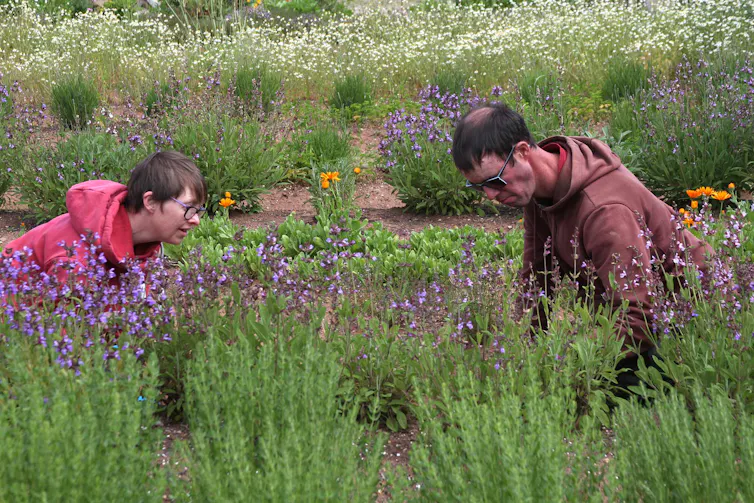
Esk Valley Community
Shared Lives schemes exist across the country, and the evidence behind them is quietly compelling.
Both an independent report from Social Finance and research by Shared Lives Plus have concluded that it would cost on average £26,000 less per person per year for a learning disabled person to be in shared lives arrangements (compared with more conventional supported living arrangements).
Based on this figure, Shared Lives Plus have calculated that if shared lives services were delivering 10% of social care support to 130,000 people with a learning disability, it would save the taxpayer £2.6 billion per year. A more realistic goal of 5% is calculated to save £1.3 billion per year.
People using them also report lower levels of loneliness and higher levels of satisfaction. They tend to produce the kind of stable, long-term relationships that the mainstream care market consistently struggles to sustain. This suggests that Shared Lives deserves far more attention than it currently receives and has the potential to play a key role in responding to the social care crisis.
Botton Village today therefore contains two organisations, one operating on a type of shared lives model and the other operating on a conventional service model.
In one half there is Esk Valley, pooling the income each household receives into a communal budget, with households drawing from it based on need, and embedding care in the routines and relationships of shared community life.
In the other half there is the Village Trust, providing care as a more standardised professional service. What makes this so striking is that almost every variable that might explain differences in outcomes is held constant. The setting is the same. The history before 2014 is the same. The founding tradition is the same. Only the model of care differs. Over time I came to see the split not primarily as a local management dispute (though it was also that), but as two philosophical visions of care made concrete.
The difference was never more visible to me than at Michaelmas.
Michaelmas, the feast of St Michael, celebrated in late September, had historically been one of the village’s most significant community occasions. The turn of the seasons was marked as a shared event when villagers, co-workers and volunteers gathered together at a large meal. When I was there, that celebration continued as it always had in the Esk Valley half of the village.
But in the Village Trust half, there were no celebrations. That year the festival fell on a Sunday. Participation was not part of anyone’s contracted working hours. So, it did not happen.
It is, on the surface, a small thing. But it points to something large: when care is organised as a professional service, the moments of familial and community life that fall outside the job description simply disappear.
The inspection data now recognises the benefits of communal life for people with learning disabilities. The shared lives arrangement that includes Esk Valley Camphill Community (then Avalon Scarborough Services) received a “Good” rating in its most recent report from the Care Quality Commission in 2023.
More broadly, across the UK in 2023, the Care Quality Commission rated 97% of Shared Lives schemes in England as good or outstanding, compared with just 78% of the wider social care sector.
Meanwhile, the Village Trust half of Botton, despite sharing the same location as Esk Valley, received a “Requires Improvement” rating. Care Quality Commission inspections capture certain things well and others less so, and no single report is the whole picture. But taken alongside everything else it contributes to an overall case that is hard to dismiss. Indeed, Esk Valley’s own GP, Dr Marcus Van Dam, has arrived at a similar picture through a clinical audit of residents’ health records across both halves of the village, findings he presented at a public lecture in Ireland.
To me, these differences were not just abstract. They were visible in everyday life across the village.
What daily life revealed about care
One of the sharpest observations I heard during my time in Botton came from Maisie, a co-worker who had been at the village since long before the 2014 split.
We were talking about the period prior to the split when regulators had begun to look more closely at Botton and at how work was structured within it. Their concern, as Maisie described it, was that villagers had little genuine choice about whether to participate in workshops.
“The social workers kept wanting residents to have ‘choice’,” Maisie said. “They said they didn’t have to work if they didn’t want to. But whenever you talked to anyone, they were so proud they had a job, just like their parents and their siblings.”
The anxiety behind the intervention was not inherently unreasonable. In the past there have been instances of those with learning disabilities being put to work in ways that exploited rather than supported them.
But Maisie’s point cut in a different direction. The regulatory framework was applying the logic of conventional employment, where work is something that you do in exchange for money, and would most likely not freely choose to do full-time otherwise.
As the Care Quality Commission framed it in its 2011 report concerning the pre-split Botton Village:
Each villager has a timetable of activities, which covers the working day with little flexibility. If someone wanted to spend the day doing something different or have a lie in on a morning, they are not aware that they can do this.
But the formerly unified Camphill community at Botton operated on a different logic entirely, and the Esk Valley half continues to do so. The villagers who tended the gardens, ran the workshops and helped maintain the farms were not working in the conventional sense. They were contributing to a community they were part of, and that contribution was visible and meaningful to the people around them. Besides, many villagers also spent some time each week volunteering outside the community, for example for the North York Moors National Park Authority or the nearby Cycle Hub Cafe.
Stripping out the expectation of participation in community life, in the name of protecting choice, risked stripping out something the villagers genuinely valued about their own lives.
It is a tension that the Harvard divinity professor Dan McKanan has also identified in his extensive studies of Camphill communities. In his research, he found that regulators had begun evaluating Camphill communities as if the villagers living in them were customers, with the criteria for good care being the range of individual choices on offer. McKanan recalls someone telling him: “The Care Inspectorate came in and said, where’s the choice of food on the menu? I said, we are trying to emulate family life. How many families have a menu?”
It is a good question. When we sit down to eat at a family table, even as adults returning to visit our parents, we don’t expect a restaurant menu. We understand that family life doesn’t operate like a market. We accept shared meals, shared routines, the ordinary small negotiations of living alongside other people. Most of us would think something had gone badly wrong if choice from a formalised menu became part of family life. The puzzle is why we don’t bring the same intuition to how we organise social care.
The forum
Importantly, Esk Valley did have structures to ensure villagers had a genuine say in how they lived their lives together in community, including their work.
Once a month, the whole community, split into four groups of nearby households, gathered for a forum. Villagers, co-workers and volunteers sat together in a circle, and anyone could raise anything they wanted discussed: a concern about a workshop rota, a suggestion for a community event, a complaint about how something had been handled. The chair moved around the circle. Everyone was given the chance to speak.
I attended several of these sessions during my time in Esk Valley. What struck me was less the content of what was discussed, which ranged from the practical to the personal, and more the quality of the listening. People waited. They responded to what had actually been said. Villagers with learning disabilities that meant they found verbal communication or social cues difficult were given the time and space they needed and gave it back to others in turn.
Decisions that affected the whole community were made, in a meaningful sense, by the whole community. This kind of collective voice, in which the people being supported have a real say in how their care is organised, is almost entirely absent from mainstream social care.
By the end of my fieldwork, Esk Valley no longer felt like simply an unconventional care model. It felt like evidence that community itself may be part of what good care actually is. Not a backdrop to care. Not an optional extra. Part of the thing itself.
Perhaps care wasn’t supposed to be a service
Britain’s social care crisis is usually framed in terms of what we don’t have enough of: staff, funding, capacity. Those shortages are real, and they matter. But after three months in Esk Valley, I found myself wondering whether social care would be in such a state if we were more willing to question our assumptions about what good care is supposed to look like in the first place.
Esk Valley is not a simple national blueprint. A valley community in North Yorkshire, organised around decades of shared life and a specific philosophical tradition, cannot quickly and easily be replicated to serve hundreds of thousands of people nationally.
There should be greater recognition and support for existing intentional communities, and a concerted effort to help establish new ones. Yet communities cannot be built overnight. They depend on relationships, shared commitments and a culture that develops over years rather than months.
Creating more intentional social care communities similar to Esk Valley would therefore be part of a long-term response to the social care crisis, offering an alternative model of support centred on belonging, contribution and community life.
But the most important thing Esk Valley vividly reveals is not an easily scalable national solution to the social care crisis. It is that our current social care models are not inevitable, but the product of a particular history and of broader assumptions about how we live together. By embodying a radically different model of social care – and of social life – that not only works but thrives in practice, it invites us to question our assumptions about what good care is in the first place, and, more broadly, what it means to live a good life.
In particular, it raises the possibility that some of what people with learning disabilities most need may be what our current conventional model is structurally least able to provide: the experience of belonging to a community, of contributing to shared life, and of being genuinely part of something over time.
I often think about Max and what he said that afternoon in the valley: “It’s been the best two years of my life.”
What Max had found in Esk Valley was not just better support. It was a place where he belonged. Before moving to Esk Valley, Max had more formal freedom: at home, his family would have done anything within their means to accommodate him, and in a supported living arrangement he could have had money and more individual options.
What he didn’t have was a community structured firmly enough to give him genuine belonging, and within which his particular individuality could actually develop and take shape. It was the structure of the community itself, the workshops, the shared mealtimes, the rhythm of communal life, which gave him the ground to become himself. He wasn’t less free for being expected to show up. He became the best version of himself because of it.
Whether a care system organised primarily as a professional service can ever fully provide that or whether something essential is lost in the translation of community into contract, is a question we have not begun to ask seriously enough.
*All names have been changed to protect the anonymity of study participants
For you: more from our Insights series:
-
AI godbots: religious leaders warn of ‘alarming consequences’ when machines speak in the name of God
-
‘It ain’t no unicorn’: meet the researchers who’ve interviewed 130 Bigfoot hunters
To hear about new Insights articles, join the hundreds of thousands of people who value The Conversation’s evidence-based news. Subscribe to our newsletter.

Thomas Moore receives funding from the Arts and Humanities Research Council (UKRI) Grant Number AH/R012733/1.