
What jobs are most associated with deaths from radiation-related cancer? Surprisingly, the answer is cabin crew and pilots – ahead of nuclear technologists, whose work involves handling radioactive materials used in medical imaging and treatment.
That’s the finding of a new study that analysed more than 12.7 million death records from 2020 to 2024, covering more than 500 occupations. The researchers ranked the occupations by the proportion of deaths in which a radiation-related cancer was listed as a cause.
For the analysis, the researchers concentrated on cancers that previous research had suggested is associated with radiation, including breast cancer, leukaemia, brain tumours, prostate cancer and melanoma. About 6.9% of deaths among cabin crew and 6.7% among pilots were from these cancers.
The pattern was particularly interesting because it was not seen for cancers that were not considered radiation-related, nor among aircraft mechanics and engineers who spend their careers around aeroplanes but remain on the ground.
The obvious question is why working on an aircraft should expose anyone to much radiation at all. The answer has nothing to do with the aircraft itself. It comes from above it.
Cosmic radiation
The Earth is continuously struck by cosmic radiation, consisting primarily of extraordinarily energetic particles originating from outside the solar system. Many are thought to have been accelerated by violent events, such as exploding stars.
We are exposed to some of this radiation even while sitting at home, but there is an enormous difference between living at sea level and travelling at 35,000 feet.
As well as supplying the air we breathe, the atmosphere protects us from much of the radiation arriving from space. At ground level there is a huge mass of atmosphere above us, and cosmic particles must pass through it before reaching our bodies. During that journey, they collide repeatedly with atoms in the air and lose energy.
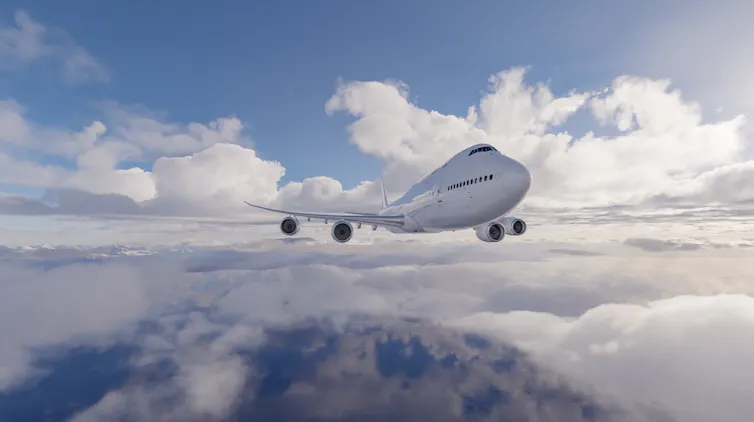
An airliner climbs above a substantial part of this protective blanket. At typical commercial aviation altitudes, measurements suggest that the radiation dose approximately doubles for each additional 1,830 metres, or 6,000 feet, of altitude. The metal skin of an aircraft provides comparatively little protection from these very energetic particles.
EB Adventure Photography/Shutterstock.com
Altitude is only part of the story. The Earth has another remarkably effective radiation shield: its magnetic field.
Charged cosmic particles are deflected by this field, but the protection varies across the planet. It is greater near the equator and weaker towards the magnetic poles, which is why a long flight at high northern latitudes can produce a greater radiation dose than a similar flight nearer the equator.
Solar activity influences radiation levels too, meaning cosmic radiation exposure is not simply determined by how many hours someone spends in an aircraft. A short, relatively low-altitude flight near the equator is different from a long flight at 40,000 feet across the far north.
Measurements on commercial aircraft have found doses ranging from less than one microsievert on some flights to more than 60 microsieverts on others.
One calculation estimated an effective dose of about 67 microsieverts for a nine-hour flight from Athens to New York. These are small doses individually, but pilots and cabin crew repeat the exposure hundreds of times over many years.
That cumulative exposure is what makes cabin crew different from regular passengers.
The authors of the new study estimate that pilots and cabin crew receive around 3-6 millisieverts of cosmic radiation each year. Someone taking ten return cross-country flights annually in the US, by comparison, would receive around 0.4 millisieverts from flying. In other words, being an airline pilot or cabin crew is, from the point of view of radiation exposure, a genuine radiation occupation.
Why might that matter for cancer? Ionising radiation has enough energy to remove electrons from atoms and molecules. When that happens inside a cell, it can damage important biological molecules, including DNA.
Cells have sophisticated machinery for repairing DNA damage, and most damage is either successfully repaired or the damaged cell dies. Occasionally, however, the repair is imperfect and a mutation survives.
Cancer develops through the accumulation of such alterations in cells, which is why exposure to ionising radiation has long been known to increase cancer risk.
What about frequent flyers?
The new study doesn’t prove that cosmic radiation caused the cancers recorded among pilots and cabin crew.
The researchers knew people’s occupations from their death certificates, but not how many years they had spent flying, how many hours they flew each year, the routes and altitudes involved, or the radiation dose each individual had accumulated. There is nevertheless something intriguing about the pattern they found, and an interesting question is at what point a passenger becomes a genuinely frequent flyer.
Radiation does not know whether the person sitting in an aircraft is wearing a pilot’s uniform, serving drinks or answering emails. What matters is accumulated dose.
Someone taking dozens of long-haul flights each year, particularly on high-latitude routes, will inevitably receive more cosmic radiation than someone who flies twice a year.
There is no particular number of flights at which this suddenly becomes dangerous, and for most passengers cosmic radiation is not a reason to avoid flying. But for people whose lives involve exceptionally frequent long-haul travel, it is reasonable to recognise cosmic radiation as one of the less obvious consequences of spending so much time at altitude.
That is perhaps the clearest message from the new research. We usually think of radiation exposure as something associated with X-ray machines, nuclear reactors or radioactive materials, and therefore something that occurs in places where radiation is carefully controlled. But every passenger aircraft routinely enters a radiation environment quite different from the one in which we live on the ground.
For an occasional traveller, the additional exposure is small. For pilots and cabin crew, repeated flight after flight over an entire career, those small doses accumulate – and the new study suggests we should take that occupational exposure more seriously.

Justin Stebbing does not work for, consult, own shares in or receive funding from any company or organisation that would benefit from this article, and has disclosed no relevant affiliations beyond their academic appointment.