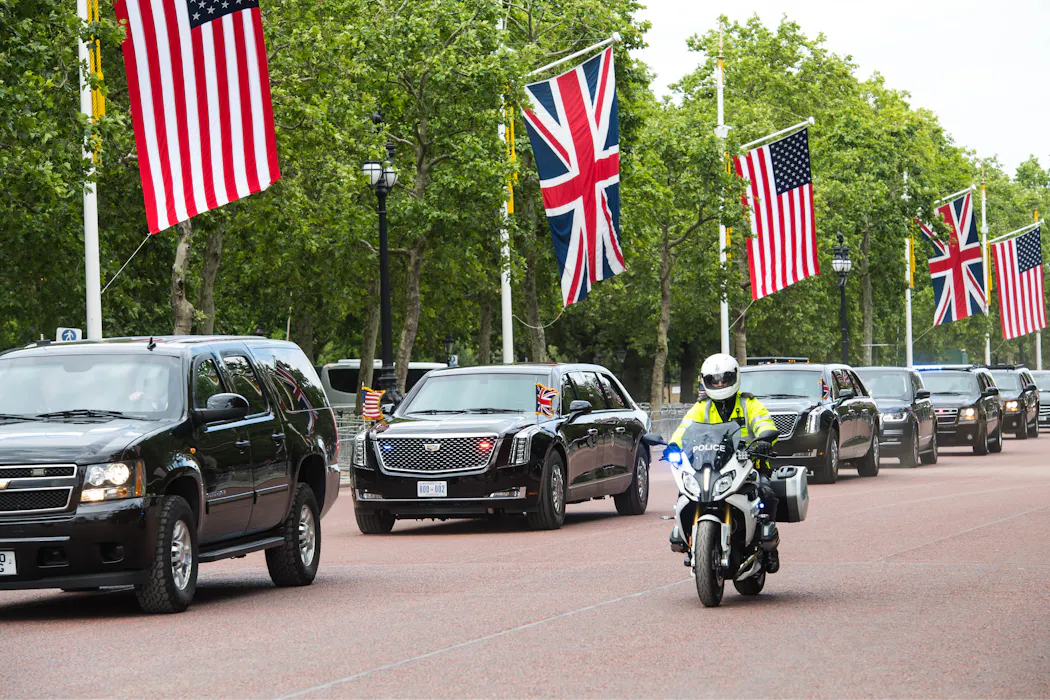
The hard work of government has begun for Andy Burnham. The new prime minister will be forced to confront a multitude of thorny issues, among which is the question of the UK’s partnership with the US. So what will the so-called “special relationship” look like in the Burnham-Trump era, and how can Burnham harness the lessons of Labour’s history?
Despite the Maga moment dominating American politics, Burnham should remember that the US has a progressive historical tradition. Indeed, the seeds of the US-UK special relationship were sown at a point in its history when American progressivism was at the forefront of political discourse, with Franklin D. Roosevelt in the White House.
Roosevelt’s New Deal programme aimed to pull the country from the depths of the Great Depression through investment in infrastructure and job-creation programmes. This was in line with developments in Keynesianism, proposing that governments should increase spending in lean times to boost the economy via increases in consumer demand.
The term “special relationship” is often used to describe the wartime alliance between the UK and the US. In fact, it masks a deeper union based on idea-sharing among progressive thinkers on both sides of the Atlantic.
The Keynesian foundations of New Deal economics were studied carefully in Britain by figures on the Labour left such as Evan Durbin, Hugh Gaitskell and Douglas Jay. They produced detailed research that fed directly into the policy programme of the 1945 Labour government.
Hugh Dalton – the first chancellor under Labour prime minister Clement Attlee – was also a close observer of the New Deal as it rolled out. During his time in the cabinet, he followed the US lead with an economic policy characterised by public works and state intervention.
Resetting the special relationship
What the progressive politicians of the 1930s and 1940s on both sides of the Atlantic had in common was more than economic policy – it was a shared set of values that consolidated the special relationship. Both sides wanted to make economic security a foundation stone of freedom. And both were working towards democratic reform as an antidote to extremism by making the executive more responsive to its electors. Lastly, both countries subscribed to the idea that the government had a responsibility to intervene in order to improve the welfare of its people.
These values show the potential for a reset of the special relationship. Burnham and his foreign secretary Ed Miliband could use them as a framework in defining the UK’s future with America. Conventional wisdom suggests that the US holds all the cards when it comes to US-UK dealings. After all, the UK depends on the US for everything from defence procurement to cloud computing.
The argument goes, therefore, that to protect the UK’s geopolitical interests the country must build up strategic autonomy in the long term. But it must also cosy up to America as much as possible in the short term.
This all-or-nothing approach is misguided. In many ways, the disastrous appointment of Peter Mandelson as UK ambassador to the US epitomises the pitfalls of abandoning values and common sense for strategic gains. Mandelson, while certainly being someone who could woo Trump, seriously damaged the previous prime minister, and any assumed gains never materialised.

Rawpixel.com/Shutterstock
But at the same time, it is both unrealistic and undesirable for the UK to aim for complete autonomy from its transatlantic neighbour, with which it shares so many ties. What’s more, in an increasingly multipolar world Burnham must view America as part of the wider geopolitical landscape with other big players including China, Russia and Europe.
Far better would be a firm, balanced approach towards the US, grounded in the original values of the special relationship. Recapturing a progressive understanding of US-UK history during the Trump presidency would present challenges, but Burnham should remember that the shared values of the two countries are more important than any one occupant of the White House.
And while the new prime minister may have another three years in power wielding a legislative majority, Trump’s fortunes could be dealt a severe blow in the November midterm elections. His party faces losing control of the House of Representatives and possibly the Senate as well. This has the potential to shift the balance of authority between the two leaders enough for Burnham to seize the initiative.
It’s safe to assume that the new prime minister isn’t delighted with the present state of the special relationship. During the Makerfield byelection campaign, Burnham described American politics as “poisonous” and he has repeatedly criticised Trump.
As a man who has built his political brand on standing up for the underdog, it seems unlikely that Burnham will go down the path of capitulating to American demands at every turn. However, it is less obvious how he means to reinvent the partnership. Whatever answers he comes up with should be grounded in the progressive roots of the special relationship, using the shared values of economic security, democratic reform and social welfare to guide his foreign policy.

Rachel Reville is a member of the Labour Party.