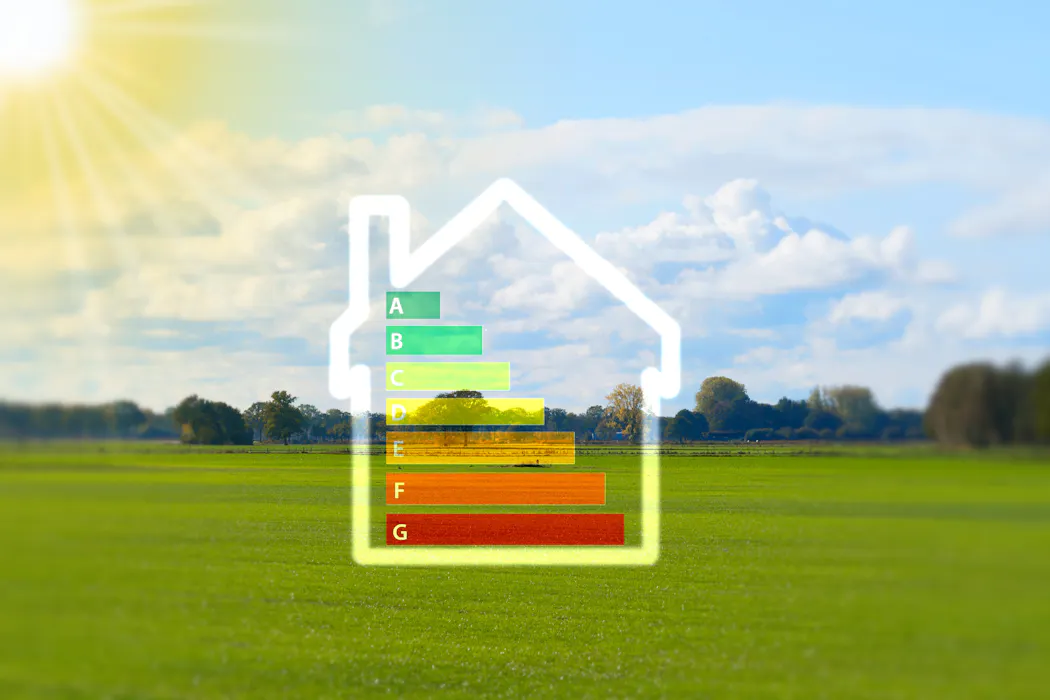
Imagine an apartment that could be teleported across Europe. In Spain, its energy certificate might read D. In Germany, the same apartment could earn a C on a scale that runs to H. In Brussels, it might land on B, one of more than 15 subclasses. In the Netherlands, where the scale climbs to A+, it would look positively mediocre.
Same walls, same boiler, same physics, eight different letters.
This is not a thought experiment. It is how Europe has rated its buildings for two decades. Energy performance certificates or EPCs are used across most of Europe. Building energy ratings (BER) are issued in Ireland. In France, Diagnostic de Performance Énergétique (DPE) were introduced under EU law in 2002. Yet each country was left to design its own scale.
The result became known in building-policy circles as the Babel tower of EPCs: dozens of national ladders slicing the same quantity – kilowatt-hours per square metre per year – into incompatible alphabets. Denmark even labels its best homes by vintage, with classes indicating year of construction called A2020, A2015 and A2010.
The demolition order
That tower is now being dismantled. The recast energy performance of buildings directive, in force since May 2024, requires all 27 member states to rebuild their certificates on a single closed scale from A to G. This EU directive had a transposition deadline (the final date by which an EU member state must update its national laws) of May 29 2026.
The new scale’s two anchors are elegant. Class A is reserved for zero-emission buildings: highly efficient homes using no fossil fuels. Class G is pegged to the worst-performing buildings in each country’s own stock at the moment the scale launches – so G means “among your nation’s worst”, wherever your home is. Countries may add an A+ or an A0 for buildings that beat the zero-emission threshold by at least 20% and generate more renewable energy than they consume. Europe has, for the first time, defined a grade for buildings better than zero.
Read more:
Homes need more renewable energy tech – here’s how to make sure retrofits avoid creating e-waste
Ireland moved first. On May 24 2026, five days before the deadline, it collapsed its 15-band scale into eight that is still topped by A0 for strictly zero-emission homes, bound by several conditions.
But the tower is falling floor by floor, not in one demolition. The directive lets any country that rescaled its certificates between January 2019 and May 2024 postpone the change until the end of 2029.
France, which rebuilt its DPE in 2021, sits squarely in that window. Meanwhile most member states had not finalised their new class boundaries by the May deadline: the Netherlands was still drafting, Spain still consulting.
For the next few years, house-hunters comparing energy credentials across borders will meet old scales, new scales and transition arrangements simultaneously. Harmonisation, paradoxically, begins by adding confusion.
The UK’s different bet
And the UK? No longer bound by the directive, it is running the opposite experiment: abolishing the single headline letter altogether.
In England and Wales, the familiar A-G energy-efficiency rating (a score based largely on modelled energy costs and similiar to what the EU is moving towards) is to be replaced by four separate metrics: fabric performance, heating system, smart readiness and energy cost. Each of these are calculated under a new physics-based methodology called the home energy model.
This reform, originally due in October 2026, was delayed in March to the second half of 2027, with old and new certificates running side by side until October 2029.
Scotland has legislated its own version: three ratings, heat retention, heating system and energy cost, under regulations made in 2025.

Francesco Scatena/Shutterstock
The philosophical split is real. Brussels is betting that one simple, comparable letter drives renovation. London and Edinburgh are betting the single letter was the problem, that mashing insulation quality, heating carbon and running costs into one score hid exactly the information households needed, letting a poorly insulated home with a cheap gas boiler outscore a well-insulated one with an electric system.
In May, the King’s speech did announce a European Partnership Bill creating powers to “dynamically align” UK law with the EU’s. But look at the scope: farming and food, emissions trading and electricity trading – the three areas agreed at the 2025 UK-EU summit. Buildings are not on the list.
The bill does allow ministers to extend alignment to new areas once parliament approves future treaties, so the door is ajar.
For now, though, the position is quietly remarkable: Britain is legislating to align with EU rules on the electricity flowing through its wires, while deliberately diverging on how it labels the buildings the electricity flows into.
If you are buying, selling or renting in the next three years, check the date on any certificate: a label issued before your country’s rescaling means something different from one issued after, and most existing certificates remain valid for up to ten years.
Ask which scale it was issued under. And trust the number more than the letter: the kilowatt-hours per square metre, per year, printed beside the grade is the one language every scale, old and new, EU and UK, has in common.
The Babel tower is coming down – but until it does, the arithmetic travels better than the alphabet.

Lala Rukh receives funding from Research Ireland for the ERBE Centre for Doctoral Training under grant agreement No 18/EPSRC-CDT/3586. She is affiliated with the University of Galway, Ireland and MaREI, the Research Ireland Centre for Energy, Climate and Marine research and innovation.