There are plenty of British politicians who love talking about sport. It makes them appear normal, grounded and relatable to voters.
But it seems that not many enjoy talking about the political side of it – especially the concept of “sportswashing”, when sport is allegedly used by a country to deflect attention away from concerns over issues such as human rights violations it might be involved in.
My recently published research shows that UK politicians have been extremely reluctant to discuss this difficult subject. The term “sportswashing” has been uttered just 37 times in the UK parliament since its first mention in 2021 (that was in relation to the failed plans for a breakaway European super league).
Elsewhere, the idea of sportswashing has become widely discussed, as ever increasing levels of sporting investment are used by (usually authoritarian) governments as a form of global influence.
But even in 2022, referred to by some as sportswashing’s “biggest year” – because of the men’s World Cup in Qatar and the winter Olympics in Beijing – the term was uttered just five times.
This hesitancy to address the topic might appear strange when the UK is home to some of the most high-profile events and teams accused of being associated with sportswashing.
For example, the Premier League’s Manchester City is often cited as an example of sportswashing. It is owned by Sheikh Mansour, vice president and deputy prime minister of the United Arab Emirates, which has been widely criticised for its record on human rights.
Some have argued that this kind of ownership transforms the club’s fans into “proxy defenders of the UAE government and Abu Dhabi royal family […] creating a halo effect whereby supporters conflate their joy over their club’s success with its ownership regime”.
Likewise, the Gulf State Bahrain essentially owns the UK-based Formula One McLaren team. Another Premier League side, Newcastle United is majority-owned by the Saudi Arabian sovereign wealth fund.
When the Saudi take over was finalised in October 2021, it was the subject of over 400 newspaper articles globally that month – all of which used the term “sportswashing”. But despite the international interest and the controversial nature of the deal, UK politicians decided it wasn’t worth talking about in the House of Commons.
No UK government minister has ever mentioned sportswashing in parliament, other than to confirm that the government does not have an official definition of the term. No official government documents or texts using the word, including research and policy papers, consultations and press releases, can be found on the official UK government website.
No Labour MP has used the term in the House of Commons since the party took office in July 2024, even when legislation on football governance was being passed. Yet part of that bill was designed to strengthen the “fit and proper persons” test for football club ownership.
There was one debate in the House of Lords in March 2024 however, which might help to explain why there has been such limited official discussion. That exchange included mention of the “benefits of inward investment” in the UK’s sports sector.
So perhaps the Conservative government of the time viewed foreign investment in UK sports as a positive development, and had no concerns about its source.
Human rights
Wider investments in other areas of the economy might also be a consideration. Saudi Arabia’s crown prince Mohammed bin Salman warned the then UK prime minister Boris Johnson in 2021 that relations between the two countries would be “damaged” if the takeover of Newcastle United was not permitted by the Premier League.
Bin Salman has previously said he does not care about the accusations, telling Fox News: “If sportswashing is going to increase my GDP by 1%, then we’ll continue doing sportswashing.”
The recent announcement of a £3.7 billion trade deal between the UK and six Gulf States may also help to explain the apparent reluctance of UK politicians to raise the issue of sportswashing.
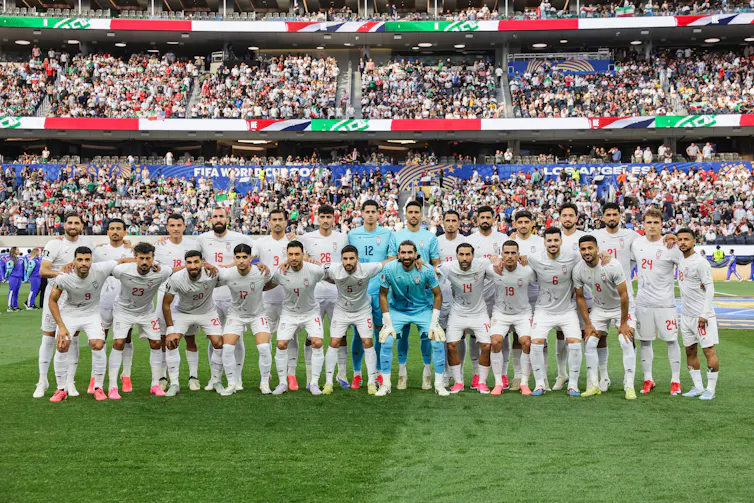
For sport and politics continue to be deeply entwined. This year’s men’s football World Cup, is a case in point. Human rights groups had suggested that the World Cup 2026 be a “bonanza of sportswashing” in the US, due to concerns about immigration and threats to press freedom.
EPA/CHRIS TORRES
In the event, politics has never been far from the action on the field.
To mention just a couple of examples, a tournament referee from Somalia was refused entry to the US, while Iran’s team had to move its training base to Mexico as conflict in the Middle East rumbled on.
So debates about politics and its relationship with sport will no doubt continue. But political inaction in sporting issues often represents a strategic decision to not intervene.
Keir Starmer may have felt comfortable calling for the recent Champions League final to be free to air or to ask Fifa not to change
the time of a match between Mexico and England.
But it would appear that he, his government, and many other politicians feel less inclined to get involved in the more difficult discussions relating to sport in the UK.

Stephen Crossley does not work for, consult, own shares in or receive funding from any company or organisation that would benefit from this article, and has disclosed no relevant affiliations beyond their academic appointment.