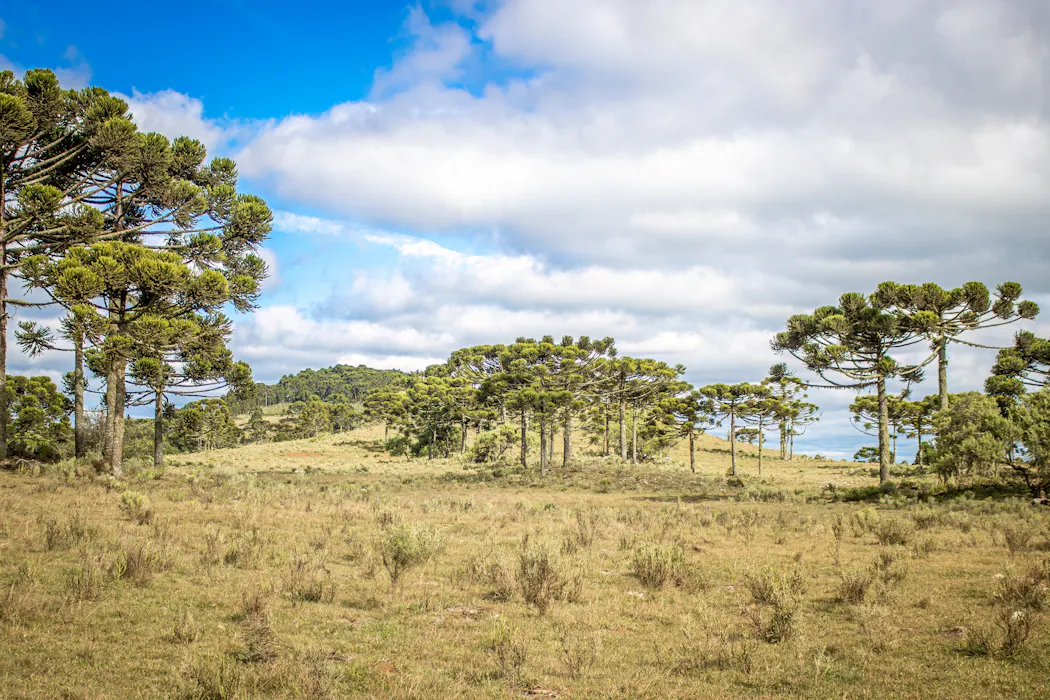
When you think of a South American rainforest, you probably don’t imagine biting winds, heavy frosts and freezing temperatures. But in the mountains of southern Brazil, that’s exactly what you can find. On this highland plateau, far from Amazonia in the country’s coldest region, grows one of the world’s most intriguing ecosystems.
For millions of years, this region has been home to a biodiverse patchwork of Araucaria forests and campos grasslands. The Araucaria trees which characterise this region are closely related to the monkey puzzle trees widely cultivated in Britain, and their relatives once fed dinosaurs around the world. In the present, though, this landscape is in trouble – 150 years of logging and agricultural expansion has destroyed most of the forest-grassland mosaic, and the cool, wet conditions it needs are now rapidly disappearing.
Lessons from the past can help us conserve this ancient ecosystem. Rolling back the centuries with an international team, my recent research uncovered the unexpected ways in which humans and climate changes combined to shape Brazil’s Araucaria forests over the last 6,000 years. Far from being inherently destructive, they were critical in forming the ecosystem’s character.
The Araucaria forest region is peppered with archaeological sites, including many belonging to the southern Jê people. After arriving in the region around 2,000 years ago, they transformed the landscape, from pit-house villages in the forests to funerary earthworks on commanding heights.

FMPortella/Shutterstock
At the same time, the Araucaria forest, so central to their way of life, seems to have expanded. Initially, researchers believed that forest expansions had tracked climatic changes, but more recent studies have suggested that the southern Jê themselves spread the forest. Our latest research suggests a more nuanced story.
We used a combination of different approaches to understand the last 6,000 years of Araucaria forest history. Pollen and tiny charcoal fragments preserved in layers of bog mud showed how the surrounding area’s vegetation and fire activity changed through time. We compared these results to archaeological findings and a record of past rainfall from a nearby cave, as well as to computer models which predicted how the forest would have behaved if climate alone had driven its dynamics. Together, the results revealed a surprise.
An unexpected history
My colleagues and I found that, when the forests expanded, they generally did so at the times and places we’d predicted based on climate conditions. Strangely, though, vegetation change was very uneven across the region.
Most pollen records – including three new ones near archaeological sites – showed only minor forest expansions, if any at all. But a few sites exhibited drastic increases in forest pollen – even when close neighbours didn’t. This patchy response suggests that the forest dynamics were driven by something more complex than just broad-scale climatic changes.
The answer lies in the interaction of climate change and fire dynamics. Fire is a natural part of the Araucaria forest region. Campos grasslands burn readily, killing tree seedlings and preventing forest expansion, though mature Araucaria forest patches are fairly fireproof.
In the past, changes to warmer and wetter conditions, which slightly favoured the forests and reduced fire, had limited effects in most places. Where major changes happened, it seems to have been because the landscape was already close to a tipping point. In those areas, it only took a little more forest and a little less fire to spark a chain reaction that saw forest growth shut out the fires and overrun the grasslands.

Ponevina/ Wikimedia Commons, CC BY-NC-ND

However, a handful of pollen records bucked this wider trend of forests avoiding fire. These locations – most notably, the three near archaeological sites – experienced periods with both high fire activity and relatively high Araucaria forest. They also saw crop cultivation and slight increases in pollen from Araucaria trees. These are the fingerprints on the forest, the first direct evidence of how the southern Jê shaped this ecosystem over the last 2,000 years.
Our data can’t tell us exactly what this looked like, but it does give us clues. Charcoal probably came from a mixture of daily life and land management, with fires clearing spaces for crops to be planted. There’s no sign that this led to forest loss, though – it may even have been an agroforestry system, with maize and beans growing under the canopy of culturally useful trees, including Araucaria. At one site, this influence created a landscape unlike any seen in previous studies, which developed and changed over centuries with the rhythms of the nearby village. The southern Jê may not have spread trees widely across the landscape, but they certainly shaped the forests around the places they lived.
Although our findings focus on the past, they are invaluable for this ecosystem’s future. Seeing how climate changes pushed forest-grassland dynamics over tipping points in unpredictable ways is a worry: as conditions in southern Brazil continue to get warmer and wetter, this will make it harder to conserve both Araucaria forest and campos grasslands.
And the revelations about the region’s human history matter, too. Southern Brazil still has southern Jê communities – the Kaingang and Laklãnõ Xokleng. Our results highlight that there’s no inherent conflict between people and Araucaria forest. As these Indigenous communities continue to fight for their rights to their ancestral land, conservation would do well to learn from them and to establish better ways of linking people with the forests – before it’s too late.

Oliver Wilson has received funding from NERC, INQUA, and the University of Reading.