
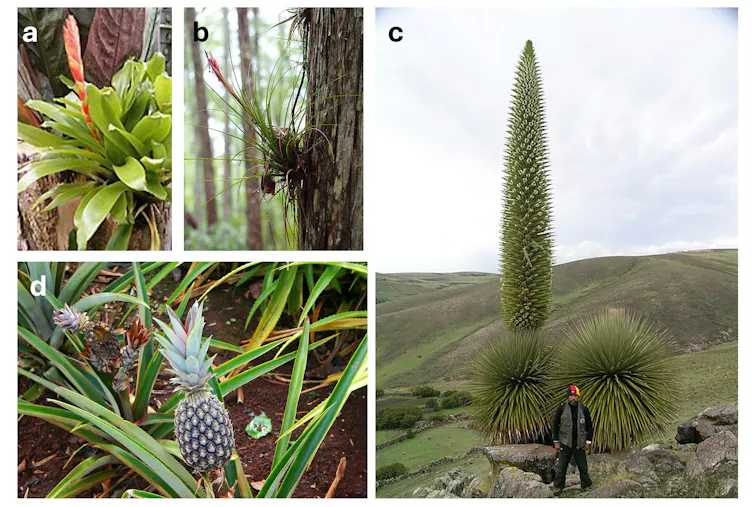
High above the rainforest floor, tiny ponds form in the leaves of plants perched on tree branches. Frogs breed in these ponds, alongside insects, microbes and even tiny crustaceans, creating miniature ecosystems suspended high in the canopy. These are the bromeliads – the remarkable plant family that also gave us air plants, the towering 12-metre “Queen of the Andes”, and the pineapple on your terrible pizza.
Many people think of plants as nice-looking greens. Essential for clean air, yes, but simple organisms. A step change in research is shaking up the way scientists think about plants: they are far more complex and more like us than you might imagine. This blossoming field of science is too delightful to do it justice in one or two stories.
This article is part of a series, Plant Curious, exploring scientific studies that challenge the way you view plantlife.
Bromeliads are one of the great evolutionary success stories of the neotropics, the tropical ecosystems of the Americas. The ancestor of all living bromeliads existed just 20 million years ago, and since then, they have branched into about 3,800 species. To put this into perspective, hydrozoans – a lineage of predatory jellyfish-like animals – took more than 500 million years to evolve about 3,800 species.
Explaining how the remarkable plant biodiversity of the neotropics evolved remains one of the greatest challenges in evolutionary biology. Bromeliads, which are almost entirely unique to this region, provide one of the best natural experiments for investigation. My colleague Elizabeth Forward and I have published a new study that confirms hummingbirds played a crucial role in this plant family’s evolution.
Over the past 20 million years, bromeliads repeatedly evolved new adaptations to the point that some of them are hard to recognise as close cousins.
Many abandoned the forest floor to grow on tree branches as epiphytes (meaning they use their host as a perch and don’t harm it). Others evolved leaf formations that trap rainwater. Some evolved Cam photosynthesis, the same water-saving strategy used by cacti living in the harshest deserts.
Plants that use Cam photosynthesis only absorb carbon dioxide at night, when it is cooler. These adaptations allowed bromeliads to maximise new ecological opportunities at high speed.
However, one idea that dates back to Charles Darwin is perhaps the strongest, and that is the influence of different pollinators.
Wikimedia, CC BY
The hummingbird hypothesis
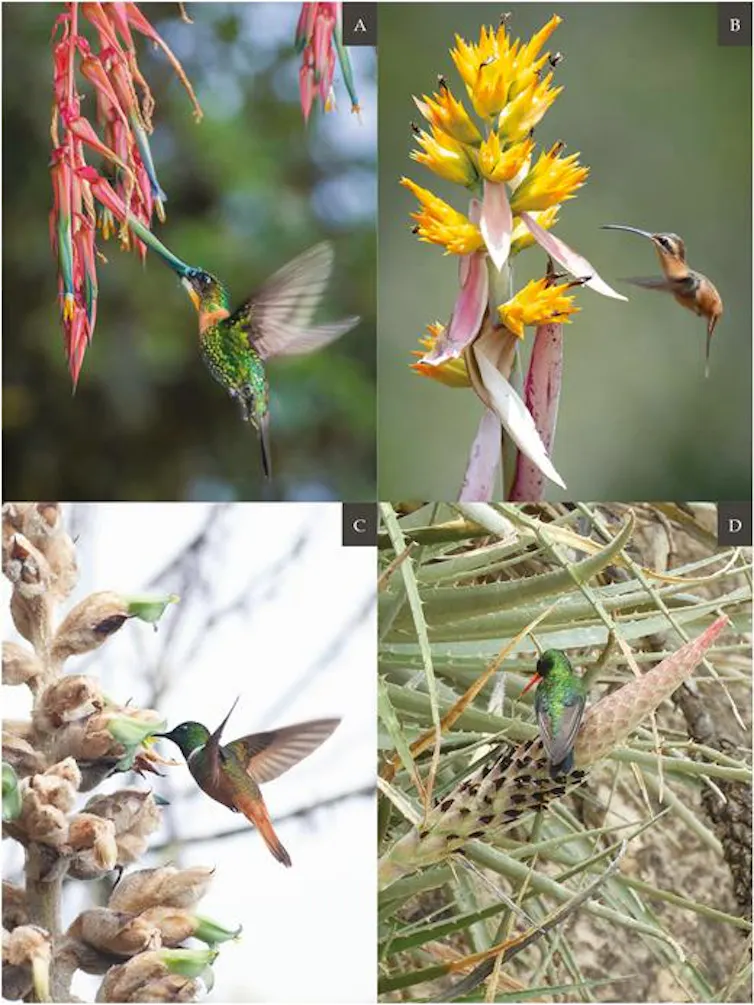
Most flowering plants, including the earliest bromeliad ancestors, are pollinated by insects such as bees. However, at least half of all bromeliad species today are pollinated by hummingbirds, and some others rely on bats, butterflies or moths.
Scientists have long suspected that the repeated evolutionary shifts between pollinators helped accelerate the formation of new bromeliad species. But exactly when these shifts occurred, and what effect they had on diversity, has remained uncertain.
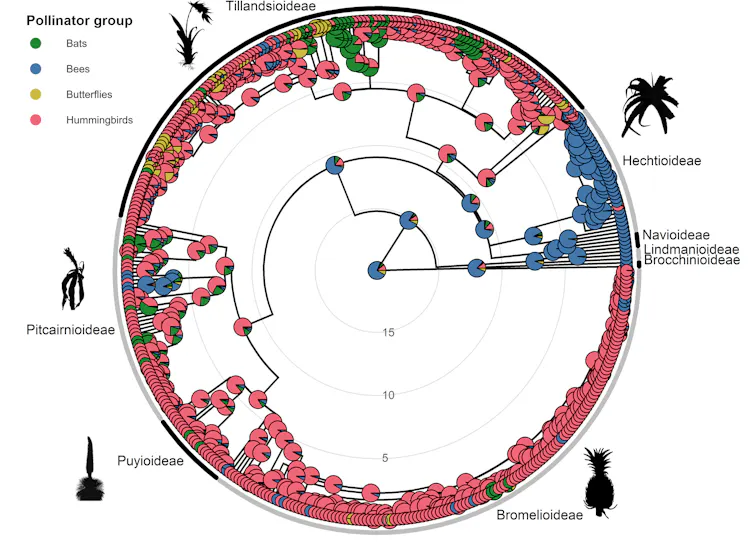
My colleague and I tested this idea. We compiled pollinator records for more than 400 bromeliad species, and reconstructed the history of how bromeliads switched between pollinators through 20 million years of evolution.
Botanical Journal of the Linnean Society, CC BY
Our analyses support the idea that the earliest bromeliads were pollinated by bees. Following this, there were repeated shifts, primarily to hummingbirds, but also bats and butterflies. Bromeliads experimented with different pollinators as they spread into new habitats across the neotropics. Our results reveal a more dynamic evolutionary history than scientists previously suspected.
One pattern stood out. The bromeliads pollinated by hummingbirds split into new species at almost double the normal rate.
New species usually arise when populations become separated and gradually stop exchanging genetic material. Given enough time and isolation, enough genetic differences accumulate that they become unable to reproduce with each other. Pollinators can influence this process because they help shape which populations of plants are genetically connected and can reproduce together.
One possibility is that hummingbirds move pollen around differently to insects as many species move larger distances, which changes how genetic material flows across landscapes. Different pollinators also favour different flower colours, shapes and flowering times. Hummingbirds often prefer long, bright red and tubular flowers with copious nectar rewards, which match their long, slender beaks and hovering feeding behaviour. Over thousands of generations, these small differences build up. In mountainous regions, where many hummingbirds live, and in which valleys and peaks naturally separate populations, these effects may become even stronger.
Like most evolutionary stories, there is unlikely to be a single explanation that explains everything. Other innovations, such as epiphytism, also accelerate diversification rates. However, our study suggests that hummingbirds were of particular importance for bromeliads, helping to accelerate one of the fastest known plant radiations.
Botanical Journal of the Linnean Society, CC BY
An ongoing evolutionary story
This high-speed evolutionary story of bromeliads has not finished. Our reconstruction shows that many shifts between pollinators occurred surprisingly recently. For example, the hummingbird-pollinated Hechtia iltisii, which looks a bit like a cross between a spider plant and an aloe vera. Its closest cousins are bee-pollinated.
In fact, about a quarter of bromeliad species changed their pollinator from that of their most recent ancestor in the last few million years, suggesting that bromeliads are still experimenting today. But they, and hummingbirds, face unprecedented pressures from habitat loss and climate change, threatening not only individual species but the evolutionary interactions that generate biodiversity across the neotropics.
Up to 81% of bromeliads are predicted to be possibly threatened with extinction. And dozens of hummingbird species are considered endangered.
Every pineapple in the supermarket, every air plant on a bathroom windowsill, and every pond-forming bromeliad clinging to a rainforest tree is the result of 20 million years of high-speed evolutionary experimentation. Tiny hummingbirds in particular have helped transform a single ancestral plant population into one of the richest bouquets of neotropical plant biodiversity.

Jamie Thompson receives funding from The Leverhulme Trust.