Following the Soviet Union’s collapse in 1991, Russia endured a period of violent criminal lawlessness known as the “wild 90s”. Organised crime spiked, with gangs taking control of banks, factories and other lucrative markets. Contract killings, shootings and car bombings became part of urban life.
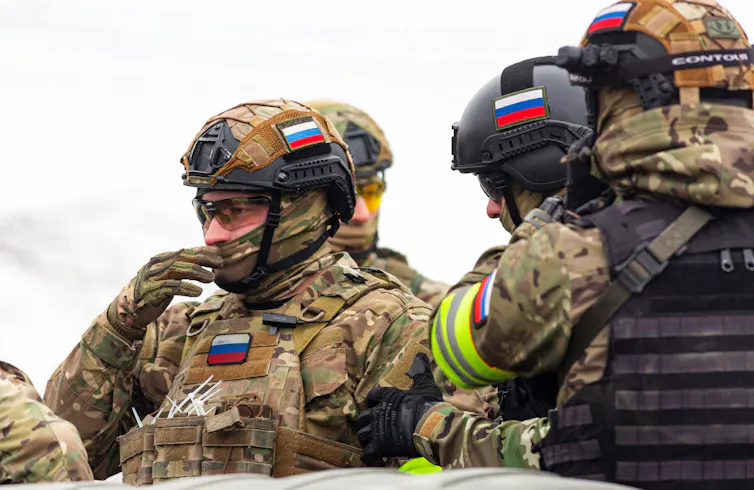
There are now fears that the Ukraine war will give rise to a similar situation as members of Russia’s army, as well as former convicts who were pardoned in exchange for military service, return from the frontlines.
A variety of conditions enabled organised crime to flourish in the 1990s. Weak state institutions, economic turmoil and mass privatisation following the Soviet Union’s collapse created a governance vacuum in Russia.
As criminologist Federico Varese, of the University of Oxford, explains in his work, criminal groups stepped in to provide “private protection” in areas where the state was ineffective or absent. They provided services such as contract enforcement, debt recovery and physical business security.
Sociologist Vadim Volkov, meanwhile, describes the rise of “violent entrepreneurs” who commodified coercion in an environment where legal institutions had largely collapsed. Russia’s murder rate surged in this period. Between 1990 and 1994, it more than doubled to a peak of over 33 killings per 100,000 people. This made Russia’s murder rate among the highest globally.
Dmitriy Kandinskiy / Shutterstock
Contemporary Russia presents a different picture. Following Vladimir Putin’s rise to power in 1999, the Russian state has consolidated its authority. Putin quickly expanded the state’s security apparatus while reasserting control over criminal networks.
In many cases, organised crime has become integrated into systems of governance, complementing the state’s political or strategic interests. For example, criminal networks have facilitated sanctions evasion by transporting restricted goods through parallel trade routes and acquiring sanctioned technologies via intermediary networks in third countries.
Reinforcing this transformation
The Ukraine war is likely to reinforce this more recent transformation. Expanded western sanctions imposed since the start of the war have widened opportunities for illicit trade and smuggling networks. But the most significant consequences arise from the social and security challenges associated with large-scale military demobilisation.
Since the full-scale invasion in 2022, Russia has mobilised hundreds of thousands of military personnel. This includes up to 180,000 former convicts. Many of these people have experienced prolonged exposure to combat. Military service does not inherently lead to criminality and it would be inaccurate to suggest that all returning veterans are likely to become offenders.
However, evidence from post-conflict societies such as Colombia, Sierra Leone, Cambodia and Bosnia-Herzegovina suggests that poorly managed demobilisation can reshape criminal markets. Research on disarmament, demobilisation and reintegration consistently demonstrates that unemployment, psychological trauma and weak institutional support creates opportunities for criminal groups to recruit former combatants.
Military service also teaches soldiers organisational skills beyond battlefield experience such as logistics, intelligence gathering and network management. These skills are all transferable to contemporary organised crime. In modern organised crime environments, traditional racketeering is complemented by cybercrime, cryptocurrency laundering and transnational financial crime.
Even if only a small proportion of military personnel returning from Ukraine become involved in criminal activity, they could change the composition and improve the operational sophistication of Russian crime groups. While the circumstances differ, the case of Colombia illustrates how poorly managed demobilisation can transform organised crime.
In the 2000s, over 30,000 fighters from right-wing paramilitary groups in Colombia were demobilised. A minority of these former combatants subsequently joined or established criminal organisations. They provided military training, discipline and networks, aiding the capabilities of organised crime.
These groups rapidly became major players in the Colombian organised crime ecosystem. A Human Rights Watch report found they became major perpetrators of drug trafficking, extortion and violence. Estimates suggest they controlled up to half of the Colombia’s cocaine exports by 2011.
WorldStockStudio / Shutterstock
The Russian state is far stronger than the one that emerged after the collapse of the Soviet Union. This makes a wholesale resurgence of traditional criminal violence unlikely. Instead, the Ukraine war looks set to accelerate a new generation of criminal networks that are more professional, militarised and embedded within state structures.
However, the Kremlin still faces a difficult balancing act. Contemporary Russian governance has relied upon managing and exploiting criminal groups. And Moscow appears wary of the broad social instability that would emerge if criminal organisations become sufficiently powerful or autonomous to operate beyond state control.
Russia has thus began preparing plans for the return of veterans from Ukraine. The Kremlin has implemented initiatives such as the “Time of Heroes” programme. This programme channels selected veterans into public administration and political office following their demobilisation. Although limited, such planning reflects official recognition that domestic consequences of war will extend beyond the battlefield.
Regardless of these efforts, the distinction between organised crime and state power in Russia is likely to become harder to draw than at any point since the end of the cold war.

Adriana Marin does not work for, consult, own shares in or receive funding from any company or organisation that would benefit from this article, and has disclosed no relevant affiliations beyond their academic appointment.