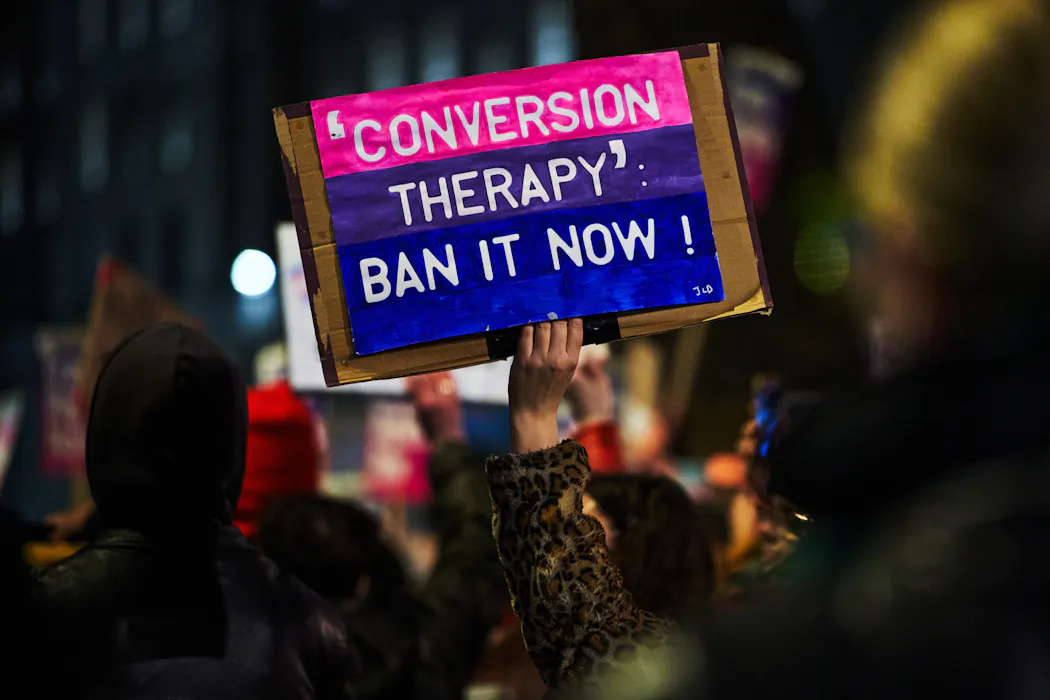
After eight years of successive governments pledging action, the UK government has finally published draft legislation to ban conversion practices in England and Wales. If enacted, it would create new criminal offences to protect people from attempts to change their sexual orientation or gender identity.
The proposals come as international momentum has grown. Earlier this year, the Council of Europe called on all member states to prohibit conversion practices, recognising them as discriminatory abuse incompatible with human rights.
The legislation also reflects growing evidence about how conversion practices operate in the UK. Research, including a recent report from the LGBTQ+ anti-abuse charity Galop, to which I contributed, shows these practices continue to occur across the country today.
Cases typically involve manipulation, humiliation, intimidation and social isolation. They take place often within families, religious communities or other trusted relationships. Existing criminal offences do not adequately capture these cumulative patterns of abuse, leaving many without effective legal protection.
Against that background, the draft bill has several strengths. Unlike legislation in some countries, it protects both adults and children. Unlike the government’s 2021 draft proposals, which didn’t become law, it does not include provisions that allow people over 18 to give informed consent. As I have argued in my research, valid consent cannot be given to coercive and controlling practices.
Those convicted of carrying out abusive conversion practices under the proposals could face an unlimited fine, imprisonment for up to five years, or both.
The draft bill also creates offences for encouraging or assisting someone to undergo conversion practices abroad. And it introduces civil protection orders, which allow courts to intervene before serious harm occurs. The bill contains no exemptions for parents or religious practices where their conduct amounts to conversion practices. Its explanatory notes also make clear that it protects asexual people, another welcome development.
The new offence is based on a two-stage test. First, only abusive conversion practices are criminalised. The explanatory notes define “abuse” broadly to include humiliation, intimidation and manipulation. Many documented conversion practices are likely to satisfy this definition. Even so, the distinction between abusive and supposedly “non-abusive” conversion practices risks implying that some forms of conversion practices could be legitimate.
Survivor evidence and research consistently argue that all conversion practices are abusive. This is because they seek to change or suppress LGBTQ+ identities based on the stigmatising assumption that those identities are inherently inferior. Conversion practices also occur typically through fundamentally unequal power relationships.

Josep Suria/Shutterstock
Secondly, the abusive conduct must cause either serious harm to physical or mental health, or serious alarm or distress that substantially affects a person’s day-to-day life. This is a relatively high threshold. But it mirrors the existing offence of controlling or coercive behaviour, with which conversion practices share many characteristics.
Whether this strikes the right balance between protecting victims and ensuring prosecutions remain workable is likely to become one of the main issues during parliamentary scrutiny.
Defining ‘conversion practices’
The definition itself also departs from emerging international consensus. The definition developed by the UN independent expert on sexual orientation and gender identity has strongly influenced the definition adopted by the Council of Europe and several other countries.
That definition describes conversion practices as attempts to change or suppress a person’s sexual orientation or gender identity, because LGBTQ+ identities are regarded as inherently inferior.
The UK has taken a different approach, instead focusing on abusive conduct intended to change a person’s sexual orientation or transgender identity. This narrower formulation may make prosecutions more straightforward, but leaves crucial questions unanswered.
Most notably, the legislation does not expressly refer to the suppression of sexual orientation or gender identity. Survivor testimony consistently shows that many conversion practices seek not to change identity itself, but to pressure people into denying or concealing it.
It might be argued that courts could interpret sexual orientation and gender identity consistently with UK equality law, which protects their expression. If so, suppression could still fall within the scope of the legislation. However, the position is considerably less clear than under the UN or Council of Europe definitions.
Another issue likely to receive close scrutiny concerns healthcare. The bill sets a high threshold before healthcare service providers could commit an offence. Liability would arise only where conduct falls far below the standards reasonably expected of someone in their position. This is intended to protect legitimate medical and therapeutic practice. Parliament will need to consider whether this provides sufficient protection against conversion practices occurring in healthcare settings – particularly in relation to gender identity.
Some critics argue that the proposals violate freedom of religion and freedom of expression. Those concerns are, arguably, baseless. The bill does not criminalise expressing beliefs or conversations between people. It targets abusive conduct that causes serious harm or distress.
It is a fundamental legal principle that no human rights, including freedom of religion and freedom of expression, can be used to justify harming others. Notably, both the Church of England and the Church in Wales have supported a statutory ban on conversion practices, as have many other faith groups worldwide.
The bill will now undergo pre-legislative scrutiny, giving parliamentarians, survivors and legal experts the opportunity to improve it. But after years of delay, the publication of the draft legislation marks an important step towards recognising conversion practices for what they are: a form of discriminatory abuse that demands a decisive legal response.

Ilias Trispiotis does not work for, consult, own shares in or receive funding from any company or organisation that would benefit from this article, and has disclosed no relevant affiliations beyond their academic appointment.