This curation of The Conversation UK’s arts and culture coverage was first published in our fortnightly newsletter, Something Good.
The first round of the World Cup is over and despite this usually being the most sedate bit of the tournament, there have been some surprisingly gripping matches.
I have been told that New Zealand and Iran’s 2-2 draw was unexpectedly thrilling.
There has also been a lot of lovely talk in my various group chats about Vozinha, the 40-year-old Cape Verdean goalkeeper who was going to retire but thankfully didn’t. The African nation unexpectedly tied with European champions Spain, a historic win and debut for Cape Verde, which wouldn’t have happened without Vozinha’s career-topping performance.
And, of course, on Wednesday night, England started their 2026 World Cup campaign with a stonking 4-2 win over Croatia. And, Scotland (whose fans are winning hearts with their antics in Boston) also won their opening match, beating Haiti 1-0.
This is the first tournament to happen across three nations with Mexico, the US and Canada hosting games. Football… sorry, soccer, is the most popular sport in the world; however, it has taken a while for America to join the rest of us. In this episode of The Conversation Weekly podcast, we speak to John Sloop, a professor of communication studies and historian of soccer and its fans in the United States, about how the country finally fell in love with beautiful game.
At The Conversation, our coverage is being coordinated globally and our American team, in a move that felt quite pointed, published this article on why “soccer” is a fine term for the game. What do you think?
Answer our poll at the end of the article, and let us know what your highlights of the tournament have been so far in the comments. Environment editor Rachael Jolley let us know hers: “I’m mostly loving the Scotland fans, their disco dance at the end of the match and the parade with bagpipes.”
Read more:
How the US finally fell in love with soccer
Debates and reappraisals

Smithsonian., CC BY-NC
The anthropologist Matei Candea has been mapping how the different parts of the world view the idea of free speech and how they value it. Some people think it should be absolute, others think there are important qualifications. And in some countries, many people feel that restricted speech is a trade off – if in return you get prosperity and order. Is there one true idea of freedom of speech?
In his new book, he argues there are three competing modes of freedom of speech: reason, carnival and honour. “Reason” envisions the rational exchange of opinions within the law. “Carnival” values free speech as a radical attack on established laws and orthodoxies. “Honour” is concerned with the courage of truth-speakers doing their duty. Rather than being mutually exclusive cultural ideas they should be considered together.
Reason, Carnival and Honour: An Anthropology of Free Speech by Matei Candea is out now
Read more:
Freedom of speech takes many forms and they are always cultural
In cinemas, an unfairly overlooked Virginia Woolf story is finally getting its screen debut. Night and Day has long been seen an as anomaly in Woolf’s catalogue because there is none of her usual modernist experimentation or exploration of the issues of post-war society and there is something decidedly Victorian in its realism. For this, it received unfavourable reception on its publication in 1919. Expert in modernist literature Peter Adkins feels this was unjust, writing that “Night and Day is a far more provocative and captivating novel than is commonly assumed”.
Night and Day is in cinemas now
Read more:
The overlooked Virginia Woolf novel about to hit cinemas – Night and Day
Nature captured
If you are looking for an injection of art, the Opera Gallery in London offers two very different responses to nature in bringing together Dutch sculptor Pieter Obels and French-Chinese artist Feng Xiao-Min. The fluid bold lines of Obels’ metal sculptures sit in contrast with the soft misty painted canvases of Xiao-Min. The exhibition marks Feng Xiao-Min’s first exhibition in the UK and Pieter Obels’ return to London after 10 years.
Pieter Obels | Feng Xiao-Min is at the Opera Gallery London until July 5 2026
Read more:
Pieter Obels and Feng Xiao-Min: a compelling exploration of nature through steel and paint
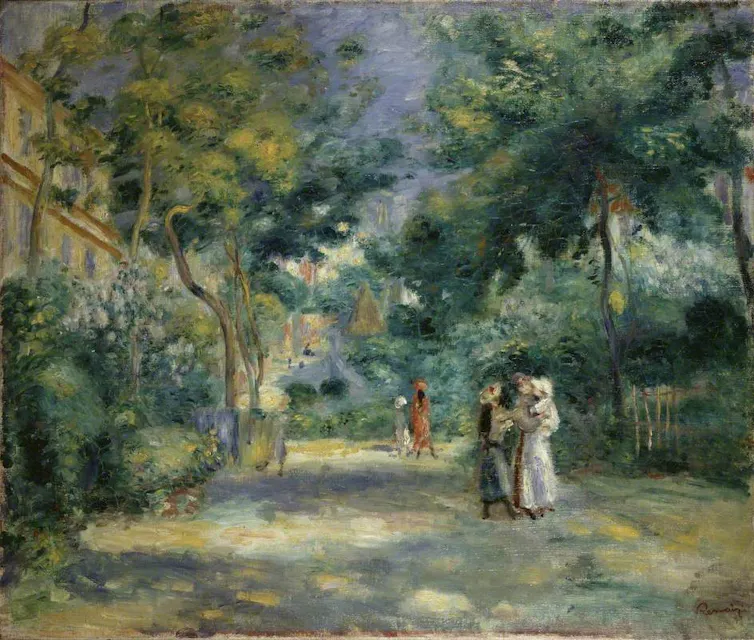
Ashmolean Museum, Oxford, CC BY-NC
Why were Monet, Renoir, Morisot, Pissarro and their colleagues so attracted to painting gardens? This is questions that art expert Clare Willsdon tried to answer in her book In the Gardens of Impressionism. The answer is complex but social change at the time the impressionists were working made leisure gardens accessible to not just the wealthy but everyone. “The great horticultural movement” was making gardening a popular hobby, helped by technological breakthrough like iron-and-glass greenhouses and the increasing accessibility of exciting new plant species.
In the Gardens of Impressionism is available now
Read more:
Why impressionists loved to paint gardens
This article features references to books that have been included for editorial reasons, and may contain links to bookshop.org. If you click on one of the links and go on to buy something, The Conversation UK may earn a commission.
