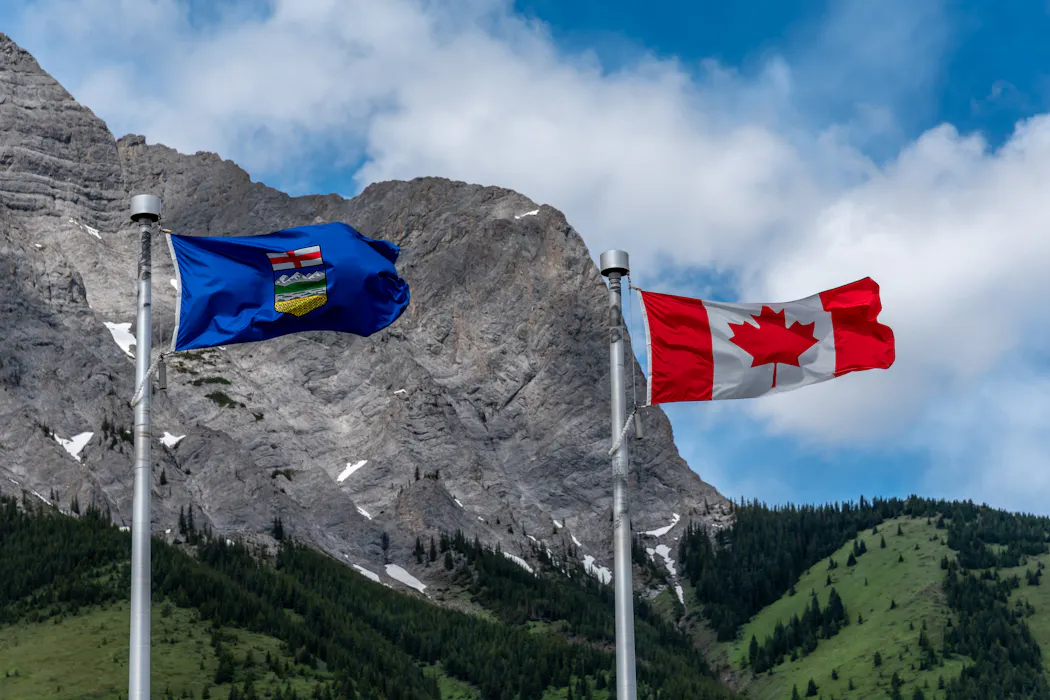
Albertans will head to the polls in October for what has been referred to as a “referendum on a referendum”. They will be asked to choose between two options: should Alberta remain a province of Canada, or should their province begin the legal process to hold a binding referendum on whether Alberta should separate from Canada?
This was announced on May 21 in a televised address by Alberta’s premier, Danielle Smith – a politician who, in the same breath, said she would personally vote to stay. The question on whether Alberta should remain or separate will appear alongside other questions on immigration policy and constitutional changes.
There is support in Alberta for a referendum. Around 700,000 Albertans signed petitions in 2025 and 2026 calling for a vote about either remaining in Canada or separating. That is a remarkable number in a province of just over 5 million people.
The groups behind the petitions say they gathered enough votes to trigger a province-wide referendum on independence. However, the petitions were struck down by an Alberta court in December 2025 and May 2026 for infringing indigenous treaty rights.
Decades of grievances
Alberta sits on the fourth-largest proven oil reserves on the planet. And for decades, many people there have felt that the rest of Canada – particularly the federal government in Ottawa – has been drawing disproportionately on Alberta’s prosperity.
This anger traces back to 1980. That year, Canada’s then-prime minister, Pierre Trudeau, introduced the National Energy Program, capping domestic oil prices below world market rates and redirecting oil revenues to the federal government. The policy, which was repealed in 1985, devastated Alberta’s economy.
In the years that followed, Alberta’s unemployment rate more than tripled – from under 4% in 1980 to a peak of 12.4% by 1984. Tens of thousands of jobs disappeared as oil companies left the province, with estimates suggesting Alberta lost up to CA$100 billion (£54 billion) in revenue during the National Energy Program era.
Canada’s equalisation payment system, under which wealthier provinces indirectly subsidise poorer ones, has kept the wound open. Alberta consistently contributes far more to the federal treasury than it receives back in spending.
More recently, federal climate policies – including a carbon tax, emissions caps on the oil sector and what legislation critics have called the “no more pipelines bill” – have become focal points for the sense held by many Albertans that Ottawa is strangling their province’s economic lifeline.
Read more:
As Alberta separatists court the U.S., prosperity is fuelling a sovereigntist turn
What the law provides
Under international law, all people have the right to self-determination – the right to shape their own political, economic and cultural future. But outside of colonial contexts, this right is almost always understood to mean self-government within an existing state, not the right to break away from it.
As legal scholars have argued, international law does not grant the component parts of sovereign states a right to secede unilaterally.
Although the International Court of Justice confirmed in its 2010 advisory opinion on Kosovo that there is no outright prohibition on declarations of independence, a legal right to secession outside the colonial context exists only in the most extreme circumstances.
This generally refers to contexts where people are actively oppressed or denied any meaningful say in their own governance. Alberta, a wealthy and democratic province with its own elected legislature, falls short of that threshold.
Under Canadian constitutional law, there is also no right to unilateral secession. The law does not expressly provide for or prohibit a province from leaving. But the Canadian Supreme Court’s landmark 1998 ruling – triggered by Quebec’s 1995 independence referendum in which the separatist side lost by less than one percentage point – settled the core question. The court held that Quebec could not declare independence on its own.
However, the court did not leave matters there. It went further, establishing what legal scholars have called a framework of “normative due process” for secession claims. If a clear majority votes yes on a clear question on secession, the federal government has a constitutional obligation to negotiate the province’s constitutional future in good faith. Democracy, the rule of law and the protection of minorities must all be respected – by both sides.
The Clarity Act of 2000, passed in response to Quebec’s 1995 independence referendum and the subsequent Supreme Court judgment, sets out those conditions: the question must be unambiguous and the majority must be clear. Under Section 2 of the Act, the House of Commons has the final say on what counts as a clear majority.
Canada’s prime minister, Mark Carney, has already signalled that a simple 50%+1 majority would not be enough for a province’s independence. And whether the Clarity Act is even triggered by the October vote is itself contested. Since the question does not directly ask whether Albertans want to secede, some argue the Act’s threshold requirements simply do not apply at this stage.
In any case, even a successful future referendum would only be the beginning. Any actual separation would require negotiated constitutional amendments – a complex, multi-party process involving the federal parliament and provincial legislatures – that would take years and could be blocked at multiple points.
Read more:
What if Alberta really did vote to separate?
Alberta is not the only place in the world where questions of self-determination are live. Scotland, Catalonia and – following elections in May 2026 – Wales all have governments with pro-independence or pro-referendum positions.
Each faces its own version of the same tension: the democratic impulse to let people decide, and the legal and political reality that separating from a larger state is never as straightforward as a ballot paper makes it look.
Alberta’s October vote will not settle the question of independence. But it will tell the rest of Canada – and the world – just how seriously that question needs to be taken.

The authors do not work for, consult, own shares in or receive funding from any company or organisation that would benefit from this article, and have disclosed no relevant affiliations beyond their academic appointment.