
You come home after a stressful day and reach out to your cat for a bit of comfort. It hisses. Maybe takes a swipe. Or simply flicks its tail and saunters off without so much as a meow. A dog, by contrast, greets you as though they’ve just won the lottery.
Of course, some owners will argue their cats are very loving, but is it a cat or dog that is actually better for your mood? A Dutch study has just tried to find out. The researchers tracked pet owners across five days to see whether interacting with a dog or cat influences mood in real time.
The study, published in the journal Frontiers in Psychology, used an app, sending out around ten notifications a day for five days – including non‑working days – to catch people in the act of playing with their pet. Whenever participants were pinged, they had to answer quick questions about whether they were interacting with their pet, their current mood, and how stressed they felt (the owner, not the pet).
The researchers found that interacting with a pet was linked to short-term mood improvement – and the species didn’t matter. Both dogs and cats made their owners feel good for a short time. However, despite providing a short boost of happiness, cats and dogs were not able to reduce their owner’s stress. And while dogs just didn’t seem to help, cats seemed to be making things worse.
The results are intriguing, but the study has some limitations. For one, there were far fewer cat owners (36) than dog owners (75), so the comparison isn’t exactly fair. Also, the study simply doesn’t have enough “statistical power” to draw firm conclusions. The researchers acknowledge this themselves.
It should also be considered that real-life data can be messier. For cleaner statistics, the researchers needed to exclude instances in which a cat and dog were present at the same time. But many pet owners, or anyone who has watched an episode of the cartoon Tom and Jerry, will know that multi-pet households don’t always operate in a neat fashion. Sometimes the positive impact may not come from one pet but a combination; however, more research is needed to explore this further.
Pets have personalities
And let’s be fair here, pets have personalities. Just like humans, a dog or cat could be aloof or adoring, lazy or active, goofy or serious. The interaction between owner and pet personality traits can change how we bond, reflecting the psychological concept of attachment. Attachment theory suggests that early-life relationships can shape how we form bonds in adulthood.
It’s also worth noting that the researchers used single‑item questions to measure things like pet interaction. There are clear benefits to this – it keeps the survey short, but it also means we don’t really know what kind of interaction people were having (Were they having a cuddle? A quick pat?). Without that detail, it’s difficult to know how the quality of interactions influenced the findings.
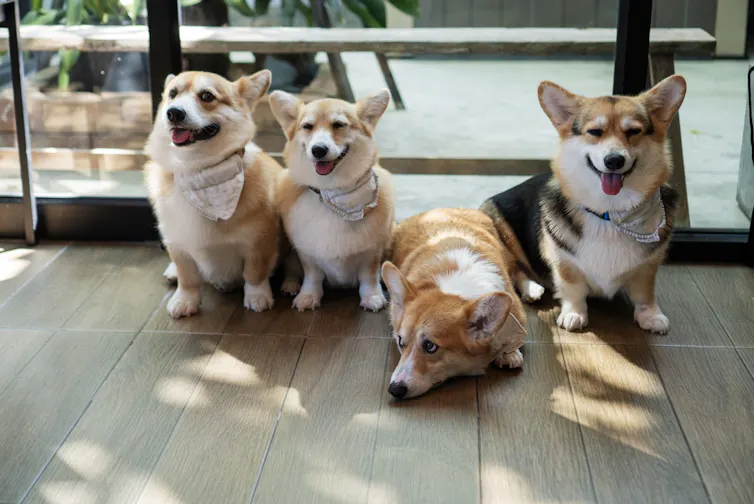
Kaewmanee jiangsihui/Shutterstock.com
This is important because dogs and cats need different things from our interactions with them. While dogs were domesticated for cooperation with humans, cats were domesticated to manage pests like rodents.
Cats have undergone far less intensive selective breeding than dogs, so they still share traits with the solitary and territorial wildcat – a fact that many owners can attest to. When it comes to understanding our feline friends, it looks like we might be quite bad at recognising when cats are displeased. In fact, those communication problems are also true with dogs – owners don’t always spot when they are anxious or uncomfortable.
Despite this, animals have been used to help improve human wellbeing since the 18th century and decades of replicated evidence doesn’t lie. But the quality and type of interaction between pet and person probably matter a great deal. If your cat curls up on your lap for a nap, your stress might just melt away. But if they want nothing to do with you and meow in sassy objection, then scooping up kitty for a cuddle might just frazzle you further.

Jodie Raybould works for Coventry University
Daniel Waldeck works for Coventry University