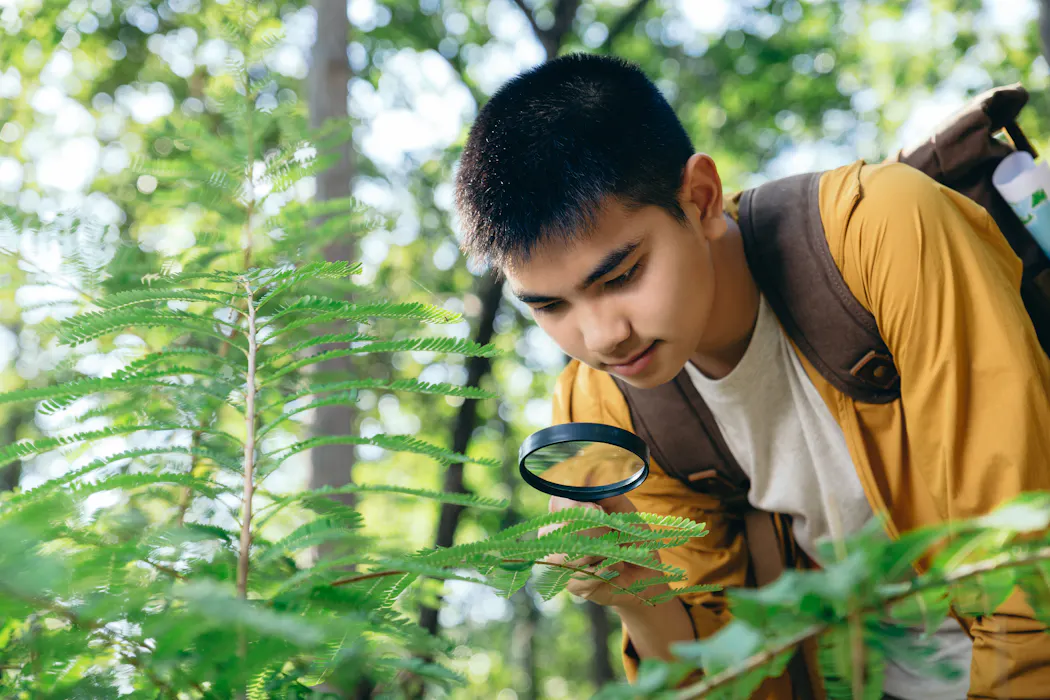
Most of my ecology and evolution undergraduates have never held a pair of binoculars or looked at a bug through a magnifying glass. They don’t know how to use a key to identify a plant or insect, let alone why they should bother. They struggle to name common garden birds. They expect to learn about biodiversity from behind the safety of a computer screen. Fieldwork is considered a luxury or an inconvenience, depending on your tolerance to rain.
It’s not the students’ fault. Ecology and evolution offerings in the biology school curriculum are slim pickings: blink and you miss them among a sea of cells and neurons. The education system has done little to nurture a curiosity and understanding of nature in real life.
This is about to change.
Fifteen years ago, environmentalist and author Mary Colwell started campaigning for the government to introduce a GCSE in natural history. It was a bold ambition.

PeopleImages/Shutterstock
The term natural history musters images of dusty museums and misshapen taxidermy. But there’s now so much evidence highlighting the benefits of connecting with nature. That includes research that shows how nature-literate kids are likely to be more resilient. Evidence also shows clear trends of a biodiversity crisis and rising concerns about our declining exposure to and experience of nature. This is what ecologists call the “extinction of experience” with the natural world.
After much campaigning and several setbacks, a draft curriculum has just been released for public consultation.
Read more:
Here’s how to create a more nature-literate society
This curriculum serves the field of ecology pretty well. Students will learn to identify native species found in grasslands, woodlands, urban and marine environments. They will learn about the dynamic relationships between species and the implications of human influence (including climate change) for habitats, ecosystems and species. This helps equip the next generation as effective stewards of the natural world, and it complements other subjects such as biology and geography.
But does it promise enough?
Noticing nature is the first step towards understanding it. We have become a nature-blind society: “plant blindness” is a term used to describe how we fail to see the most common wildlife (plants) under our noses. We need to re-learn the innate ability we all had as toddlers to notice the tiny creatures beneath our feet or the fractal patterns emanating through sunlit leaves.
This can only be done by directly experiencing nature. This new GCSE promises 20 hours of fieldwork. “It’s twice as much as geography GCSE,” boasted representatives from the Department of Education in a curriculum consultation I attended recently.
That equates to less than 15% of the total GCSE teaching time (150 hours). For comparison, GCSE PE has a more substantial practical component consisting of 30% teaching time – equivalent to 45 hours.
Twenty hours is an average of 15 minutes a week over a two-year GCSE. Hardly time to step outside, let alone find something that catches your eye, make notes about its appearance and behaviour then find the right identification key to name it. In a time-stressed world, noticing nature – really observing it closely, not just ticking species off a list – offers an excuse to slow down, be mindful and spark your curiosity.
Students need time to contemplate how specific plants, animals and fungi connect together into the tangled web of life. A nature-journal style assessment would help kids engage, remember, reflect and grow a real attachment and personal relationship with the wildlife they are learning about. It would offer cross-curricular links too, with art, biology, geography.
But let’s focus on the pros. There is fieldwork and it’s flexible. Teachers can adapt the curriculum to make the most of their local nature opportunities. It’s also a fantastic opportunity to explore the role of digital tools and monitoring technology (platforms like iNaturalist and Merlin Bird ID app) as ways to help children notice and name nature on their doorstep. That could be in their school grounds, local park or in pavement cracks on their walk to school.
Will urban kids be disadvantaged? With the right resources, hopefully not. Urban ecology is a rapidly growing research area, and green spaces are increasingly valued in cities and towns. With more than 60% of the world’s human population predicted to be living in cities by 2050, being tuned into urban nature is perhaps the most valuable skill of all.
The proposed curriculum focuses exclusively on UK habitats and species. This makes the content relatable. Despite our poor species richness, UK species are also the best described in the world. This is because, ever since the 1600s, we have been a nation of nature lovers obsessed with observing, recording and sharing our findings from nature. At least we used to be.
To understand UK nature, children need to meet Gilbert White – the 17th-century parson whose observations of wildlife in his garden transformed the way we look at (and record) the natural world.
White made people notice what organisms were doing, not just what they were. He popularised UK wildlife, giving rise to centuries of naturalists who shaped aspects of our culture, science and heritage today. A UK-based natural history GCSE that doesn’t capture our rich history of naturalists is not serving our children.
An interdisciplinary opportunity
This move for biodiversity education will certainly help narrow the nature literacy gap my colleagues and I see in ecology students at university.
I hope this qualification will be a success, widely adopted by all types of schools across the country. But will it appeal to prospective pupils and their guardians?
Pitching it as “a GCSE to teach teens to plant wildflower-friendly gardens” sets it up to be niche and middle-class before it even launches. Natural history is about so much more than planting wildflowers.
To widen the appeal, it’s important to emphasise the interdisciplinary relevance of the qualification.
That requires drawing links with health. NHS doctors are now prescribing green therapies such as park walks and gardening for patients. Nature is good for our health because we evolved as part of nature.
For many non-western societies, nature’s value is deeply spiritual. There is an opportunity to integrate learning on diversity, beliefs and multi-culturalism.
And there’s so much potential to integrate art. The original naturalists were artists. In observing nature carefully, they noticed anatomical structures, stages of metamorphosis, mimicry. Sketching nature – without judgment – to record its structure, form, behaviour and interactions, could bridge the age-old division between arts and sciences.

Seirian Sumner receives funding from UK government’s Natural Environment Research Council (NERC) and the Biotechnology and Biological Sciences Research Council (BBSRC). She is a Trustee and Fellow of the Royal Entomological Society, and author of the book ‘Endless Forms: Why We Should Love Wasps’.