The Scottish parliamentary election in May saw Reform UK return the same number of MSPs to Holyrood – 17 – as Scottish Labour. This remarkable result – effectively from a standing start – showed that the party is now a force to be reckoned with in Scotland just as in other parts of the UK. But where did it attract votes north of the border?
My analysis examines constituency-level patterns in support for Reform UK, compared with the other main parties. It focuses on three constituency characteristics: deprivation levels, whether it is classified as urban or rural, and centre–periphery location. The aim is to identify broad territorial patterns in party performance, rather than to draw firm conclusions about individual voters.
The figures discussed here are average vote shares across constituencies within each category. In other words, they show the average party result in, for example, more deprived constituencies compared with less deprived constituencies. This approach is useful for mapping the territorial profile of party support, but it should be complemented with individual-level data before drawing firm conclusions about voter motivations or social characteristics.
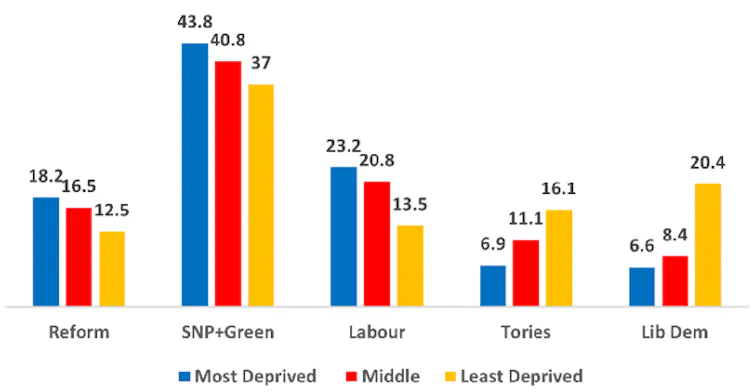
The first pattern concerns deprivation. Reform UK support appears to be higher in the most deprived third of constituencies than in the least deprived third. On this dimension, Reform looks closer to the SNP-Green and Labour pattern than to the Conservatives and Liberal Democrats, whose support is more concentrated in less deprived constituencies.
This does not mean that Reform voters are necessarily more deprived at the individual level, as constituency-level data cannot show this. But the aggregate pattern is still important. It suggests that Reform is performing relatively better in places where socio-economic pressures are more visible, and where dissatisfaction with existing political options may be more pronounced.
Party support and socio-economic territorial divide
Dr Davide Vampa, CC BY
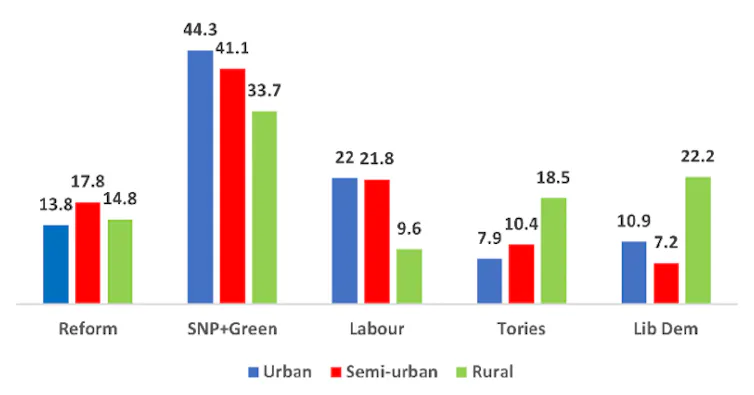
The urban-rural pattern points to a distinctive Reform geography. Reform appears to perform best in semi-urban constituencies, rather than in the most urban or most rural areas. This separates Reform from the Conservatives and Liberal Democrats, who perform more strongly in rural constituencies. It is also different from the SNP-Green vote, which is strongest in urban constituencies.
Semi-urban constituencies may be politically important because they often combine proximity to major cities with a feeling of distance from them culturally or socio-economically. These areas may therefore provide fertile ground for parties appealing to voters in places that are close to urban centres, but do not necessarily share fully in their economic opportunities, public investment or cultural politics.
Party support and urban–rural territorial divide
Dr Davide Vampa, CC BY
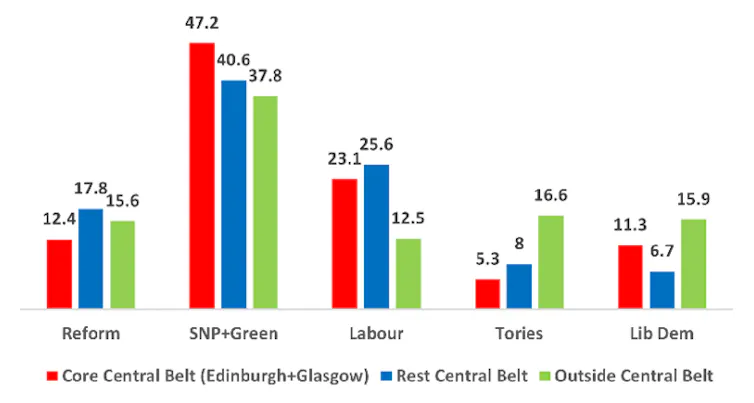
The centre-periphery divide adds another layer to this picture. Here, centre-periphery refers to three types of area: Edinburgh and Glasgow as the core of the central belt (Scotland’s main population corridor), other constituencies within the central belt but outside the two-city core, and areas beyond the central belt. Reform performs better immediately outside the Edinburgh-Glasgow political core than within it.
This pattern is again distinctive. The SNP-Green vote is more clearly concentrated in the core central belt, while the Conservatives are stronger in more peripheral constituencies. The Liberal Democrats display a U-shaped profile across the centre-periphery divide, performing relatively well both in core and more peripheral areas.
Reform’s profile is different: it is generally stronger in the periphery of the central belt than in the periphery of Scotland as a whole. In this sense, its geography is not simply one of rural or peripheral conservatism, but one of places within the central belt but outside its core. In other words, close to where political power is concentrated, but not fully part of it.
Party support and the centre-periphery divide
Dr Davide Vampa, CC BY
The contrast with the Conservatives is one of the most important findings. Reform UK’s pattern of support looks quite different from the Conservative map. While there may be overlap between the two electorates, Reform does not simply reproduce the traditional Conservative geography.
This matters because it challenges the idea that Reform’s support in Scotland can be understood simply as a Conservative splinter or replacement vote. Its territorial profile points to a potentially broader appeal, particularly in more deprived and semi-urban constituencies.
Overall, the results suggest that Scottish party competition is structured not only by ideology or national identity, but also by clear socio-economic and territorial divides. The SNP-Green and Labour vote is more urban and central, with some strength in deprived constituencies. The Conservative and Liberal Democrat vote is more rural, peripheral and less deprived.
Reform UK occupies a distinctive position: more deprived than the Conservative map, more semi-urban than rural, and stronger outside the core central belt without simply replicating the geography of established unionist parties.
These findings remain preliminary. Still, the constituency-level evidence suggests that any serious analysis of Reform UK’s performance in Scotland needs to take these territorial divides seriously.
A version of this article appears in the Scottish Election Analysis 2026.

Davide Vampa receives funding from the Royal Society of Edinburgh for the project “Populist Radical Right Politics in Devolved Contexts: The Rise of Reform UK in Scotland in Comparative Perspective.”