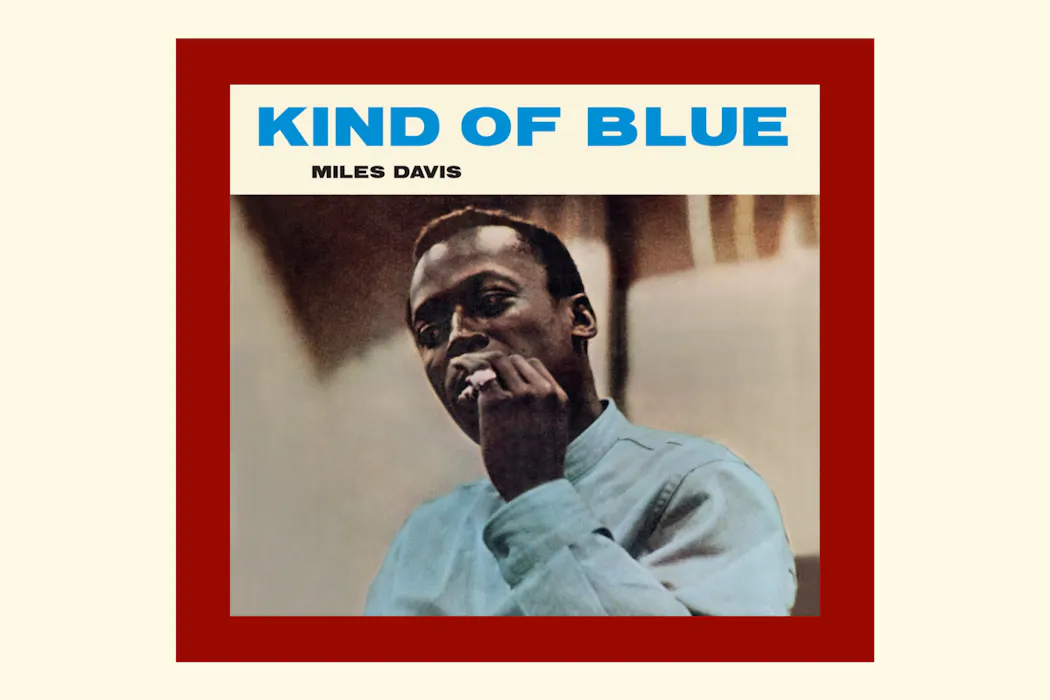
There are many things about Miles Davis to remember as we mark 100 years since his birth. There’s the 1950s and 60s elegance and lyricism, with his Harmon muted trumpet, the tone of which was once said to sound like “a man walking on eggshells”. There’s his badass attitude taking no bull from anyone, with a particular invective for the racism of America. Most of all there is his fearless innovation, always reaching for sounds unheard.
As the late (much lamented) writer and musician Greg Tate wrote: “Miles Davis was a musician you could set your atomic clock to: check in every five years or so and you’d find him a parsec ahead of everyone else.”
But this was a hazardous approach that had a price. In 1969, Davis admitted to jazz journalist Hollie West: “I have to change, it’s like a curse.” Part of that price was the risk of failure, at least by his own exacting standards.
And so, we turn to Kind of Blue (1959). It’s the highest selling jazz record of all time, (multiple times platinum); only it wasn’t quite what he was after. In 1959, a spellbound Davis saw Les Ballet Africaines (the national dance company of Guinea founded in the early 1950s) and found his next direction. In his 1989 autobiography, Miles, he wrote:
I knew I couldn’t do it from just watching them dance because I’m not African, but I loved what they were doing. I didn’t want to copy that, but I got a concept from it.
It was the sound of the “finger piano” (mbira or kalimba), in particular, that inspired him. He set about combining that impression with a love (shared with his new pianist Bill Evans) of composer Maurice Ravel’s Concerto for the Left Hand and Orchestra (1930), and half remembered sounds from his childhood “back in Arkansas, when we were walking home from church and they were playing these bad gospels”.
To chase the sound he was after, Davis employed the emerging “modal” approach. This meant essentially basing his new music on diatonic scales (think the basic seven notes do-re-me … but with the option to make any of them the “home” note) instead of the frenetic chord progressions of bebop. Despite being an important player in bebop, in his autobiography Davis recognised that the music of “Diz and Bird … wasn’t sweet” and “didn’t have harmonic lines that you could easily hum”.
This fusion of apparently disparate elements produced something of a paradox: a completely uncompromising jazz record (all the recordings were first takes), which has proved to be effortlessly accessible. But despite Kind of Blue’s winning lyricism, Davis, in his autobiography, is mildly self-reproachful:
When I tell people that I missed what I was trying to do on Kind of Blue, that I missed getting the exact sound of the African finger piano up in that sound, they just look at me like I’m crazy. Everyone said that record was a masterpiece – and I loved it too – and so they just feel I’m trying to put them on. But that’s what I was trying to do on most of that album, particularly on All Blues and So What. I just missed.
Of course, being Davis, he largely abandoned that approach, so that by 1964 he had a completely new group of young musicians and was reaching for the outer spheres of what was possible with acoustic jazz. This was a trajectory that by 1969, saw him “going electric” with the uncompromising Bitches Brew (1969), also a stunningly successful album. But that is another story.
This article features references to books that have been included for editorial reasons, and may contain links to bookshop.org. If you click on one of the links and go on to buy something, The Conversation UK may earn a commission.

Richard Worth does not work for, consult, own shares in or receive funding from any company or organisation that would benefit from this article, and has disclosed no relevant affiliations beyond their academic appointment.