
The government has promised a new era of youth justice reform focused on protecting vulnerable children and reducing harm.
At the same time, new evidence exposes uncomfortable truths about strip-searching in police custody. This is one of the most intrusive powers available to police behind closed doors, and is particularly harmful for children and other vulnerable people.
Evidence has long shown that black, Asian and minority ethnic people are disproportionately subjected to the practice. Racial disparities appear particularly pronounced among children.
In newly published research, my colleague Abi Dymond and I examined more than 25,000 custody records collected by an English police force between 2018 and 2022 to better understand what predicts strip-searching in custody. Using statistical modelling, we controlled for offence type, factors such as mental health and self-harm, use of force and time of arrival.
Even after accounting for all of these factors, black detainees remained more than twice as likely to be strip-searched as their white counterparts. These findings align with existing evidence showing persistent racial disparities in the use of strip-searching.
This level of analysis has rarely been possible before, partly because consistent, detailed data is difficult to obtain. It is also complicated by the fact that the legal threshold for strip-searching is not clear-cut.
In some custody suites (where police process and detain people within a police station), detainees may be required to change into anti-rip clothing designed to reduce the risk of self-harm. Following a 2015 court ruling, this can legally constitute a strip-search. Custody sergeants, who are responsible for overseeing detention and welfare of people in custody suites, hold considerable discretion over when and how the power is used.
One possible explanation for the racial disparities is that black people are disproportionately policed for drug offences. Drug arrests are themselves strongly associated with strip-searching, as officers may suspect detainees of concealing substances.
When we controlled for arresting offence, including those relating to drugs, the racial disparity reduced slightly. But, all else being equal, black detainees remained more than twice as likely to be strip-searched compared to white detainees. In other words, offence type explains some of the picture, but it does not explain the pattern.
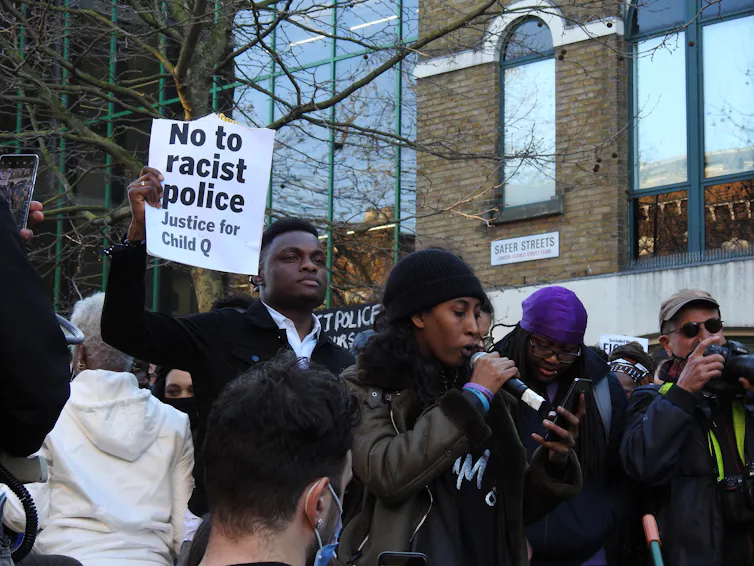
Even more striking is what happens when you look at how race intersects with other characteristics. The case of Child Q, a black schoolgirl strip-searched by police at her London school in 2020, raised concerns about “adultification”. This is the tendency to treat black children as older, more culpable and less deserving of protection than their white peers.
Our findings lend weight to those concerns. We found that black children faced significantly higher odds of being strip-searched than would be expected from either race or age alone. We found a similar pattern when examining race and gender together, with black men also facing disproportionately high odds of being strip-searched.
The only comparable study, conducted more than two decades ago in a single London custody suite, found strikingly similar results. Black detainees faced higher odds of strip-searching that could not be explained by offence type alone. But that study was not able to examine how race interacted with age and gender.
Our study, conducted nearly 20 years later in a police force serving a predominantly white, rural area, finds the same pattern. It also shows that disparities become even sharper at the intersection of race, age and gender. We found that black men had 2.3 times the odds of being strip-searched compared with white men, while black children faced around 3.5 times the odds compared with white children, even after adjusting for offence type and other relevant factors. Different place, different time, different data and still the disparities remain.
The harms of strip-searching
Official guidance for police in England and Wales states that searches should be carried out with “respect and dignity”. Yet people who have been strip-searched consistently describe their experience as “degrading”, “humiliating” and traumatic.
Strip-searches in custody are often justified on safeguarding grounds, for example to manage risks relating to self-harm and detainee safety in custody.
heardinlondon/Shutterstock
In our study, detainees with mental health concerns, histories of self-harm or substance use each had higher odds of being strip-searched, even after controlling for other important factors.
These findings are consistent with what has been described as an increasingly “risk-averse” approach by police, where officers adopt more precautionary and intrusive forms of risk management in custody settings. But a focus on officers managing risk can make the harms of strip-searching easier to overlook.
We also found that detainees against whom force was used against in custody were nearly five times more likely to be strip-searched. We cannot establish the order in which these events occurred, as force may in some cases have been used to carry out the search. But it also raises an uncomfortable possibility that strip-searching can sometimes function less as a safeguarding measure and more as a response to perceived non-compliance. A penalty perhaps for those who do not go quietly.
The previous government proposed amendments to the Police and Criminal Evidence Act intended to strengthen safeguards around strip-searching, although there has been no indication that the current government plans to take these proposals forward. While welcome in principle, procedural safeguards alone will do little to address the deeper patterns our study reveals.
When the language of care and safeguarding consistently produces worse outcomes for black men, children and other vulnerable people, society must confront what that says about the exercise of police power itself. Ultimately, the responsibility for managing risk cannot be divorced from the responsibility not to inflict harm.

Amal Ali has previously worked on research projects funded by the College of Policing and the Mayor’s Office for Police and Crime (MOPAC).