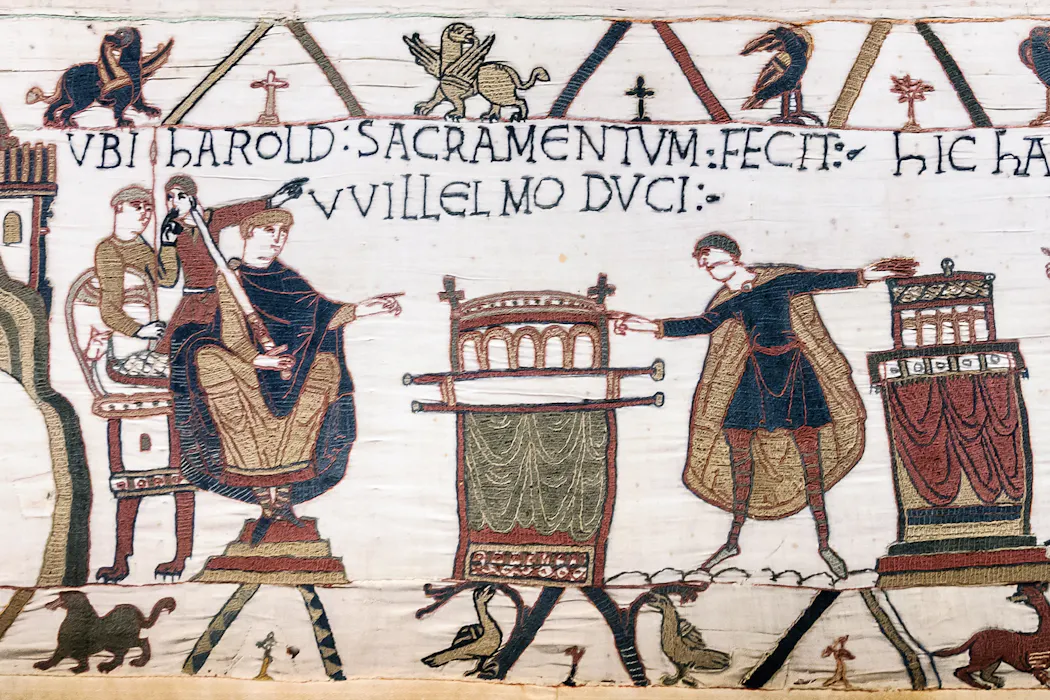

As the Bayeux Tapestry comes to London, the year 1066 and the Norman Conquest are in the spotlight. The tapestry – an embroidered cloth nearly 70 metres long, created soon after the events it depicts – tells the story of the Battle of Hastings in 1066 and William of Normandy’s triumphant defeat of Harold Godwinson, King of England.
The tapestry depicts William of Normandy as the victor, and Harold as a slippery oath-breaker who promises the English throne to William then goes back on his word. But it shows little of the wider impact of the battle on English people – except for one glimpse, just after William’s ships land at Pevensey on England’s south-east coast, when we see a woman and child fleeing a burning building, torched by Norman soldiers.
So what did 1066 feel like from an English perspective? What was it like to live through the Norman Conquest? Remarkable English documents, written in the thick of events, give us an astonishing insight into the side of the story not depicted on the famous tapestry.
The battle on October 14 1066 had far-reaching consequences for England (and later, more of Britain), as the land passed into Norman control. By 1086, only 8% of the total landed wealth of England was still held by English people, with the other 92% in Norman possession. Language, culture and tradition were trodden under the feet of the new occupying force.
Even more than a century later, the Conquest remained a raw and open wound. Around 1196, the English monk William of Newburgh writes that, whenever it rains, the battlefield at Hastings “sweats real and seemingly fresh blood”.
But some English sources have the power to take us right back into 1066 itself.
Contemporary accounts
The Life of King Edward (Vita Ædwardi Regis), was written between 1065 and 1067 and so takes us through the Norman Conquest in real time. The Life was commissioned for the wife and widow of King Edward the Confessor, Edith, who was also the sister of his successor King Harold II. It was written in Latin, probably by a Flemish monk. It’s a clever piece of political spin, setting out to bolster Edward’s reputation – including his posthumous standing as an emerging new saint.
But, unexpectedly, The Life of King Edward finds itself in the teeth of the Norman Conquest, where it struggles to find words for the devastation that has struck England and its ruling dynasties.
Book I of The Life was completed before the Battle of Hastings and deals with the exploits of the powerful Godwin family, including Edith’s father, Earl Godwin of Wessex, and her brother, Harold – who caught an arrow in the eye (probably) at Hastings.
Book II of the Life opens in crisis and despair. In the silence between the books, the Battle of Hastings has happened. Now, Edith’s husband Edward and her brothers (Harold, Leofwine and Gyrth, as well as Tostig who died at Stamford Bridge) are dead, together with other English nobles and perhaps four thousand English fighters. England’s power lies in tatters.
The writer appeals to Clio, muse of history, for help, as he desperately searches for words. “Alas!” the text exclaims, “What will you say?”
What’s fascinating here is that we don’t actually get a direct account of 1066. Instead, the author of this text is dumbfounded. What we see is a writer reeling from this catastrophic blow to the English ruling elite, talking us through the impossibility of his attempt to chronicle it. Shocked silence speaks louder than words, letting us in on the trauma of the English defeat.
How can anyone articulate the horror that has just unfolded? “What madman,” the author asks, “could write of this?” And how can he present this book to his noble patron, Edith, when – instead of a celebration – it’s now a catalogue of personal loss and the kingdom’s ruin?
Today, the Bayeux Tapestry is incomplete, its final scenes lost long ago. Scholars presume it ended with a depiction of William’s triumphant coronation as King of England. The Life of Edward, instead, shows us an alternative ending: loss, grief and desolation for the English.
Moving to later, a generation after 1066, we find a more considered, deliberate response to the Norman Conquest from defiant English voices.
Monks at Peterborough Abbey continued making year-by-year additions to their monumental Chronicle of English history (often called the Anglo-Saxon Chronicle), written in monasteries across England since the time of King Alfred the Great.
On the death of William the Conqueror in 1087, the monks wrote an epitaph – a poem summing up the life of this mighty king and his legacy. The first line takes us straight inside the reality of life under Norman occupation.
Castelas he let wyrcean ond earme men swiðe swencean
(He had castles built and wretched men sorely oppressed)
We glimpse the militarised landscape engineered by the Normans, with castles – their new technology of war and control – built across the country.
The Chronicle poem laments William’s “harshness”, his greed and cruelty to his people. Spitting with irony, it reflects on how he loved his royal forests, lavishing care on boars, hares and stags, while his destitute subjects would be blinded for killing a deer.
“Woe, alas,” the poem proclaims, “that any man should be so proud, / raise himself up and reckon himself over all men”. Just as William has tallied up his new possessions in England – the record of his lands and property in the great Domesday Book – the Chronicle poem takes its own cool and careful accounting to William’s life, and finds it wanting. This is guerrilla poetry, written in English, quietly holding out against the consequences of 1066.
Beyond the Bayeux Tapestry, these medieval documents remind us that every story has another side, and that history is not written only by the victors.

Catherine Clarke does not work for, consult, own shares in or receive funding from any company or organisation that would benefit from this article, and has disclosed no relevant affiliations beyond their academic appointment.