Indie sleaze is back, but not as you remember it. The 00s scene’s revival taps into a growing backlash against hyper-polished influencer culture, offering a messier, more authentic alternative that feels both nostalgic and deliberately staged.
The original indie sleaze look of the 2000s was an intentionally unrefined way of dressing, driven by a desire to stand apart from mainstream fashion, with a carefully constructed sense of effortless cool.
The look was built from a recognisable set of clothing and styling details.
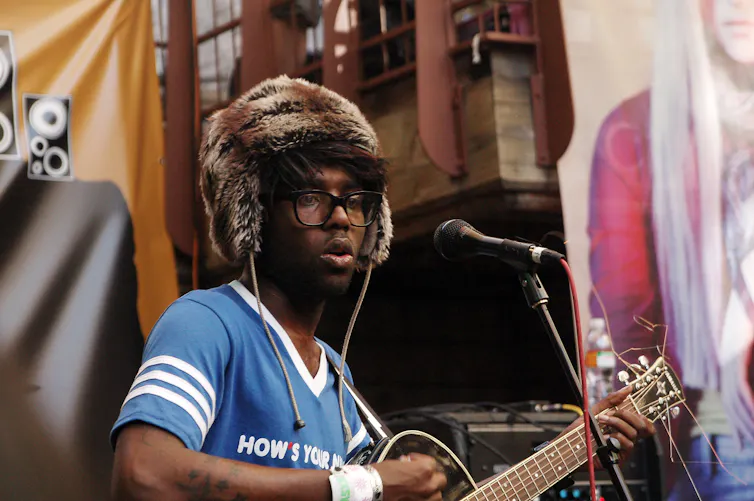
Black or acid-wash skinny jeans were central, paired with vintage T-shirts featuring band logos or bold graphics. Leather biker jackets reflected indie and punk influences, while sheer tights, often with rips or ladders, were styled with body-con dresses and oversized knits worn over mini-skirts. Footwear reinforced the relaxed, undone feel with worn-in Dr Martens, Converse and ballet flats completing the look.
Culturally, the trend was rooted in the indie music scenes and nightlife cultures of cities like London and New York. Bands like The Strokes, Arctic Monkeys, The Libertines and Yeah Yeah Yeahs influenced the style by popularising a deliberately dishevelled, off-duty look that blurred the line between stage wear and everyday dress.
The style was also worn by well known models such as Kate Moss and it girl Alexa Chung. These women brought the look to a wider audience, as they captured its mix of nonchalance and effortless styling in front of the camera and across early digital media.
No one’s 20s and 30s look the same. You might be saving for a mortgage or just struggling to pay rent. You could be swiping dating apps, or trying to understand childcare. No matter your current challenges, our Quarter Life series has articles to share in the group chat, or just to remind you that you’re not alone.
Read more from Quarter Life:
-
Why Charli XCX might be gen Z’s answer to the Romantic poets
-
Is today’s political climate making dating harder for young people?
The origin of indie sleaze
Indie sleaze emerged just before social media became fully embedded in everyday life. While early platforms like Tumblr played a role in circulating party photography and candid, flash-heavy imagery, the moment still felt more spontaneous and less controlled. It was a time before style was divided into “aesthetics” and “cores”, when young people dressed a certain way because they were part of a scene, not because they had discovered a neatly packaged, shoppable trend online.
As such, the original indie sleaze sat at a transitional moment, where subculture, style and digital self-presentation began to merge, but had not yet become fully commodified.
The indie sleaze revival taps into a desire for something that feels raw, imperfect and less controlled, in contrast to today’s hyper-curated digital environment. What makes indie sleaze appealing to a new generation is perhaps not simply how it looked, but what it allowed – messiness, excess, emotional openness and a rejection of constant self-improvement.
But there’s a contradiction. The original indie sleaze was socially driven, shaped by nightlife and real-world scenes, whereas the 2026 version exists within a culture that is far more curated. In many ways, the “sleaze” is missing. What remains is a stylised version of messiness.
The current revival grows out of the Y2K trend (a revival of early 2000s fashion and aesthetics), but it’s best understood as a reaction or mutation of it rather than a continuation. The initial Y2K revival (late 2010s into early 2020s) was glossy and hyper-feminine, reintroducing early‑2000s silhouettes like low‑rise jeans, micro bags, butterflies, neon and logo culture.
Indie sleaze draws on a similar era, but strips away the polish. Where Y2K is shiny, indie sleaze is grimy. Where Y2K is cute and curated-for-pretty, indie sleaze is curated-for-attitude. This is where the looks overlap. Neon carries over but is used abrasively rather than playfully. Ballet flats reappear but styled with sheer tights and dark makeup rather than the sweet and girly aesthetic from before. The low-effort silhouettes remain but are framed as emotional and anti-glam rather than flirty.
Daniel L. Locke/Shutterstock
Culturally, there remains a strong link to both a musical and digitally social narrative. Take for example the song Messy, by Lola Young. Not only does the artist herself confirm to the semiotic iconography of the look with her unprettified dark, smudged makeup, heavy boots, leather, denim and oversized silhouettes, but the song itself communicates a message of messiness. Not in a chaotic party sense, but in its emotional exposure.
Lyrically the song explores themes of rejecting polite femininity; she’s too loud, too emotional, too much and she’s not interested in fixing that. That attitude translates into what indie sleaze represents today. The refusal of optimisation, acceptance of visible flaws and leaning into excess rather than managing it away.
The resurgence also reflects how we now engage with the past through platforms like TikTok and Instagram, where cultural moments are converted into digestible visual codes. Indie sleaze is no longer a subculture but an archive of recognisable signs: smudged makeup, flash photography, slip dresses, battered leather. These reference points are easy to remix and circulate, making the trend especially suited to algorithmic spaces and inseparable from digital culture, even as it romanticises pre-digital freedoms.

The authors do not work for, consult, own shares in or receive funding from any company or organisation that would benefit from this article, and have disclosed no relevant affiliations beyond their academic appointment.