Polling company YouGov has thrown into question claims of a recent upsurge in church attendance among young adults. This has not surprised some experts, who cite evidence for the more conventional story of steep religious decline. If Christianity was once central to British society, that claim remains difficult to sustain in the 21st century.
Church membership and attendance have both fallen sharply in recent decades. In England, 11.7% of the population attended church on a typical Sunday in 1979. By 2005, that figure had dropped to 6.3%. The number of people identifying as Christian remained much higher for longer, still above 70% in England and Wales in 2001.
Read more:
There may not be a Christian revival, but Britain’s traditional churches aren’t doomed
Perhaps this was because Christianity continued to function as a marker of national identity or moral inheritance, rather than active belief or practice. Research has shown how, especially for older generations, Christianity retained associations of moral propriety, ethnic identity and national belonging. For some, to be British was to be Christian.
But that tendency too has fallen fast. According to the 2021 census, the proportion identifying as Christian had dropped to 46.2%.
The reasons for this decline are varied and complex. Traditional religious beliefs face widespread scepticism. Cultural pluralism has weakened the assumption that Christianity provides the country’s shared moral framework. Churches have not escaped the collapse in confidence that has affected institutions more broadly, while abuse and corruption scandals have accelerated public cynicism and disillusionment.
But that is not the whole picture. The newly appointed Archbishop of Canterbury faces an uphill struggle to restore confidence in a struggling Church of England. But Christianity still retains the power, in some settings, to build community and inspire commitment.
Changing church communities
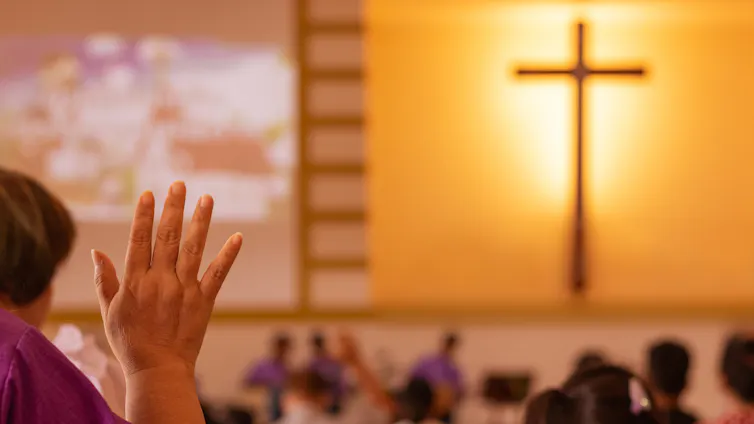
In Britain today, the most active, vibrant and socially engaged forms of Christianity are often found among ethnic minority and migrant communities.
Black Pentecostal churches seem to resist wider patterns of decline. Some have very large congregations, significant financial resources and real influence in urban centres such as Birmingham and parts of London.
Many were founded in the 1960s and 70s by Afro-Caribbean migrants who encountered the same racial prejudice in British churches that they faced elsewhere in society. Others owe their origins to Pentecostal networks in West Africa. Reporting over 12,000 weekly attendants at its “Prayer City” in Kent, Kingsway International Christian Centre claims to be “the largest growing church in western Europe.”
From the perspective of a moribund Church of England, these black majority churches represent a Christian vitality that many Anglican congregations struggle to sustain.
Research has also identified lively churches attracting Christians of Asian heritage, especially international students at British universities. Others have pointed to the revitalising effect of Eastern European migration on Roman Catholic parishes.
Puttipong Klinklai/Shutterstock
This may be one reason the political right has taken such a keen interest in Christianity in recent years. Nigel Farage has linked British identity to “Judeo-Christian principles”. Speaking in the House of Commons, former Conservative, now Reform MP Danny Kruger called for a recovery of a “Christian politics”. He contrasts this with “wokeism”: a “dangerous ideology of power” which should be “banished from public life”. Reform-adjacent campaigners, meanwhile, have made no secret of their hostility to Islam.
Some are reclaiming Christianity as part of a symbolic defence of British nationalism. At the Unite the Kingdom rally in London in September 2025, campaigners carried wooden crosses and chanted “Christ is King”. Far-right activist Tommy Robinson has leaned more heavily into Christian nationalist rhetoric, as has Restore Britain founder Rupert Lowe.
If Christianity can offer belonging and solidarity to black migrants navigating a hostile environment, it has also become, in a very different register, a badge of white ethno-nationalism.
Christian nationalism in Britain
The fusion of Christianity and far-right nationalism has a long history in the US. What is unusual is its growing visibility in the UK, which never really had its equivalent of the US Christian right. There are signs that a US-style conservative Christianity may be gaining ground in the UK.
The UK’s Christian Legal Centre resembles US organisations defending the right to affirm Christian values in the workplace. Defendants have included a homelessness officer dismissed from a job at a local council after telling a woman with an incurable illness to “put her faith in God”, and a magistrate fired for objecting to an adoption application from a same-sex couple. Both lost their cases.
Funding from the American Christian right has reportedly fuelled European campaigns promoting conservative perspectives on LGBT issues and the status of women.
This convergence of evangelical conservatism constitutes only a small minority of practising Christians in the UK. If Christian nationalism is becoming more visible, it is not because this minority is necessarily growing in size and power, but because political activists have found that Christian language resonates with their message. And they have become increasingly willing to borrow from the rhetoric of their American political allies.
This is reflected in the increasing affinity between British rightwing politics and the “Make America great again” (Maga) movement. It also points to growing momentum behind a more aggressive use of Christianity in British political life: not as a faith of worship or service, but as a nationalist weapon aimed at defending a particular form of British culture.
While it is currently not possible to gauge the size of a UK strand of “Christian nationalism”, its political, rather than religious, focus means its supporters are not limited to practising Christians. As with its US equivalent, they are more preoccupied with questions of national identity and cultural legitimacy – who belongs and who does not – than with questions of religious truth or practice.
This Christian nationalism foregrounds a common set of enemies: globalism, liberal morality, immigration and Islam. All are presented as inimical to the values of ordinary British citizens, echoing the Christian nationalism of Donald Trump’s America.
Some British Christian leaders have already pushed back against this message, emphasising Christian values of hospitality and compassion and seeking distance from Reform UK. But when they represent churches whose moral and political authority has largely ebbed away, this may not be enough to prevent a US-style Christian nationalism from gaining traction in the UK.

Mathew Guest does not work for, consult, own shares in or receive funding from any company or organisation that would benefit from this article, and has disclosed no relevant affiliations beyond their academic appointment.