For the first time since Viktor Orbán came to power in 2010, the Hungarian electorate is faced with a genuinely competitive campaign ahead of the 2026 general election on April 12.
For the past 16 years, Prime Minister Orbán’s party Fidesz has dominated. Faced with smear campaigns and attacks portraying opponents as a threat to national interests and sovereignty, any opposition has been fragmented and ineffectual, held together by uneasy alliances.
This time round, however, Fidesz’s hold is threatened by a single challenger, the Respect and Freedom Party (Tisza), which is currently leading by around 20 percentage points in the polls. Founded in 2020 and led by Péter Magyar since 2024, this centre-right party positions itself as a cross-ideological alternative. Its main focus is tackling government corruption and improving living standards and public services. Its international stance is pro-European and unifying.
The 2026 contest comes at a time of economic strain and growing public dissatisfaction. Hungary is one of the EU’s poorest member states. It also ranks among the most corrupt in international indices. Voters are therefore not just choosing between parties, but between the continuation of an entrenched system and what the Tisza is framing as a regime change.
Hungary is widely described as a competitive autocracy. Elections are regularly held, but the government dominates most of the media and benefits from institutional rules that favour it. Research bears this out. Campaigns in competitive autocracies occur in constrained information environments: governments dominate the media, limit opposition visibility, and, as studies I have contributed to show, often disseminate misinformation from the top.
Wikimedia, CC BY
.jpg)
Increased public engagement
Fidesz has reshaped the country’s political system in ways that help it retain a durable electoral advantage. Since 2010, televised debates have disappeared from election campaigns. Around 85% of the media is now controlled by pro-government outlets that often convey identical narratives.
In line with these constraints, the government’s rhetoric has centred on security for over a decade. In 2022, Russia’s invasion of Ukraine gave new momentum to the Fidesz campaign. It framed the opposition as pro-war. Campaign events were held in controlled settings, with Orbán appearing in pro-government media and smaller local events.
The 2026 election campaign has been different. Orbán is now campaigning more actively across the country. While he has continued to claim that the opposition, aligned with Ukraine and the EU, would take Hungary to war, he has been making frequent appearances and directly engaging with voters. Other government figures have also taken on a more visible role. Ministers are touring the country and appearing at campaign events.
The party has also made efforts to strengthen its social media presence as a way to distribute pro-government messages.
Despite this, the government’s control over the campaign agenda has been less stable than in previous elections. Increased exposure has come with greater risks.
High-profile party members have generated public controversy. In January, transportation minister János Lázár drew ire for comments he made about the country not needing foreign labour, in which he also insulted Hungarian Roma.
Elsewhere, there have been confrontations at campaign events, where protesters have openly challenged the prime minister and black-clad security personnel have intervened. Anti-government protests at these events have also multiplied, reflecting this more direct and less controlled campaign environment.
Robust opposition
This shift is in direct response to the challenge Tisza poses. The party emerged as a major contender following the 2024 European parliamentary elections.
Magyar is a former Fidesz member and the ex-husband of the former justice minister Judit Varga. He entered frontline politics in early 2024, distancing himself from the government following the presidential pardon scandal, which led to the resignation of both Varga and president Katalin Novák. He later released a recording of Varga referring to alleged interference in a major corruption case.
He has spent the past two years touring the country and building local Tisza organisations. In his speeches, streamed on social media, Magyar often responds within hours to government-related developments then returns to them in later appearances. Following allegations of intelligence interference targeting his party, he quickly incorporated the issue into his campaign.
Cost of living
This campaign is unfolding against a backdrop of difficult economic conditions. Inflation is high, living costs are rising, the economy is stagnant. Research shows that competitive authoritarian governments, like Orbán’s, use propaganda to shape media narratives and reduce the salience of economic problems for voters. Tisza, by contrast, has made living standards a central theme.
In the final weeks of the campaign, Magyar has emphasised the argument that Orbán’s government is aligned with Russia and highlighted concerns about election rigging as a basis to call for electoral reform. Orbán has struggled to push back on all counts and has found itself unable to shift the campaign agenda back towards security issues.
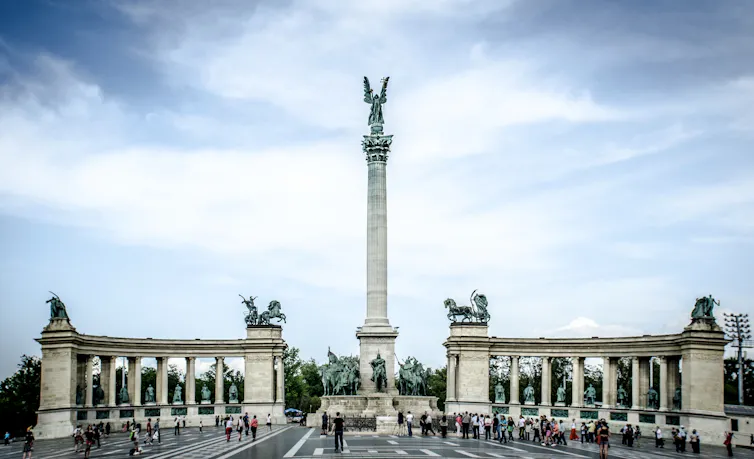
Magyar’s party has also demonstrated its ability to connect to the public. On March 15, a key national holiday marking the 1848 Revolution, Tisza held a rally in Heroes’ Square, Budapest, rivalling the government’s own peace march. Sources vary on the scale of both events. Fidesz quoted the Hungarian Tourism Agency’s figures of 180,000 people at the government’s march, and 150,000 at Tisza’s. Politico quoted sources close to the opposition estimating their attendees numbering over 350,000.
In his speech at his march, Orbán again framed the election as a contest between peace and war, casting it as a decision between himself and Ukrainian President Volodymyr Zelenskyy. Magyar, however, used national symbols and historical references to present the vote as a decisive turning point in Hungary’s political direction.
For years, Fidesz shaped campaigns on its own terms, limiting uncertainty. The current campaign shows that this control can be disrupted: rather than responding to government attacks, the opposition has set the agenda by elevating issues that mobilise public attention, forcing the government into a more competitive mode of campaigning.
This election therefore presents the possibility of more than a routine change of government. It could mark a turning point for the political system. Whether or not such a shift materialises, the campaign demonstrates that even in constrained environments, ruling parties can be pushed into forms of competition more typical of democratic settings. Once this happens, structural advantages no longer compensate for the strategic demands of open contest.

Zsofia Bocskay does not work for, consult, own shares in or receive funding from any company or organisation that would benefit from this article, and has disclosed no relevant affiliations beyond their academic appointment.