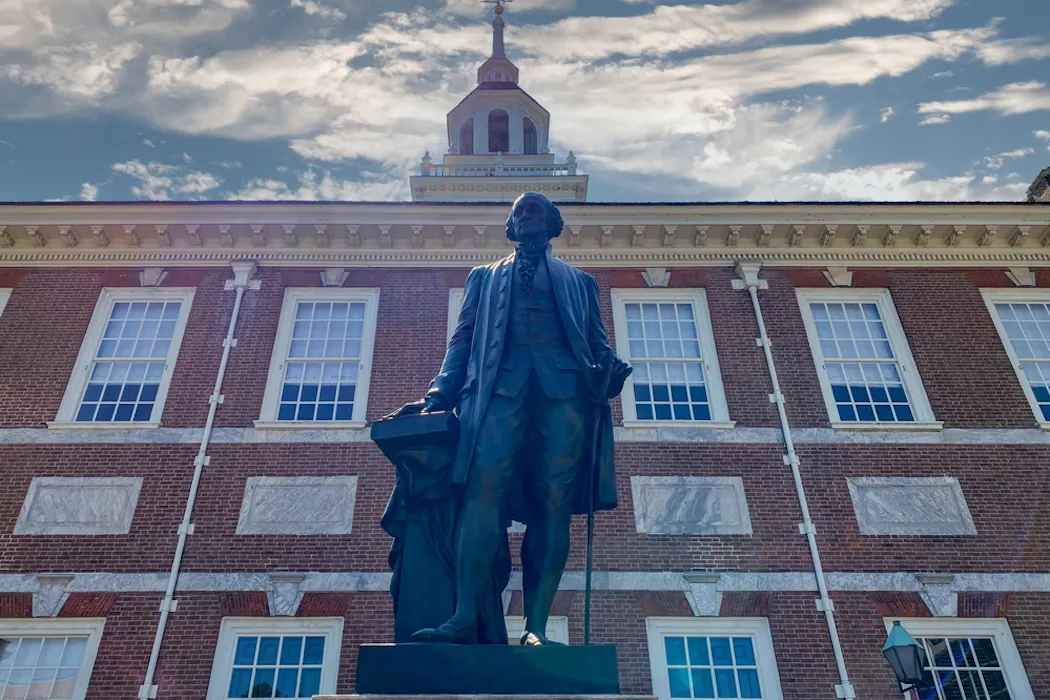
The 250th anniversary of the US Declaration of Independence has become yet another flashpoint in a politically divided America. There are even two different government organisations overseeing the celebrations.
The United States Semiquincentennial Commission was set up by the US Congress in 2016 as a bipartisan body to oversee the semiquincentennial celebration and signed into law by Barack Obama. They branded the celebration as America250 and set to work to plan the national jamboree.
Freedom 250, meanwhile, was set up by the Trump administration under the supervision of the White House Task Force on Celebrating America’s 250th Birthday. Federal funds were diverted from the congressional commission towards the events planned by the Trump-aligned celebration.
But more important than the squabbles over who owns the celebrations, the boycotts of the Great American State Fair or the controversies surrounding celebratory monuments such as the 250-foot triumphal arch, dubbed by its critics the “Arc de Trump”, are the battles being fought over whose interpretation of history will be presented as the nation looks back over its first 250 years.
The commemorative celebrations are being run through the National Park Service, part of the Department of the Interior. One of its most important monuments, the President’s House memorial in Philadelphia – where the first two presidents, George Washington and John Adams, lived and worked when the city served as America’s capital in the 1790s – has been at the centre of a controversy over competing interpretations of history.
This goes back to the early weeks of Trump’s second term. In March 2025 he issued executive order 14253: Restoring Truth and Sanity to American History. The order requires the Department of the Interior to ensure that the educational materials in its jurisdiction – including the national parks – do not “inappropriately disparage Americans past or living (including persons living in colonial times), and instead focus on the greatness of the achievements and progress of the American people”.
It also ordered the restoration of sites removed or changed since 2020, when Confederate monuments had been removed in response to the Black Lives Matter movement. Finally, it charged vice president J.D. Vance with implementing the same policies at the Smithsonian Museum.
In November 2025 an administration official, Jeffrey Anderson, published an essay alleging that “woke orthodoxy” had hijacked America’s story. This was circulated to members of the Trump administration. The President’s House, he wrote, focused too much on the evils of slavery. There was not enough information about the achievements of the men who lived and worked there.
Working under the Secretary of State for the Interior’s order implementing the president’s executive order, the national park service began the removal of historical panels in places of national significance early in 2026. This included the President’s House memorial in Philadelphia.
Washington had infamously brought his slaves with him to the house and had moved them every six months to avoid Pennsylvania’s emancipation laws. The President’s House exhibit had told this story, something that Anderson’s essay had particularly objected to. This and other explanations of US history deemed to “inappropriately disparage Americans past” were removed.
Legal battle
The City of Philadelphia, which had been instrumental in the development of the President’s House site, took the administration to court over the decision. The administration’s lawyers argued that: “Ultimately, the government gets to choose the message it wants to convey.”
Presiding judge, Cynthia M. Rufe, disagreed. In a decision comparing the administration’s actions to the Ministry of Truth in George Orwell’s novel 1984, Rufe held that the US government does not have the power to “dissemble and disassemble historical truths when it has some domain over historical facts”. She ordered the removals stopped and anything removed under the order to be replaced.
On June 18, her decision was unanimously overturned by the Third Circuit Court of Appeals. In a decision written by prominent conservative judge, Thomas M. Hardiman, the court held that the city had no “statutory, property, or contractual rights that
empower it to curate the exhibits in the President’s House”. His judgment praised the historical context provided by the replacement panels.
Activists and government officials disagree with Judge Hardiman, and so do Philadelphia’s tour guides. At the open-air site, volunteers share copies and read aloud from the removed intepretative panels.
The legal battle to oppose Trump’s executive order is not over. A coalition of interest groups sued the Department of the Interior, challenging the lawfulness of the removal of hundreds of exhibits and markers across the US, including the President’s House.
Less than a week before Philadelphia lost on appeal, federal judge Angel Kelley found that the government was seeking “to rewrite the Nation’s history with a white-out pen”. She ordered the government to stop removing the signs, exhibits and artefacts and return those that had already had been removed by July 3. In her view, the government had rushed to remove the items in time for July 4 and “it is equally important that our shared history be honestly told and fully restored by the 250th Anniversary”.
That order has now been paused by the First Circuit Court of Appeals until the full case can be heard. But the First Circuit is not bound by the decision in the Philadelphia case and is dominated by Democratic appointees. Split decisions by the federal circuit courts can lead the US Supreme Court to take up a case on appeal. Ultimately it might fall to America’s top court to decide whether the order to remove and replace exhibits is lawful.
The executive order states that museums “should be places where individuals go to learn – not to be subjected to ideological indoctrination or divisive narratives that distort our shared history”. Many critics believe that is exactly what the executive order does.
Now – as with so many of the contested decisions taken during the second Trump administration – it will be down to the courts. At stake, as the US prepares to commemorate and celebrate its 250th anniversary, is the nature of America’s story about itself.

Andrea Loux Jarman does not work for, consult, own shares in or receive funding from any company or organisation that would benefit from this article, and has disclosed no relevant affiliations beyond their academic appointment.