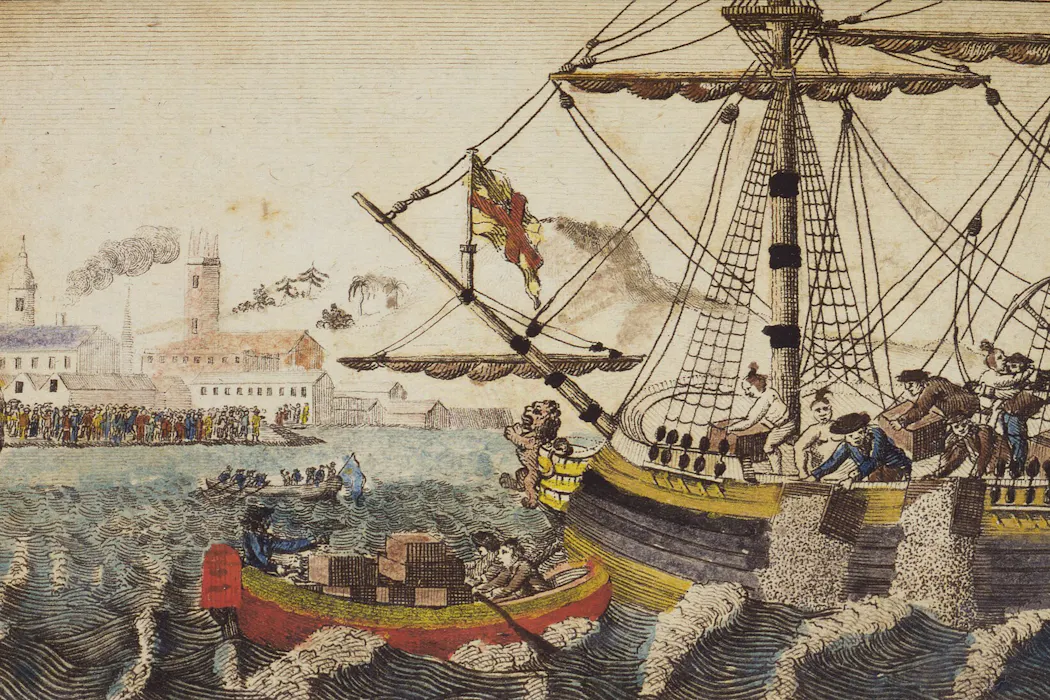
The American revolution was not a straightforward contest between colonists and mother country, despite what the Declaration of Independence said about dissolving the bonds between one people and another. There were, of course, loyalists in America who refused to join the rebel cause. And in Britain, there were many who took the side of the revolution.
Just like in the colonies themselves, people’s choice of allegiance was sometimes a matter of self-interest. Merchants and manufacturers, whose livelihoods depended on trade with America, were some of the most vocal opponents of the British government’s aggressive policies in the 1760s and 1770s. When fighting broke out in 1775, they organised petitions calling for peace and reconciliation.
But the revolution was also a question of principle – a struggle over the nature and limits of freedom – and plenty of British people treated it that way too.
In fact, since the 1760s, the American colonists’ dispute with the government had been closely tied to questions about corruption, oligarchy and executive tyranny in Britain itself. The London-based journalist and politician John Wilkes had catalysed a popular opposition movement, making himself the champion of a coalition of London merchants and labourers. They believed the king was gathering too much power, using bribes and jobs to control parliament and keep it from truly representing the people.
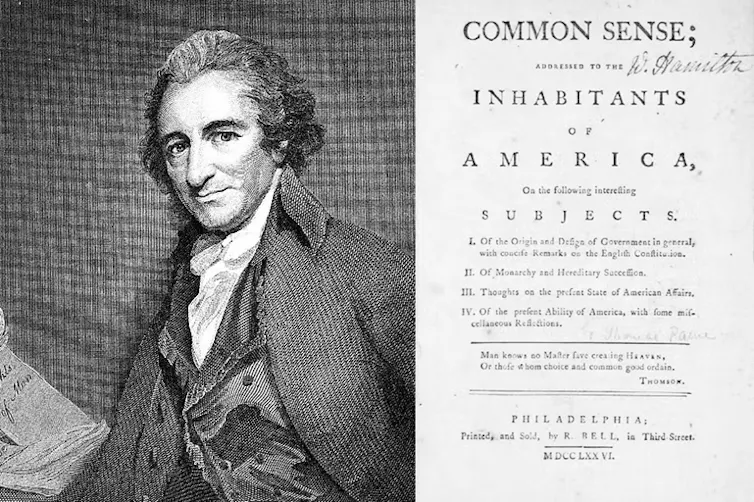
It was this political background that produced Thomas Paine, who moved to Philadelphia in 1774 with a recommendation from Benjamin Franklin (who himself was based in London from 1757 until 1775 when he headed home to join the revolution). A new collection of Paine’s writings suggests that he was far more active than previously thought in the newspaper and pamphlet debates of the 1760s and early 1770s. He did not become a revolutionary in America, but in Britain.
Wikimedia Commons
Meanwhile American colonists’ arguments about their own lack of representation, and their abuse by corrupt ministers, resonated across the Atlantic. Wilkes never really won Franklin’s respect, but he did work closely with the Virginian Arthur Lee, who wrote frequently in opposition newspapers while he lived in London between 1770 and 1776. Once “arbitrary rule” was established in the colonies, Lee warned, it would “speedily traverse the ocean, and finally fix itself in England.”
Among those who linked the growing American crisis to the question of representative government was the antislavery activist and lawyer Granville Sharp. He published a pamphlet in 1774 declaring “the people’s natural right to a share in the legislature,” in which he argued that “all British subjects,” including those in America and Ireland, were “equally free by the law of nature.” Irish legislative independence was indeed one of the outcomes of the transatlantic revolutionary struggle.
Working against despotism
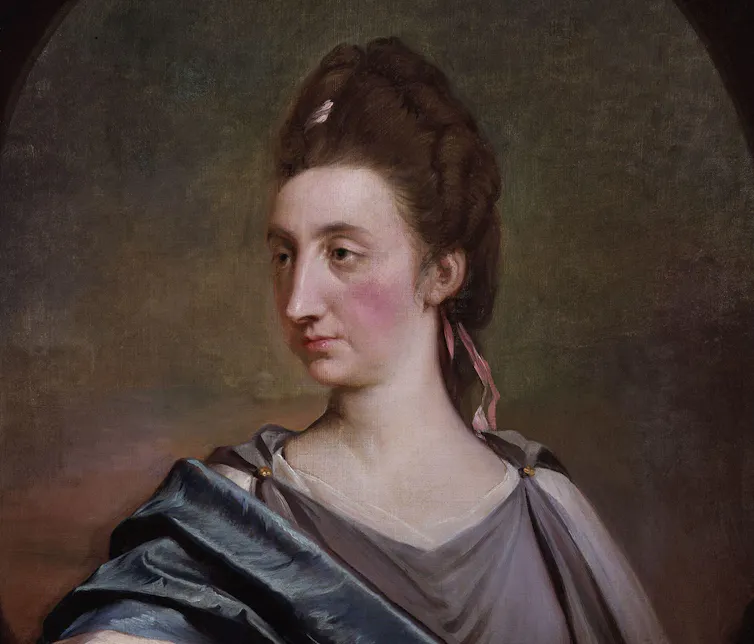
As the crisis lurched into outright rebellion in 1775, the historian Catharine Macaulay accused the government of working to speed up “the slow but steady progress of despotism” throughout Britain and its empire. Indeed, Macaulay’s History of England championed the republican revolutionaries of the 17th century.
Portrait by Robert Edge Pine
As the historian Mary Sarah Bilder has recently shown, it inspired Thomas Jefferson’s text of the Declaration of Independence. Macaulay’s brother, John Sawbridge, was one of Wilkes’ leading allies in parliament.
The patriot cause in the colonies also won strong support among Britain’s dissenting Protestants – those who refused to toe the Church of England line and therefore suffered various exclusions from civil life in Britain. Dissenters had their own tradition of fighting for liberty, which fed into the joint struggles over parliamentary reform and American rights.
In the mid-1770s, dissenting schoolteacher James Burgh published a three-volume catalogue of “public errors, defects, and abuses” in the British political system. “When the people take redress into their own hands,” he predicted, “woe to the tyrants”.
Spirit of revolution
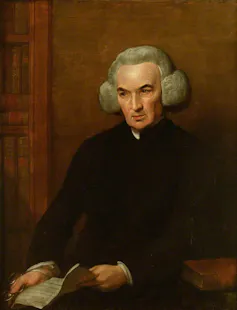
Perhaps the most influential pro-American tract published in Britain, though, was the work of the Welsh dissenting intellectual and preacher, Richard Price. His Observations on Civil Liberty sold 60,000 copies, its circulation boosted by the flurry of indignant responses from friends of the government.
Price emphasised that liberty depended on popular sovereignty – the rule of all people equally – which he said was being abused on both sides of the ocean. Revolution in America, he argued, was part of an approaching “revolution in the affairs of this kingdom”.
National Library of Wales
Price’s book (according to its detractors) made an impression on Britain’s ordinary working people, “taylors, tallow-chandlers, soap-boilers … chimney sweeps” and so on, not to mention “female patriots”. It was certainly read by James Aitken – “John the Painter” – a house painter who had been radicalised to the revolutionary cause while living in the American colonies in the early 1770s. Aitken set fire to the Portsmouth naval dockyard in late 1776 as part of a campaign to cripple the Royal Navy. He was caught and executed in 1777. By then, authorities were seriously worried about the impact the American Revolution was having close to home.
Most British people never sided with the rebels. Even Price and his fellow sympathisers did not go as far as Paine had done (in Common Sense) and call for the end of the monarchy itself. When Britain’s longstanding Catholic enemy, France, entered the war on the American side in 1778, public opinion swung more firmly behind the government.
Still, at the Gordon Riots two years later people were said to have shouted: “Peace with America, and war with France!” Anger at Britain’s corrupt and oligarchic politics was still widespread.
When the British war effort at last petered out following defeat at Yorktown in 1781, a new government took over led by men who had opposed war in the first place. They took some reforming steps before collapsing into infighting.
Price, along with plenty of like-minded people, took hope from the outcome. “The struggle has been glorious on the part of America,” he wrote his American friend Benjamin Rush in 1783, “and it has now issued just as I wished it to issue, in the emancipation of the American states and the establishment of their independence”.

Tom Cutterham does not work for, consult, own shares in or receive funding from any company or organisation that would benefit from this article, and has disclosed no relevant affiliations beyond their academic appointment.