Buckingham Palace has disclosed that the king has paid tax of £11.7 million in 2023-24 and £12.9 million in 2024-25. The bulk of this tax liability arises from his income from the Duchy of Lancaster, which for 2023-24 was £27.5 million.
This makes him one of the top 100 taxpayers in the country. Kensington Palace has also disclosed that Prince William paid £7.76 million in tax on the profits of the Duchy of Cornwall.
The king is not legally liable to pay tax. In principle, it makes little sense for the crown to pay money to the crown. Yet by the 1990s it was becoming increasingly anomalous that one of the wealthiest people in the country did not pay tax. This was especially the case when some of that income stems from the Duchy of Lancaster – the monarch’s “private” income, derived from their “private” estate.
As a result, from 1993 onwards, Elizabeth II agreed to pay tax on her private income. The king has renewed this agreement, but this is the first time that a sitting monarch has disclosed their tax bill.
The palace described this decision as part of “the Royal Household’s commitment to transparency”. It brings the monarchy more into line with an increasing expectation for public figures in general to be more transparent about their tax affairs.
Over the past 20 years, it has become expected that the prime minister and the chancellor disclose their tax returns. In following suit, the king is providing an example of how monarchy can change to meet public expectations.
However, unlike other public figures, only the overall tax paid has been disclosed – not how this figure has been arrived at, or if any expenses have been deducted. These disclosures are unlikely to satisfy calls for more transparency about royal finances, following the scandals around Andrew Mountbatten Windsor.
Also likely to raise eyebrows is the disclosure that the size of the sovereign grant will increase to nearly £100 million following the completion of the renovations of Buckingham Palace.
The publicly funded sovereign grant pays for the monarchy’s operational costs. It is calculated by applying a set percentage to the revenues from the crown estate. The crown estate is best considered as an independently managed property portfolio of land, and its profits are paid to the Treasury. As the sovereign grant is not income received personally by the king or William, this is not subject to income tax.
For 2027-28, the percentage of the grant will be set at 20.5%, generating just under £100 million. It is expected that this sum will remain flat for the following five years, meaning a real-terms reduction year on year. This is a drop from the 2025-26 figure of £132.1 million, but that figure included a £60 million uplift for Buckingham Palace renovations. Setting aside those costs, the sovereign grant for the monarchy’s operational costs will almost double from the £51.8 million paid for in 2024-25.
The reason given for this is that a series of works are due on royal palaces, plus an investment in cybersecurity. This has been agreed to by the government without debate, and is likely to be scrutinised when the sovereign grant bill – which will implement this agreement into law – is brought before parliament.
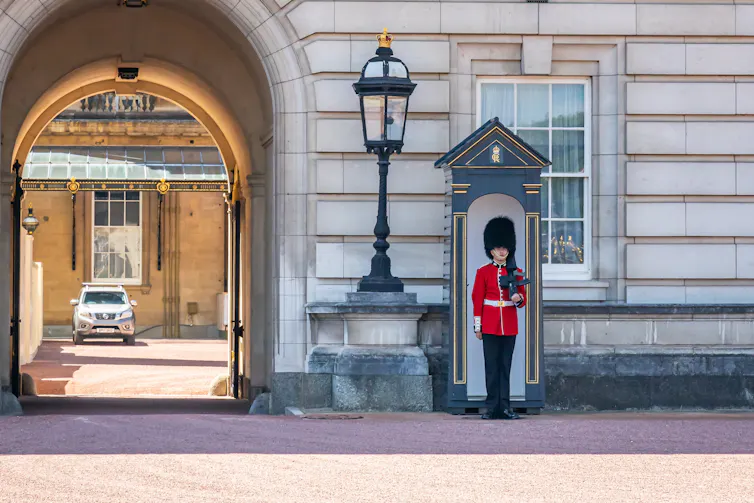
JeanLucIchard/Shutterstock
A more transparent monarchy
The Duchies of Lancaster and Cornwall are the main source of income for the king and Prince of Wales, respectively. But their true legal status is contested, and are quite unlike anything else in English law. Given the public interest in the monarchy, this makes questions of transparency all the more important.
Some argue that in substance, the two duchies are public and part of the state. The fact that they remain separate to the crown estate was a historical accident. They were not considered especially valuable at the time the crown estate was established. However, the palace maintains that they are the king’s and prince of Wales’s “private” estates.
This has become more controversial in recent years, as it has emerged just how extensive the property interests of the two duchies has become. An investigation by the Sunday Times and Channel 4 showed that they both extended beyond farming and rural properties, to leasing offices to government departments and charities, to receiving income from a motorway service station and fees from the military for training on Duchy land.
Dartmoor Prison, part of the Duchy of Cornwall, costs the Ministry of Justice £1.5 million in rent a year, even though it is unsuitable to use as a prison due to toxic levels of radon gas. As the duchies are not corporations in the traditional sense, they do not pay corporation tax.
There are indications of change. The Duchy of Cornwall has announced that it will sell around a quarter of its land, raising £500 million to invest in five “heartland” areas to provide more affordable housing, and improve the environmental impact of the estate. Prince William has also said that he will no longer personally profit from the rent generated by Dartmoor Prison.
Will Bax, the duchy’s chief executive, states that William believes that the duchy “shouldn’t just exist to own land. It should first and foremost exist to have a positive impact on the world”. Becoming more transparent about its finances is clearly part of this.
It has also been announced that the king and queen will not use Buckingham Palace as their London residence, but will instead remain at Clarence House. It has long been said that the royal family have not been enormous fans of the draughty palace – Clarence House is much smaller, and more homely and comfortable.
Buckingham Palace will still be the “headquarters” of the monarchy, and will remain the focus of ceremonial occasions. This creates an opportunity for the palace to be made more open to the public, and for longer potentially increasing revenue to help pay for its upkeep. There is also potential for it to be used in other creative ways – being opened up for receptions, private hire, or to host international summits. All could generate revenue and reduce the reliance on the sovereign grant.
Taking all of this together, there is clearly a shift in the idea of monarchy, becoming a more open institution, in which the public can increasingly become part of, instead of being kept fully outside of the palace railings.

Craig Prescott does not work for, consult, own shares in or receive funding from any company or organisation that would benefit from this article, and has disclosed no relevant affiliations beyond their academic appointment.