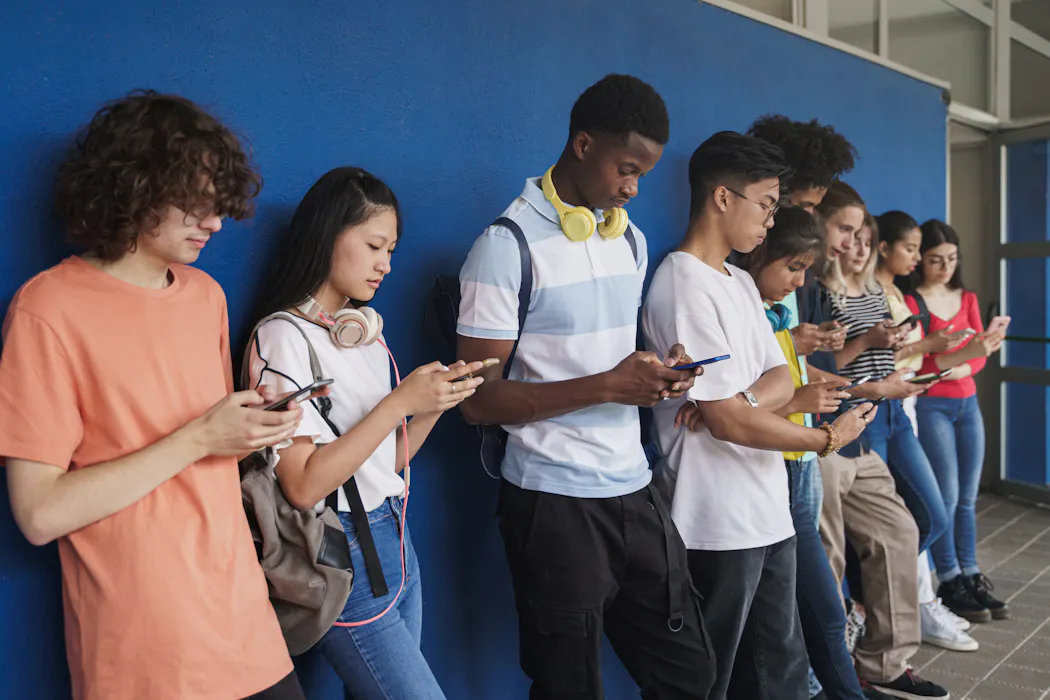
The UK government’s decision to introduce restrictions on children’s access to social media marks a significant moment in the evolution of online safety policy. For supporters, it represents a long-overdue response to growing concerns about children’s wellbeing. For critics, it raises questions about effectiveness, enforcement and unintended consequences.
Yet regardless of where one stands on the policy itself, its announcement provides an opportunity to reflect on a broader question: what exactly has this debate been about?
At one level, the answer appears straightforward. Public concern about children’s social media use has grown steadily over recent years. It has been fuelled by worries about a wide range of issues, from mental health and body image to online exploitation, misinformation and the changing nature of childhood itself. The government’s proposals are intended to respond to these concerns and reduce young people’s exposure to risk.
Read more:
UK under-16 social media ban: what parents need to know
Yet one of the striking features of the debate is that the phrase “social media harms” has come to encompass an extraordinary range of anxieties. Depending on who is speaking, the problem may be cyberbullying, pornography, misogynistic influencers, loneliness, political polarisation, declining attention spans, excessive screen time, image-based abuse or the feeling that childhood is becoming increasingly mediated through screens.
These concerns are real and deserving of attention but they do not necessarily share the same causes or solutions.
When multiple anxieties become bundled together, it becomes tempting to seek a single response. Yet many of the challenges that worry parents, educators and policymakers are not solely technological in nature.
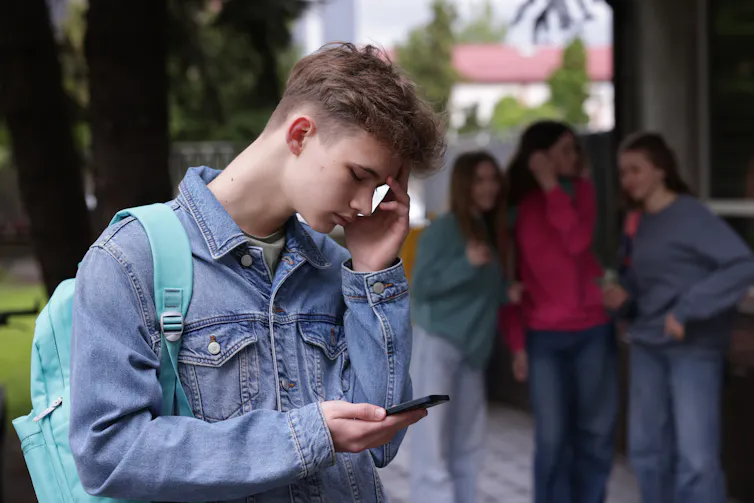
Young people were navigating body image pressures long before social media. Bullying and social exclusion existed before smartphones. Concerns about unrealistic representations of sex and relationships and success have existed for decades. Young people have always had to negotiate questions of identity, belonging, popularity and status.
New Africa/Shutterstock
Social media may amplify these dynamics, but it does not create them from nothing. Understanding this distinction is important because it shapes how we understand both the problem and the solution. If online harms are understood primarily as problems of access, restricting access becomes the obvious response. If they are understood as the product of interactions between technology, relationships, culture and wider social conditions, the picture becomes considerably more complicated.
Changing relationships with tech
As a researcher who studies young people’s digital lives, what has struck me most throughout these debates is that many discussions about children and social media are not really about children and social media alone. They are also conversations about how adults feel about technology more generally.
Over the past two decades, digital technologies have transformed how people communicate, access information, form relationships and participate in public life. For much of that period, these developments were discussed primarily in terms of opportunity, innovation and connection. Increasingly, however, public conversations about technology are framed through the language of risk, uncertainty and loss.
Concerns about social media sit alongside wider unease about the power of technology companies. They accompany fears about the commercialisation of attention, the collection of personal data, the spread of misinformation and the growing influence of algorithms over everyday life.
Right now, debates about children’s social media use are unfolding against a backdrop of rapid technological change more broadly. The emergence of generative AI, deepfakes and increasingly sophisticated algorithmic systems has intensified public uncertainty about the role technology should play in society.
Parents, educators and policymakers are being asked to make decisions about technologies whose long-term implications remain unclear. Researchers are trying to study developments that evolve faster than evidence can often keep pace with. Schools are preparing young people for futures that are difficult to imagine.
In this context, proposals to restrict children’s access to social media can offer something that is often in short supply: a sense of certainty and control. They provide a visible intervention that governments can announce, institutions can implement and parents can understand. Faced with complex and rapidly evolving challenges, there is understandable appeal in policies that appear to offer a clear solution.
However, there is an important difference between taking action and resolving a problem.
What happens next?
One of the lessons emerging from international experience, including developments in Australia, is that the effectiveness of such restrictions remains uncertain. Young people may migrate to alternative platforms or create hidden accounts. They may become less willing to discuss their online experiences with trusted adults. Some may lose access to online communities, information or support networks that play an important role in their lives. The available evidence does not yet allow us to confidently conclude that restricting access will produce the wide-ranging benefits that many hope for.
This does not necessarily mean that restrictions are misguided. It does, however, suggest that policies can sometimes provide reassurance before we know whether they will meaningfully reduce harm. In that sense, there is a risk that social media bans become partly performative. They demonstrate that something is being done and may provide a welcome sense of action in the face of uncertainty. Yet they can also encourage the belief that a complex problem is being solved when many of the underlying issues remain unresolved.
Perhaps the greatest danger is not that restrictions fail, but that they succeed just enough to convince us that the work is done.
Even if age restrictions prove effective, young people will still eventually enter digital environments. They will still need to understand how algorithms shape the information they encounter. They will still need to evaluate misinformation, navigate relationships online, recognise manipulation and make sense of increasingly complex digital cultures. They will still require opportunities to develop critical thinking, digital literacy and healthy relationship skills.
More fundamentally, questions about the design of digital environments themselves will remain. If our concerns centre on addictive design, algorithmic amplification, misinformation or the concentration of power among technology companies, then restricting children’s access addresses only part of the issue. The broader challenge concerns the nature of the digital spaces that all of us inhabit.

Emily Setty receives funding from Leverhulme Trust, ESRC, University of Surrey and third-sector, commercial and government organisations.