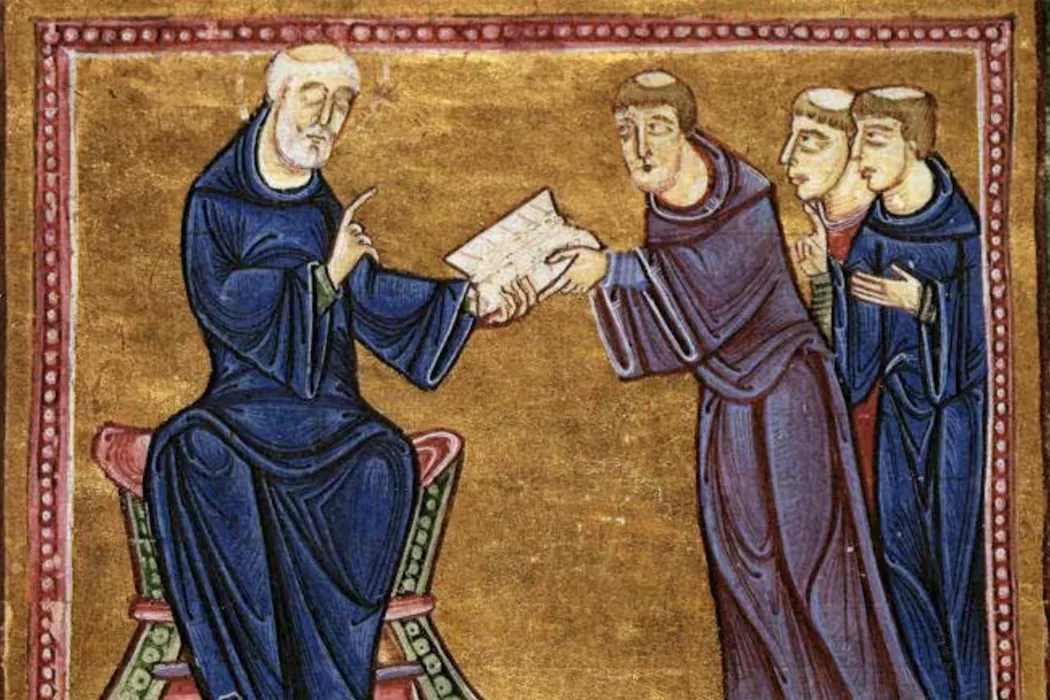

What might a sixth-century monastic rulebook have to say about how we live today? Living by the Rule: Contemporary Meets Medieval, the centrepiece of this summer’s exhibitions at the Sainsbury Centre in Norwich, takes up that question. As curators, we bring present-day habits and assumptions into dialogue with a seemingly distant counterpoint: medieval monasticism, and in particular the Rule of St Benedict, written in sixth-century Italy.
Benedict was born into a noble Roman family around 480, shortly after the fall of the Roman empire. It was a period in which the political and economic certainties that had structured society for centuries were rapidly unravelling.
As a young man, he abandoned his studies and set out to live differently. He experimented with forms of withdrawal from society, including years of living as a cave-dwelling hermit, before eventually founding a large religious community at Monte Cassino, halfway between Rome and Naples.
Read more:
How medieval monks tried to stay warm in the winter

Uffizi Gallery

The Rule was written towards the end of his life, a direct product of his reflections and experiences. It offered a framework for a radically different kind of life, explicitly set apart from the social hierarchies and economic imperatives of the wider world. Benedict imagined a life of stability, community and measure; one devoted to the care for souls and, ultimately, to spiritual salvation.
Many of Benedict’s rules were pragmatic rather than ideological: who should be served their dinner first, how to make sure everyone wakes up on time for night prayers, when to schedule toilet breaks. His Rule is preoccupied with all the gritty detail of creaturely routines, because these habitual concerns were fundamental to the smooth running of a community. Benedict believed that if a community functioned well, it made space for its members to engage with the meaning of life beyond the everyday.
Living by the Rule
Curating Living by the Rule: Contemporary Meets Medieval, we were aware that the idea of “living by the rule” might sound off-putting to some visitors – too close to simply doing what you’re told. It also sits uneasily with the individualism of our age, in which meaning is often framed in terms of personal fulfilment or even “optimisation”. Rules, by contrast, point to our dependence on others and the obligations that come with it.
It is important, though, not to confuse Benedict’s “Rule” with modern laws or regulations. The term comes from the Greek kanon, via the Latin regula, meaning a pattern, model or yardstick: something to guide judgment rather than dictate behaviour. Unlike modern faith in impersonal rules, Benedict’s approach is strikingly flexible. Nothing is so fixed that it cannot be adapted, or even set aside, in light of different people and circumstances.
Translating these ideas into an exhibition was far from straightforward.
At the heart of our work was the conviction that something fascinating emerges when medieval objects are brought into dialogue with contemporary artworks. Rather than organising the exhibition around a single theme or subject, we were interested in something more fundamental: art’s relationship to lived experience and how it shapes, and is shaped by, the forms of life around it.
This also required taking the radical break between the medieval and the modern seriously. There are, of course, points of deep resonance between monastic life and today’s world – in the shaping of institutions, for example, or in how we structure time. Yet the rise of modern mass societies also introduced conditions that make any straightforward translation of Benedict’s Rule into contemporary social life far from simple.
Importantly, the monks were experimenting with a different way of living – and of living together. As Benedict puts it, this way has to differ from the world’s way.
Modern artists, too, have often tried to operate at a distance from the world – its priorities, habits and ways of seeing. For a long time, art has not been tied to any clearly shared social function or agreed purpose. Instead, it has come to exist at a remove from everyday life, a shift that brings both losses (in stable purpose and patronage) and gains (in new creative and entrepreneurial freedoms). Modern art, in this sense, becomes an experiment in another way of doing things – though one that remains entangled with the very world it seems to resist.
So what happens when the medieval monastery meets contemporary art? The sections of the exhibition and its accompanying book explore principles that are both attractive and repulsive to us now.
These include stabilitas – the expectation that monks remain within their monastery for life; obedience, expressed in submission to the authority of the abbot; the renunciation of private property in favour of shared ownership based on use and need; and a life oriented above all towards prayer. Together, these demanding and remarkably enduring principles offer a striking way to view the present, unsettling some of our basic assumptions about how life is organised and what it is for.
We invite visitors to leap from the medieval to contemporary and back again, without knowing exactly what they will find. We hope the results are vivid and unexpected, throwing up questions and offering plenty of food for thought – unfamiliar ideas and experiences to be chewed over and digested.
The rules we live by today – whether chosen or inherited – are the product of historical forces. Art reminds us that life is never fixed, and that it can always be organised differently.
Living by the Rule: Contemporary meets Medieval is at the Sainsbury Centre in Norwich until October 4 2026.

Ed Krčma works for the University of East Anglia.
Jessica Barker receives funding from The Paul Mellon Centre for Studies in British Art, the Ruddock Foundation for the Arts, and Sam Fogg.