The summit between Chinese president, Xi Jinping, and US president, Donald Trump, reportedly covered a lot of ground. The two leaders are said to have discussed trade, technology and the war in Iran, agreeing that Strait of Hormuz should be kept open. But the most potentially hazardous issue they covered was the future of Taiwan, which Xi said if handled poorly, could lead to conflict and “an extremely dangerous situation”.
The danger is not simply that Xi and Trump disagree over Taiwan’s future. It is that actions one leader may see as defensive could easily be interpreted by the other as evidence of hostile intent. It’s a security dilemma that is well known in international diplomacy.
For Washington, arms sales to Taiwan, including a recent multibillion-dollar package, are intended to strengthen deterrence and reduce the likelihood of conflict by making coercion more costly for Beijing. But even ostensibly defensive arms sold to Taiwan appear immensely threatening to the Chinese government, given Beijing’s determination to restore Taiwan to Chinese sovereignty.
Chinese fears that Washington’s arms sales will embolden the Taiwanese leadership to seek independence are mirrored in US fears that China will seek to use force to reunify Taiwan. In the weeks and months before the summit, in a clear signal to Trump and the leaders in Taipei that China means business, Beijing ramped up the scale and frequency of its military exercises and drills.
The danger is not that either side necessarily wants war. It is that both sides may believe they are acting defensively while interpreting the other side’s defensive moves as preparation for aggression.
History suggests that the danger of a superpower clash can sometimes be reduced through direct leader-to-leader diplomacy. One important example came during the final decade of the cold war.
Following the 1983 Able Archer crisis (when Soviet leaders reportedly feared that a Nato nuclear exercise might conceal preparations for a real nuclear strike) the then US president, Ronald Reagan, began to reconsider how Moscow interpreted US actions. Reading intelligence reports on Soviet fears, Reagan reflected that “maybe they are scared of us and think we are a threat”.
He concluded that he wanted to go “face to face” with Soviet leaders to explore whether the US-Soviet conflict was being driven by mutual fear and misperceptions.
That instinct helped pave the way for Reagan’s later diplomacy with Mikhail Gorbachev. Their meetings in Geneva (1985), Reykjavik (1986), and Washington (1988) did not erase geopolitical rivalry, but they did help create a degree of interpersonal trust between the two leaders. That trust mattered. It reduced the risk that every military move or diplomatic signal would automatically be interpreted in the most threatening way.
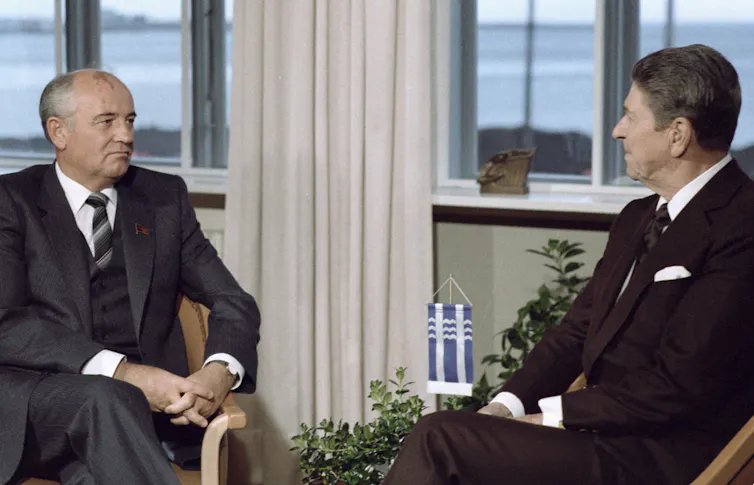
RIA Novosti archive, CC BY-SA

The lesson is not that Trump is Reagan or Xi is Gorbachev. Nor is it that personal diplomacy can magically solve a conflict as deep as Taiwan. The lesson is more modest, but also more urgent. Potential adversaries need leaders who can recognise when fear and misperceptions of the other side’s hostile intent might be driving a conflict, rather than genuine malign intent.
Communication and trust
In our upcoming book on interpersonal diplomacy and trust in international relations, we describe this process through the concept of “security dilemma sensibility”. This is the willingness to recognise that an adversary’s actions may stem from insecurity and fear as well as aggressive intent. Such moments are rare, but they can become critically important in preventing rivalry from sliding into catastrophe.
Direct leader-to-leader communication matters. It allows rivals to bypass some of the bureaucratic, political, and military filters through which signals are often distorted. The Biden-Xi summit in San Francisco in 2023 produced an important agreement to restore high-level military-to-military communications after relations had deteriorated sharply following Nancy Pelosi’s visit to Taiwan. Biden later remarked that both leaders had agreed they should be able to “pick up the phone and call directly and we’d be heard immediately”.
That kind of trusted communication channel matters enormously during crises, where silence, delay, or misinterpretation can rapidly intensify fears on both sides. But communication alone is not enough. Without at least some degree of mutual trust and security dilemma sensibility, even direct exchanges risk being dismissed as manipulative or deceptive.
That is the challenge now facing Trump and Xi over Taiwan. Trump’s transactional approach to diplomacy makes the problem especially acute. Beijing may wonder whether Taiwan is something Trump might bargain over. Taipei and US allies may worry that American commitments are less firm than Washington claims. And Trump himself may believe that personal rapport with Xi can substitute for the hard work of clarifying red lines, managing deterrence and reducing the risk of both inadvertent and deliberate escalation.
Exercising security dilemma sensibility would require both leaders to recognise that actions intended as defensive by one side are often experienced as threatening by the other. For Washington, this means appreciating why Beijing views growing US military and political support for Taiwan as a challenge to a core national objective. For Beijing, it means recognising that coercive military pressure around Taiwan deepens fears in Washington and Taipei that China is preparing to impose a solution by force.
If the summit produces only theatrical displays of toughness or transactional bargaining, the deeper dangers in the relationship will remain. But if Trump and Xi can strengthen channels of direct communication while demonstrating a greater awareness of each other’s fears and insecurities, they may reduce the risk that a future Taiwan crisis spirals through miscalculation into catastrophe.
The real test of the Trump-Xi summit is not whether either leader comes out as a winner in the eyes of their domestic constituencies and wider global opinion. They need to leave understanding that deterrence doesn’t just fail when leaders appear weak. It can also fail when they are so convinced of their own defensive intent that they can’t see how threatening they look to the other side.

Nicholas John Wheeler has received funding from the Economic and Social Research Council.
Marcus Holmes does not work for, consult, own shares in or receive funding from any company or organisation that would benefit from this article, and has disclosed no relevant affiliations beyond their academic appointment.