This autumn looks like it could be a good year to spot large numbers of wild mushrooms. Already many can be seen covering tree roots and shady spots.
Mushrooms are the part of certain fungi that you see above ground. The rest of it is either underground or within a tree trunk. All mushrooms are part of a fungus, but not all fungi produce mushrooms. There are believed to be 14,000 species of mushroom, and 140,000 of fungi.
To observe what was growing and what wasn’t this autumn, I recently joined a fungi walk in a Somerset woodland. Fungi were everywhere. Our group could barely cover half a kilometre in an hour because there was so much to stop and examine.
Among our sightings were large numbers of bright yellow stagshorn fungi (Calocera viscosa), coral-like clusters emerging from green moss, alongside vivid purple Russulas and more unusual specimens including one looking like a felty black tongue (seen in photo below), which we took for microscopic identification.
Our small group of fungi researchers recorded 39 different fungi. There’s nothing more magical than the iconic red-and-white fly agarics (Amanita muscaria), and our noted observations helped to set a nationwide record for the most of this type recorded in a single day at 276.
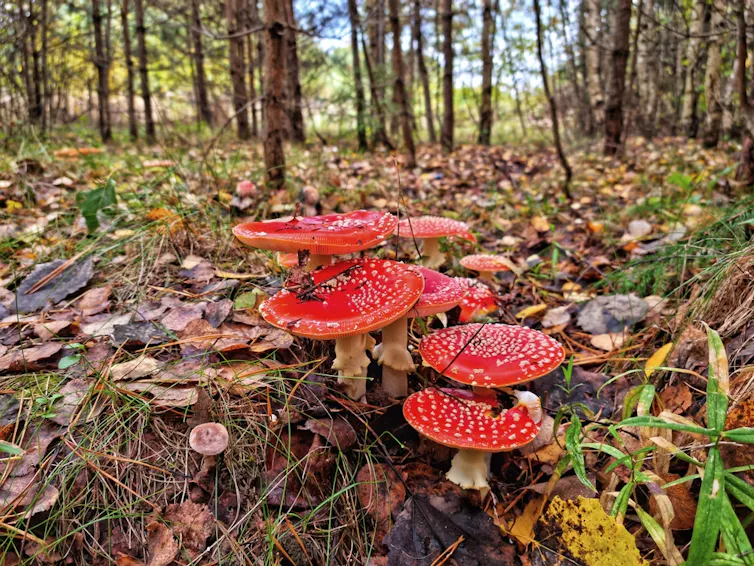
Lyubov Kolyaganova/Shutterstock
Another fungus showing off its colours this year is chicken of the woods (Laetioporus sulphureus). Look out for its cascading, bright yellow lobes bursting from urban trees. Sightings on the citizen science platform iNaturalist of this mushroom have increased by around 25% in the UK, compared with the same period last year.
The mushroom season could be about to get even better. Studies on mushroom production in pine forests have identified rainfall as among the strongest predictors of annual productivity.
Higher temperatures can limit production early in the season but help extend it later. A damp autumn, with enough warmth remaining, could therefore provide excellent mushroom weather. And that is precisely what the UK Met Office is forecasting. With a strengthening El Niño in the Pacific, the chances of a warm, wet autumn in the UK are estimated to be around 1.5 times higher than normal. For fungi emerging from a dry summer, this is good news.

Victoria MPhoto/Shutterstock
Why mushrooms pop up?
Mushrooms are the temporary fruit that fungi produce for reproduction. The main part of the fungus remains hidden and is a network of tube-like filaments called mycelium, which can come together to form a developing mushroom.
The fungus then has a clever way of using water pressure within its cells to expand this structure and push it above ground, a little like inflating a balloon.
This helps explain why mushrooms often pop up after rain. They need plenty of moisture to grow, and the mushroom “balloon” you see can be up to 90% water.
But more mushrooms don’t always mean healthier ecosystems. An abundance of certain fungi can signal ecosystems under stress.
The long, dry summer has stressed vegetation, potentially leaving trees more vulnerable to pathogens such as honey fungus (Armillaria sp.). These fungi attack living tree roots, sometimes killing their hosts, and produce mushrooms in enormous honey-coloured clusters having done so.
In the dry summer of 2025, the Royal Horticultural Society reported a 43% rise in enquiries about garden fungi, most commonly honey fungus.
Meanwhile, fungi that recycle nutrients by breaking down dead organic matter may have an unusually abundant supply of drought-stricken vegetation to feast on. Another side effect of the very dry summer.
Drying out
But some species are struggling. Many fungi rely on partnerships with living trees, exchanging nutrients and water for sugars produced through photosynthesis. For these species, vegetation productivity can strongly predict mushroom yield. Drought affecting their host trees may therefore have consequences that autumn rain cannot immediately reverse.
Others need suitable soil conditions to develop their underground mycelium, before producing mushrooms. Some soils in the UK remain exceptionally dry this autumn, requiring substantial rainfall to restore moisture.
Waxcaps, for example, are grassland fungi appearing in extraordinary colours, from pink and yellow to green, with some even smelling of garlic. Associated with long-established, nutrient-poor grasslands, they are valuable indicators of ecological quality.
Prolonged drought could affect their underground mycelium, potentially limiting fruiting even when rain returns. Returning to the balloon analogy, there may simply be nothing to inflate.
October 2026 has seen a 36.6% drop in overall fungi recordings in the UK, compared to October 2025, according to iNaturalist records. However, the season is not yet over, so it’s not yet clear how things will pan out.
How to spot fungi
To observe the latest growth, head to your local woodland or grassland, pick up a field guide or join a guided walk. You don’t need to identify everything to appreciate it, and while no UK mushrooms are dangerous to touch, never eat one unless you’re absolutely certain of its identity.
This autumn’s abundance may have prompted some commercial pickers to sweep through woods picking large numbers of fungi. The Woodland Trust, a charity, has warned this can put wildlife under pressure as they are a source of food for animals such as deer and support the soil’s health. While foraging for personal use is allowed, picking for commercial sale is illegal.
By recording your finds through citizen science projects such as iNaturalist, you can also help experts understand which species are flourishing and which are struggling in a changing climate.
If the forecast threatens your outdoor plans this autumn, remember what might soon be popping up after the rain. This might just be the year you discover some remarkable mushrooms for yourself.

Joni Wildman does not work for, consult, own shares in or receive funding from any company or organisation that would benefit from this article, and has disclosed no relevant affiliations beyond their academic appointment.