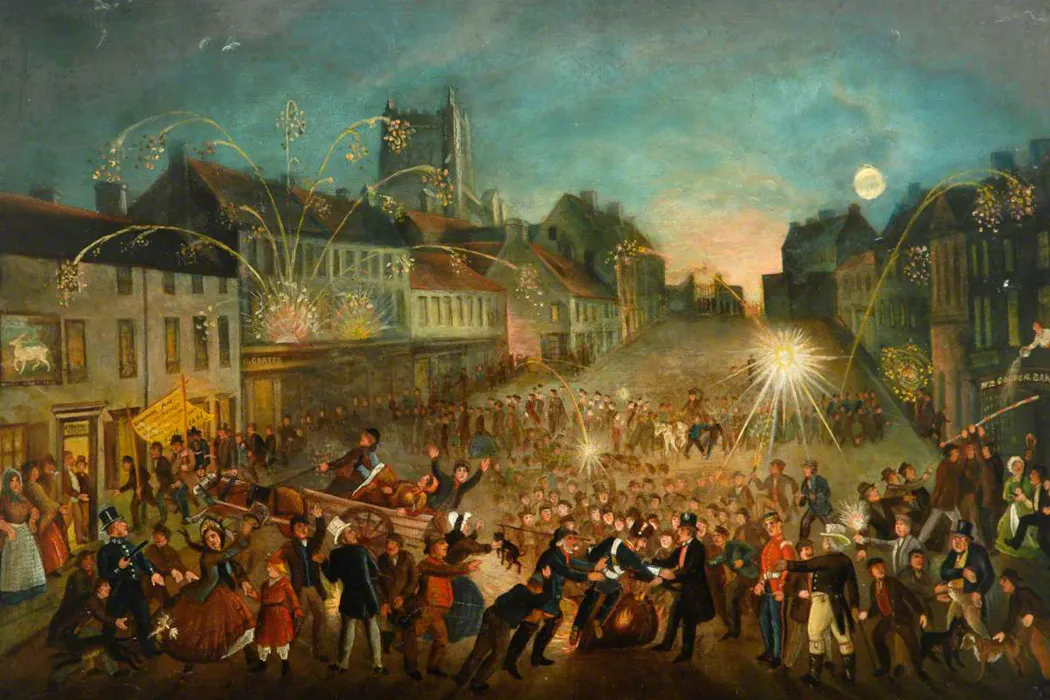
The gunpowder plot of 1605 was an attempt to assassinate King James I, blow up London’s Houses of Parliament and trigger a full-scale Catholic rebellion in England. To commemorate its spectacular failure, parliament passed the Act for a Public Thanksgiving to Almighty God Every Year on the Fifth Day of November. But few needed an excuse for celebrations as winter closed in.
In Jacobean England, November 5 added just another red-letter day to a calendar already enlivened by the bonfires lit in commemoration of Elizabeth I’s accession on November 17. But the English tradition of bonfires and feasting didn’t begin with Elizabeth either. The ritualised burning of the debris of the year can be dated back to pre-Christian times. The act of 1605 both sanctioned and positively encouraged such activities.
Food was always an important part of the merrymaking. Here are four of the most popular delicacies that have marked bonfire season in England over the centuries.
Read more:
Forget gory Gunpowder – Jacobean England had a bloodcurdling appetite for violence
1. Potatoes
As a child in the 1960s, I remember my mother wrapping potatoes in tinfoil to stick on the edge of a roaring fire to bake. Afterwards, in keeping with traditions in her native Lancashire, there would be parkin (a dense gingerbread cake) and tray-baked homemade treacle toffee that you had to hammer to break up. In village firework parties in the north of England, such food traditions are still going strong.
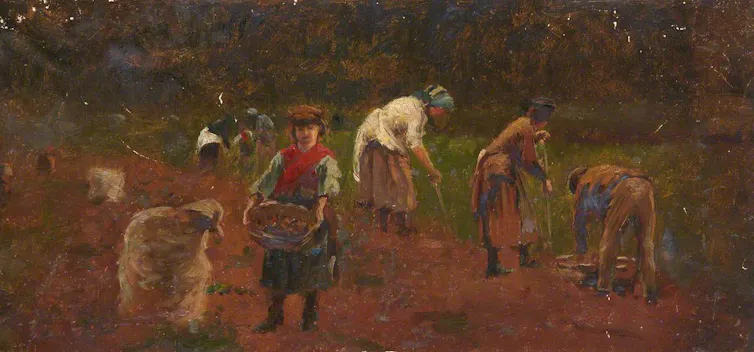
Royal Scottish Academy of Art & Architecture, CC BY
Interestingly, tossing them in the embers is mentioned in the first British reference to potatoes in a herbal (a guide to plants and herbs) by John Gerard, published in 1633. This was apparently seen as a way of making them “lose much of their windinesse, especially being eaten sopped in wine”.
Potatoes, albeit generally smaller and in fewer varieties than available today, were first introduced in England in the 1570s. Acceptance was remarkably slow. Long dismissed as an exotic novelty or livestock feed, they only became a mainstream English staple during the food shortages of the late 18th century. Yet as Gerard’s 1633 account proves, early adopters had already figured out that the embers of a fire were the easiest way to bake them.
Maybe the tradition of sopping them in wine continues today in the peculiar British tradition of putting vinegar on chips.
2. Parkin
Parkin, however, is of more recent origin. The first recorded reference to it is seemingly when a woman named Sarah Priestley was arraigned at Pontefract Quarter Sessions in 1729 for stealing oatmeal to make a parkin. This clearly indicates that parkin was already a desirable Yorkshire delicacy, but leaves its origins obscure.
Parkin seems to have evolved from “tharf cakes”, large round oaten cakes, sometimes made with plums inside. They are recorded as far back as the Lindisfarne gospels, a Christian manuscript created around AD700-715. Tharf cakes were a 12th night delicacy in Cumbria and a November 5 tradition in Sheffield up to the late 19th century.
Eighteenth-century parkin, like tharf cakes, was a thin oatmeal cake baked directly on a griddle stone. What made it parkin was the addition of ginger and a sweetener. Depending on region this is generally black treacle (Yorkshire), syrup (Lancashire) or even honey (West Yorkshire).
From the mid-19th century, parkin began to be commercially produced in ovens with bicarbonate of soda added to leaven it and give it what has become its characteristic texture.
The production of parkin drew on the surplus of oats at the end of the harvest. As oats were not generally grown in the south of England, its consumption never caught on there.
Read more:
Today’s winter wonderlands have roots in Jacobean and Georgian frost fairs
3. Soul cakes

Royal Scottish Academy of Art & Architecture, CC BY-NC
In most parts of England, it is likely that the first sweetmeats associated with November 5 were soul cakes. These are small, round cakes flavoured with spices such as nutmeg and ginger.
According to T. F. Thistleton-Dyer’s book British Popular Customs (1876), the custom of going “a-souling” – begging or singing for soul cakes – was already well established by Shakespeare’s time, as a pastime during the celebrations of All Hallowstide between October 31 and November 2.
Indeed, this tradition goes back further, as an appropriation of the Celtic tradition of Samhain and is the distant origin of modern trick or treating at Halloween.
The tradition of seeking cakes “or any good thing to make them merry” was easily adapted to Bonfire Night from 1605. This included seasonal fruits. For instance, in Cheshire, one of the songs associated with the season emphasised “we are come for apples and strong beer”.
4. Toffee apples
Apples and sweetmeats therefore became adopted as part of the fun on the new festive date of November 5 after 1605. Eventually, the two were put together. From the 1890s, toffee apples began to appear in London during these festivities.
These foods are all part of the historic experience of Bonfire Night and the smells and tastes it evokes. The festivities would not be the same without the food associated with it. Indeed, the idea that the distinctive nature and flavour of regional foods need to be protected is even enshrined in European law.
When Britain was in the EU, foodstuffs such as Melton Mowbray pies, stilton cheese and Cornish pasties were given this protected status. This continues under post-Brexit arrangements. Yet this list of protected foodstuffs does not, as yet, include parkin. Maybe it should. After all, in the north of England parkin is an important – and delicious – part of the intangible cultural heritage of Guy Fawkes Day.

Pippa Catterall does not work for, consult, own shares in or receive funding from any company or organisation that would benefit from this article, and has disclosed no relevant affiliations beyond their academic appointment.