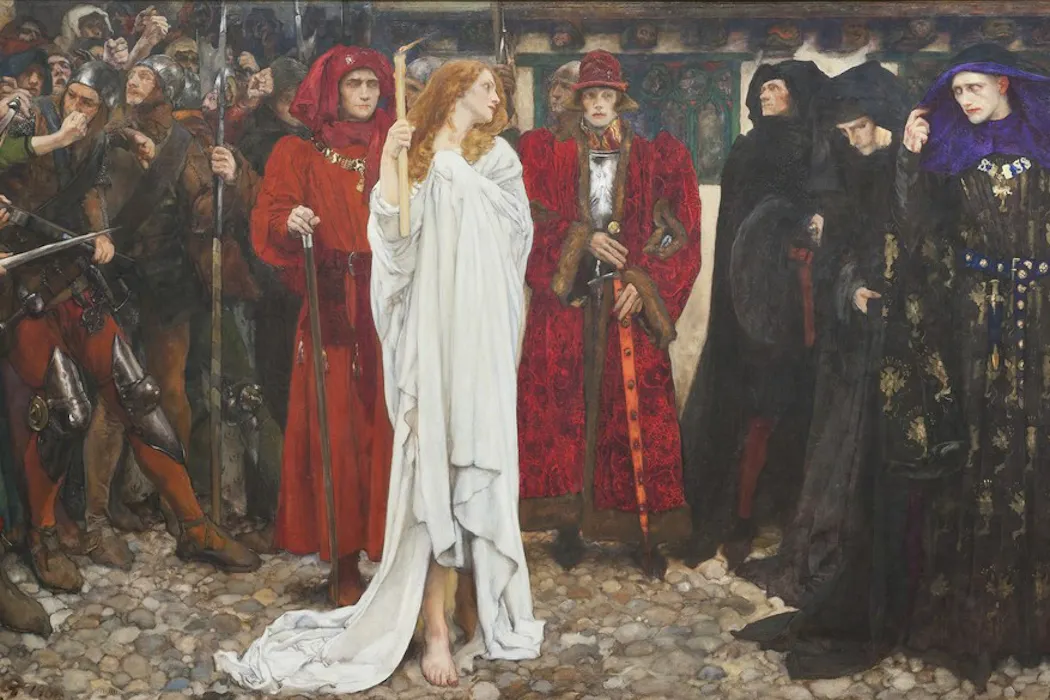

Reclaiming the label “witch” has become an act of feminist solidarity. But are we recovering the women themselves, or a posthumous identity built from accusation rather than fact?
Historical novelist Philippa Gregory’s new novel Royal Witch arrives this autumn soon after the much-trumpeted release of Practical Magic 2, with Sandra Bullock and Nicole Kidman returning to our screens as the Owens sisters.
Both tap into something powerful in contemporary culture. The witch has been reclaimed as a feminist figure: independent, knowledgeable, bonded to other women, resistant to authority.
But as a historian interested in how women’s reputations change over time, I think our enthusiasm for reclaiming the witch comes with responsibility. Before we celebrate the label, we must ask why and from whence it came.
Power and threat
Royal Witch retells the story of Eleanor Cobham, a 15th-century woman whose extraordinary rise took her from relatively modest beginnings to the highest ranks of English power as Duchess of Gloucester, married to a man briefly heir presumptive to the throne (Humphrey, Duke of Gloucester, uncle to the young Henry VI).
Then, in 1441, everything collapsed. A formal inquiry revealed that Eleanor had commissioned scholars to cast King Henry VI’s astrological chart and exposed her association with Margery Jourdemayne, the woman later notorious as the “Witch of Eye”. Eleanor was publicly humiliated, her marriage annulled and she was imprisoned for life.
It makes Gregory’s irresistible description of Eleanor, “the woman they called witch. Who would have called herself queen”, feel entirely natural. But the implied correlation between ambition and accusation is key. Eleanor belongs to a wider pattern in which the complicated political histories of powerful medieval women have gradually hardened into much simpler stories.
Take Joan of Navarre, another powerful medieval woman linked with witchcraft. A generation before Eleanor, Joan was the widow of Henry IV, stepmother to Henry V and to Humphrey, Duke of Gloucester, and Eleanor’s stepmother-in-law.
Her fall from favour involved suspicions about split loyalties and the seizure of her dower lands. As the daughter of a French princess and the former Regent of Brittany, xenophobic doubt persisted throughout her later life in England. Yet Joan, an astute political leader, was never formally accused of witchcraft.
Joan’s reputation developed through association and repetition. Chroniclers introduced witchcraft into her story; later accounts repeated it, and her reputation became entangled with other supposed magical family members. The label travelled further than the complicated political reality. Historian Elena Woodacre captures that uncertainty in her biography’s title: Joan of Navarre: Infanta, Duchess, Queen, Witch? That question mark matters.
Political expedience
Gregory’s focus, Eleanor Cobham’s tale, is different, but the same flattening occurs. She had been lady-in-waiting to Humphrey’s first wife, Jacqueline of Hainault, before becoming his mistress and, after that marriage was annulled, his second wife.
In 1441, the crucial offence was not that Eleanor’s associates had cast Henry VI’s horoscope, but that they had done so without permission; that was the treasonous act.
As with Joan of Navarre, this only became a crisis because dismantling Eleanor’s power, and in turn Humphrey’s, had become politically expedient to those bringing the charges. With Joan, it was about her income and potential double-dealings. With Humphrey, his peace-leaning rivals used it to dismantle the duke’s aggressive war policy against France and permanently eliminate Eleanor and her husband as political players.
Three men, Roger Bolingbroke, Thomas Southwell and John Home, Eleanor’s chaplain, were indicted for treason alongside Eleanor. Their fates diverged: Bolingbroke was executed, Southwell died in the Tower before judgement, but Home was eventually pardoned. Eleanor was never tried by the secular courts that judged them, but faced an ecclesiastical process instead.
What stuck, in the end, was her own admission: that she had sought spells from Margery Jourdemayne.
Jourdemayne supplied remedies and was associated with fertility treatments among elite clientele, was well known at court and, it seems, well used by it. Once Eleanor’s household became politically dangerous, Jourdemayne’s existing reputation made her vulnerable. Eleanor survived. Jourdemayne was burned at Smithfield on 27 October 1441, the same day she was found guilty.
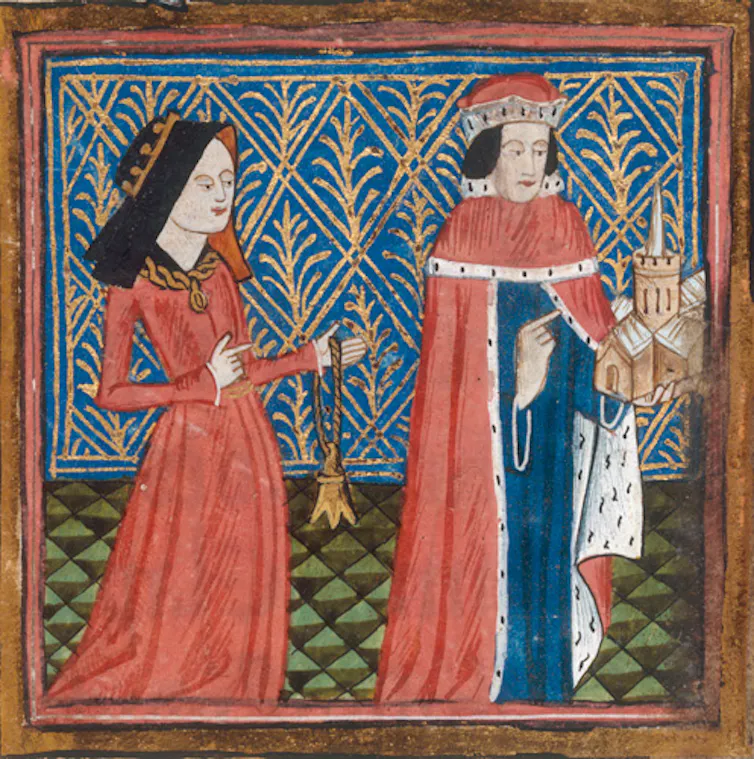
British Library / WIkipedia, CC BY

A new layer of meaning
Over time, nuance and politics are obscured behind easy labels, such as “witch”, flattening context and shielding systemic perpetrators. This is how cultural memory works. The stories societies inherit are not static records of what happened. They travel between chroniclers, novelists, films and audiences, and even historians, accumulating and shedding meaning as they go, until the most memorable version becomes more familiar than the historical event itself.
The pattern is not unique to witchcraft or to Royal Witch. Discussing The White Queen series adapted for screen from Gregory’s Cousins’ War novels, literary scholar Misty Urban observed that modern retellings “attribute the same weapons to women that medieval authors did; they simply imagine a reception by the audience that is delighted rather than horrified”.
Those accusations – manipulation, ambition, occult influence – have not disappeared. We have simply learned to read them as evidence of power rather than proof of guilt.
Witch has now acquired another layer of meaning: a celebration of female knowledge, independence and resistance to patriarchal authority. That reclamation has value, but it is a different project from recovering the lives of historical women. If we collapse the two, we risk turning a misogynistic simplification into an empowering identity without asking whether it belonged to the woman at all.
That does not mean novelists should stop writing witches. Popular culture, Gregory’s novels included, keeps histories alive. I say this as a fan and fellow historical fiction author working in the same creative tradition. Engaging the public with the past is the core of what I do as a public historian.
But the question mark matters. Every generation inherits stories, and we also rewrite them. Historical women are remembered through reputations they never chose. We need not pass them on uncritically.
This article features references to books that have been included for editorial reasons, and may contain links to bookshop.org; if you click on one of the links and go on to buy something, The Conversation UK may earn a commission.

Lynsey Cowlishaw does not work for, consult, own shares in or receive funding from any company or organisation that would benefit from this article, and has disclosed no relevant affiliations beyond their academic appointment.