The 2026 Asian Games in Japan drew to a close on October 4 following two weeks of competition between 45 countries and territories across 43 sports. Despite the official slogan “imagine one Asia”, fragmented regional politics came to the fore as the event unfolded.
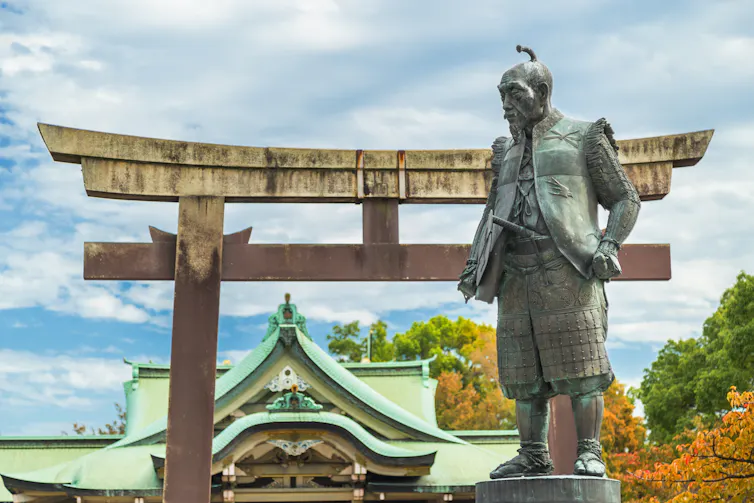
Just days before the games officially began, tensions between Japan and South Korea flared after an actor portraying a medieval Japanese warlord featured at a welcoming ceremony for the athletes in the host city of Nagoya. The warlord, Toyotomi Hideyoshi, is a local hero in Nagoya but also led the 16th-century Japanese invasion of Korea.
At the 2020 Tokyo Summer Olympics, the South Korean delegation was asked to remove a banner at the athletes’ village containing words attributed to a Korean admiral, Yi Sun-sin, who defeated the Japanese Navy in the same medieval war. With this in mind, the Nagoya ceremony particularly upset South Korea, which filed a complaint with the event organiser.
Historical issues are an area of particular sensitivity between South Korea and Japan. The 16th-century invasion was followed by a Japanese occupation of the Korean peninsula from 1910 to 1945.
cowardlion / Shutterstock
The 2026 Asian Games also marked the first time in more than four decades that North Korea sent its athletes to a sporting competition in Japan. Their participation is noteworthy in itself. Japan and North Korea have never established formal diplomatic ties, and sanctions imposed by Japan on the communist state ordinarily prevent North Koreans from travelling there.
However, Japan is home to a large North Korean diaspora made up of people related to those who moved there during the colonial period. Members of this group supported the rare North Korean visitors, hanging placards in the stadiums bearing patriotic slogans such as “Let’s show the majesty of the Republic”.
In a post-match press conference after defeating Bangladesh 10-0, the North Korean women’s football team coach, Pak Song-jin expressed his gratitude for this support. He said their cheers at the match “gave great strength and encouragement to our players and myself”. The team celebrated with these fans in the stadium after the game.
The North Korean delegation interacted mostly with this diaspora group during the games because Pyongyang tightly controls how its athletes engage with foreign nationals at international competitions. North Korea’s leadership are particularly concerned about their athletes defecting to other countries while competing abroad.
But despite these restrictions, which include 24-hour monitoring by intelligence personnel, South Korean media has reported that the authorities could not prevent two members of the North Korean team from seeking asylum in Japan.
One of the more predictable frictions on display at the Asian Games was between South and North Korea. In the opening days of the games, North Korea’s national anthem was mistakenly played for the South Korean men’s hockey team.
While this was probably an administrative error, it drew sharp criticism from South Korean officials. In a statement, the South Korean Sport and Olympic Committee said such an incident “should never happen” at an international sporting competition.
The two countries then met in a group-stage game in the women’s football, which ended in a 1-1 draw. Their coaches did not shake hands afterwards. This uneasiness continued at the post-match press conference, with Park Sung-jin not responding to questions from South Korean media.
On another occasion, a member of the North Korean shooting team called Kim Hyon-Suk did not show up to a scheduled media conference where many South Korean journalists were present. And North Korean weightlifting gold medallist Ri Seong-Geum refused to answer questions from a reporter from Seoul who was not using the term “DPR Korea”.
North Korean athletes, coaches and sports officials have long insisted on the use of this title at international competitions. The name stands for the Democratic People’s Republic of Korea and respects the sovereignty of the communist country, which South Korea does not formally recognise.
Taiwan’s diplomatic isolation
Taiwan’s delegation also encountered political problems in Japan. Before the games began, a banner was vandalised at the Taiwanese team’s training camp. The banner read: “national sport training centre”.
Taiwan takes part in international sporting events under the name of Chinese Taipei because its sovereignty is disputed internationally. China considers Taiwan one of its provinces. The banner represented Taiwan as an independent country, and this expression may have antagonised some groups at the competition.
The Taiwanese sport minister, Lee Yang, was then barred from attending the athletes’ village welcoming ceremony. Event organisers were concerned that his presence might trigger political controversy. The Taiwanese athletes left the venue in protest and, eventually, Lee was allowed to enter the village and the ceremony resumed.
Event marshals also banned Taiwanese fans from wearing clothing bearing the word “Taiwan”, as this was deemed a political message. And officials put up signs in the stands stating that waving Taiwan’s flag was prohibited in the stadiums. Taiwanese fans chanted “Team Taiwan” during the games in defiance of the regulations.
The fractured regional relations on show at the 2026 Asian Games should not be viewed in isolation. As world politics has become more divisive, international sporting contests are often turning into a stage for political contention.

Jung Woo Lee does not work for, consult, own shares in or receive funding from any company or organisation that would benefit from this article, and has disclosed no relevant affiliations beyond their academic appointment.