When Sarah Mullally was confirmed as the 106th archbishop of Canterbury, this meant a woman would become spiritual leader of the Church of England and worldwide Anglican communion for the first time in history. For many, it has been a welcome shift that recognises the importance of female leadership at all levels – both ecclesiastical and secular.
But some within the Church took issue with Mullally’s accession. For example, the Global Fellowship of Confessing Anglicans, a network of conservative Anglican churches across Africa and Asia, issued a statement declaring: “The majority of the Anglican Communion still believes that the Bible requires a male-only episcopacy.” Its members have refused to recognise her as their archbishop.
Mullally’s accession follows a pattern, as more and more women gain access to leadership positions in churches across the world. As we show in our recent book, The First Ordained Women in the Church of Sweden: Narratives of Vocation and Recognition (2026), when their vocation to the priesthood is officially recognised, it gives them self-confidence, self-respect and self-esteem. But it also elicits opposition, with the women themselves usually made responsible for keeping the peace.
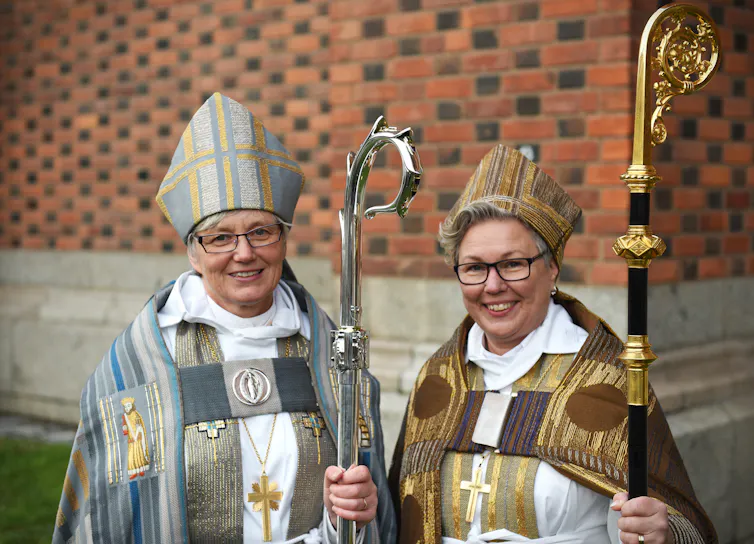
Magnus Aronson, IKON / Wikimedia, CC BY-SA

Vocational calling
On September 28 1958, after decades of ecclesial and societal calls for women’s vocation to be recognised, the Church of Sweden’s General Synod voted to open the priesthood to women. We retraced the narratives of the first 54 women who were ordained between 1960 and 1970.
Proponents of the reform referred to biblical passages such as Galatians 3:28 as promoting equality: “There is no longer Jew or Greek; there is no longer slave or free; there is no longer male and female, for all of you are one in Christ Jesus.”
To their minds, the priest is someone called not to represent Christ (as some opponents believe), but to point towards him.
On Palm Sunday in 1960, Margit Sahlin, then 46, was one of the first three women to be ordained in Sweden. Sahlin’s ordination by Archbishop Gunnar Hultgren took place at the chapel of St Catherine Foundation outside Stockholm. She had long fought for womens’ roles in the church to be expanded.
In a diary entry from the mid-1940s, Sahlin described her shock at being told by one leading opponent of female priests, the bishop Bo Giertz, that while Sahlin was welcome to think of herself as a prophet, she shouldn’t delude herself into thinking she had an ecclesial vocation.
“To be obliged in this way to forge my own path,” Sahlin wrote, “borne only by a personal faith in my vocation, without any external ecclesiastical authority to fall back on, constituted an unreasonable pressure.”
Her belief in herself was undermined by an inferiority complex – and the criticism to which she was always exposed “as a pioneer”.
As with Mullally, some opponents of Sweden’s early female ordinations invoked biblical passages that could be interpreted as reserving the priesthood for men, and promoting the subordination of women. Others cited different obstacles, including that women would be miserable in a vocation reserved for men.
They also raised the “ecumenical argument” – that such a reform could jeopardise international cooperation with the Church of England, which at that time did not approve of women priests.
To avoid the perceived risk of division of the Church, the 1958 reform included a conscience clause. Similar measures had already been taken by the state churches in Denmark and Norway. The clause guaranteed that male priests who did not agree would not have to serve alongside ordained women.
In principle, this meant that both proponents and opponents of the reform could continue to serve as priests. However, it had dire consequences, particularly for the women who were ordained.
The struggle for recognition
This conscience clause meant that women’s vocation was fully recognised – unless opponents were present. In that case, it was the women’s responsibility to safeguard what was referred to as “the neutral line”, by stepping aside and refraining from priestly duties.
Over time, this created a code of conduct where the burden of keeping the peace fell on the women alone.
It also enabled denial of recognition. For example, the Church Coalition for the Bible and Confession, formed in Sweden in 1958, provided guidelines for how this conscience clause should be interpreted. These guidelines stated, among other things, that laypeople and priests opposing the reform should avoid any contact with ordained women. One of our interviewees, Sofia (not her real name) spoke of the impact this had on her relationships with colleagues:
I have certainly felt disappointment at the absence of fellowship, in everyday life, and at not being able to share the deep joy before the face of God. I have felt particular disappointment at frozen fellowship with former fellow students. Suddenly there was nothing but silence [or] possibly a pleasant facade.
Clara (also not her real name) said that during her studies to be a pastor in 1964, if one of the women gave a sermon in the group, they would all be told: “That’s fine for a parish evening meeting, but not for the pulpit.”
“Sometimes,” she recalled, “I was told that the ordination of a woman was ineffective in all circumstances. It could be equated with the baptism of a pig. Sometimes I was so discouraged that I could scarcely bear to go to lectures and practice sessions.”
In his 1995 book The Struggle for Recognition, German philosopher Axel Honneth describes how being denied recognition can impact a person’s development of self-identity. As one of the other Swedish women ordained during the 1960s, Lena Malmgren, later wrote in the Göteborgs-Posten newspaper: “Anyone who does not respect my faith in God and his calling of me as a priest does not respect anything that is important to me, not the innermost part of my person; he violates my very person.”
‘A consequence of the Gospel’
Institutional reforms tend to be judged by the moment they are enacted. But it is still often a slow and storied process. Decisive events and dates — that Palm Sunday in 1960, say – are merely symbolic starting points for a continued struggle for the requisite structures to be put in place.
However, the Swedish reform did not result in any rupture between the Churches of Sweden and England – quite the opposite, in fact. The archbishop of Uppsala and primate of the Church of Sweden, Martin Modéus, attended Mullally’s installation as archbishop on March 25 2026.
Modéus also told the Dagen newspaper that having men and women sharing responsibility at every level of the Church was a fuller reflection of the diversity of the people the Church is called to serve – and “a consequence of the Gospel”.
“For those of us who have already had a woman serving as archbishop,” he said, in reference to his predecessor Antje Jackelén, “it is encouraging to see our sister churches taking similar steps. It is also a sign of hope in a world where there are forces pushing back against gender equality.”

Frida Mannerfelt receives funding from Lund University as well as different Swedish non-profit foundations that supports research in the humanities and theology. She is an ordined minister in the Church of Sweden.
Alexander Maurits receives funding from Lund University as well as different Swedish non-profit foundations that supports research in the humanities and theology.