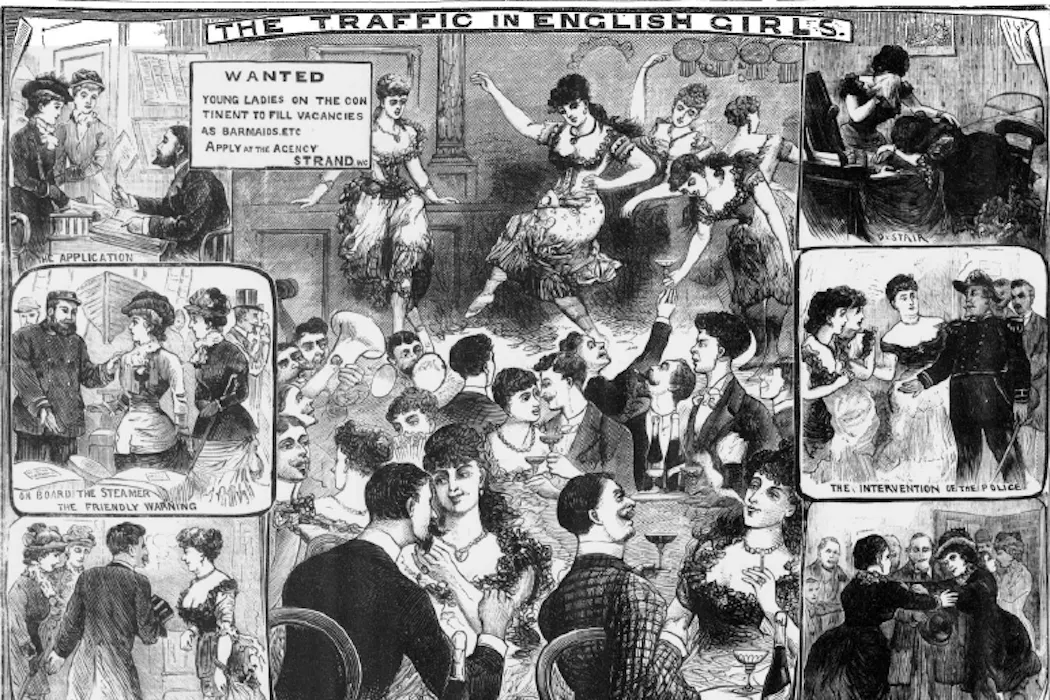
The media exposes a scandal – a network of rich, powerful men are abusing teenage girls. Outrage spreads fast and the public demands that authorities reveal the evidence and bring the perpetrators to justice. Yet the system shields many of those involved, and few face serious consequences. This isn’t about Jeffrey Epstein – it’s a scandal that unfolded in Victorian London.
Our research focuses on the women and girls at the centre of those events. In July 1885, a series of newspaper articles ran in the Pall Mall Gazette with the headline The Maiden Tribute of Modern Babylon. They exposed systematic abuse and trafficking of young girls. From the day the articles were published, there was uproar. Parliament was inundated with petitions and there was a huge demonstration in Hyde Park.
MPs were forced to respond, passing legislation which raised the age at which girls could consent to sexual intercourse from 13 to 16. Records of those events are held in the Women’s Library at London School of Economics, and some are displayed in its current exhibition, The Women’s Library at 100.
Read more:
Victims have told us the worst of Epstein’s crimes for decades – and they are still being ignored

The W.T. Stead Resource Site

The Maiden Tribute was the final step in years of campaigning for a higher age of consent. Before then, legislation which aimed to raise it had languished in parliament. According to rumours among campaigners and politicians, this was because some MPs were guilty themselves of abusing young girls. Indeed, opponents openly argued that such legislation would expose their own sons to the risk of prosecution.
Frustrated activists had turned to W.T. Stead, the editor of the Pall Mall Gazette. Feminist campaigner Josephine Butler, leading Salvation Army members and Stead undertook an investigation of child sexual exploitation, visiting everywhere from brothels to rescue homes. Stead even “purchased” a 13-year-old girl named Eliza Armstrong and sent her to France (in the Salvation Army’s care) to prove that such procuring and trafficking was possible.
Butler noted in a letter to a friend: “O! What horrors we have seen!”
The London scandal
The resulting articles took the reader through the process of recruiting and abusing young women. They portrayed a whole industry devoted to the exploitation of the girls: procurers and brothel-keepers, doctors who “certified” virginity and midwives who ministered to their wounds afterwards.
The series was swiftly syndicated around the world as “the London scandal” and people speculated on the identities of the men described. In New York, it was rumoured that many prominent American men visited the notorious brothel madam Mrs Jeffries’ houses. Some of her clients were named in the campaigning newspaper The Sentinel as MPs, Lords and Dukes, the Prince of Wales and King Leopold II of Belgium.

Sheffield Gender History
Popular outrage forced MPs to pass the Criminal Law Amendment Act by August. As well as raising the age of consent for girls, the legislation rushed to introduce new offences of procurement and brothel keeping.
Some of these offences further criminalised women rather than those exploiting them. For example, if two or more sex workers operated in shared premises for safety, they could become liable for brothel-keeping – that is still the law today. A late amendment introduced by Henry Labouchere MP also outlawed all consensual sexual activity between men; the new offence was used to convict the writer Oscar Wilde a decade later.
Ironically, only Stead and several of his colleagues were convicted as a result of these events. They were imprisoned for the kidnapping of Eliza Armstrong. Meanwhile, the men accused by campaigners of exploiting underage girls were unprosecuted and unpunished.
Read more:
Oscar Wilde’s The Ballad of Reading Gaol is a work of art activism beloved by Banksy
Lessons for today
There is much to be learned from this history. First, some very influential people do not want child sexual exploitation eradicated, making effective reform difficult to achieve. It was only through public pressure that new laws were finally passed in 1885. However, a combination of haste, conservatism and deference to elite male interests meant that the law was deeply flawed and moralistic.
Second, the victims and survivors of abuse are too easily blamed, ignored or politically exploited. Reporting of the Maiden Tribute scandal furthered specific ends. In France and America, it was used as proof of aristocratic degeneracy. Meanwhile, the exploited girls were dismissed by respectable society as “fallen”. As the MP Charles Hopwood said in the House of Commons, working-class “girls who went upon the streets … had a familiarity with these things from an early age and were quite able to take care of themselves”.

WikiCommons

Victim-blaming drew attention away from procurers, such as Mrs Jeffries, who offered girls a route out of extreme poverty or lured them with false promises of legitimate jobs. The trafficking described in the 1880s used similar recruitment techniques and enforcement methods to today. Even those girls who benefited financially from their exploitation suffered greatly in their mental and physical health.
Third, the establishment tries very hard to cover up such abuse. In Victorian London, policemen were paid off and one who refused to be bought was constructively dismissed. Earlier in 1885, campaigners had brought a private prosecution against Mrs Jeffries because the police refused to take the case any further; the judge frequently reminded witnesses not to name clients; and Mrs Jeffries pleaded guilty mid-trial, before her VIP clientele was exposed. She escaped with a fine rather than imprisonment. In 1887, Mrs Jeffries would be prosecuted again under the new Act; her clients were not.
It is not easy to make the powerful face consequences. Of the leading figures exposed in the Maiden Tribute, the only person who ended up in jail was a woman: Mary Jeffries. The men faced no reckoning, except for gossip about their involvement.
The history, then, offers useful guidance for the present: put pressure on those in power to take effective and swift action, do not trust politicians exploiting abuse to gain power, rigorously uncover institutional corruption and ensure that money and influence do not protect abusers from rightful consequences. Most importantly, believe and centre the voices of victims and survivors.

The authors do not work for, consult, own shares in or receive funding from any company or organisation that would benefit from this article, and have disclosed no relevant affiliations beyond their academic appointment.