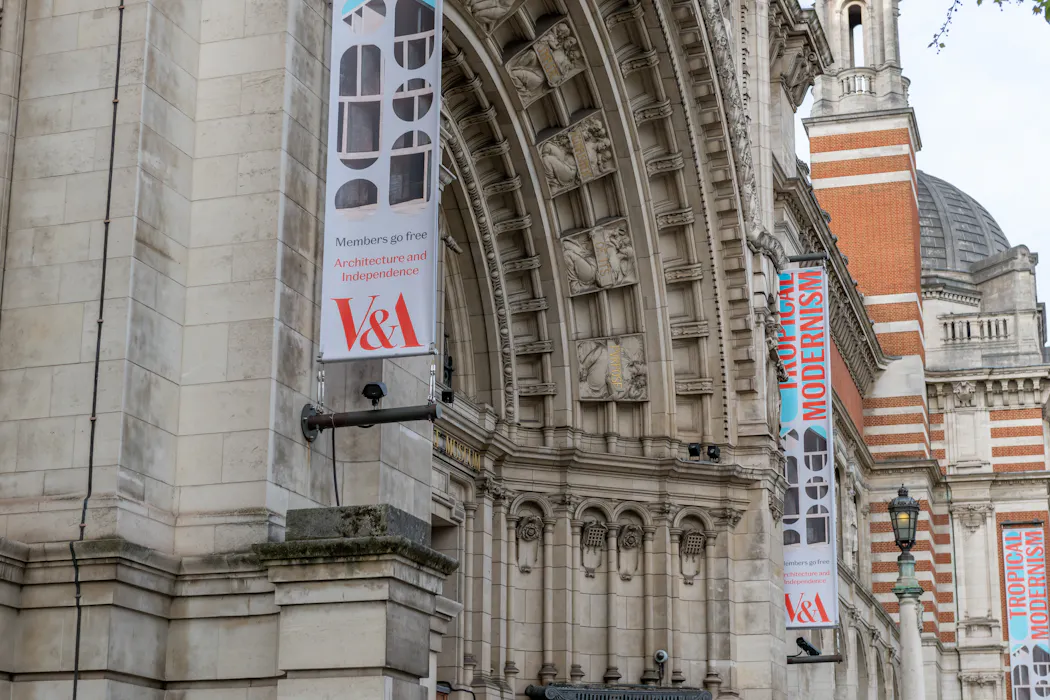
When people think about censorship, they often imagine an obvious ban: a book prohibited, an exhibition closed, or a speaker silenced.
But the recent revelation that London’s Victoria and Albert Museum changed exhibition catalogues at the request of its Chinese printer points to something subtler. It suggests that Chinese censorship is increasingly capable of shaping cultural production beyond China’s borders through reliance on foreign companies.
The V&A agreed to remove or replace images from at least two exhibition catalogues after objections from its Chinese printer. This included a historical map in a new exhibition, The Music Is Black, and an image of Lenin in a publication linked to the 2021 exhibition Fabergé: Romance to Revolution.
A V&A spokesperson told The Conversation: “We carefully consider, on a case-by-case basis, where we print all of our books. We sometimes print in China but maintain close editorial oversight. We were comfortable making these minor edits, as they did not affect the narrative, and would obviously pull production if we felt any requested change was problematic.”
The museum may see the changes as minor, but their significance lies less in the scale of the edits than in the mechanism through which they occurred.
Nothing in British law required these changes. No UK official ordered them. Yet the content of a British museum publication was altered because parts of its production process took place within a system governed by Chinese state censorship rules. That is why this matters. It reveals a form of externalised censorship that does not need to arrive as a direct prohibition. It can operate instead through contracts, deadlines, cost pressures and infrastructural dependence.
This article is part of our State of the Arts series. These articles tackle the challenges of the arts and heritage industry – and celebrate the wins, too.
This controversy tells a wider story about the heritage sector. Museums, galleries, libraries and publishers are all under pressure to control costs. If Chinese printers can produce catalogues at roughly half the price of British or European firms, the economic logic is obvious. Once an institution becomes reliant on a supply chain situated within an authoritarian censorship system, the practical conditions of cultural expression begin to change, even if the legal environment at home remains formally free.
In countries such as the UK, free speech is often understood in legal terms: are people formally allowed to publish, speak or exhibit? But the V&A case is a reminder that formal freedom is not the same as institutional resilience. A society may remain free on the surface while its institutions become increasingly susceptible to outside pressure.
Why the censorship matters
Museums matter especially because they are not ordinary commercial actors. They are memory institutions. They help shape public understanding of history, culture and identity. Their catalogues are not mere retail products but part of how knowledge is framed, archived and circulated. A “minor” change to an image in this context is therefore not politically neutral.
The deeper issue is that this is not only about suppressing taboo topics such as Tibet, Taiwan or Tiananmen. It is also about controlling the positive narrative.
Chinese information governance has long worked through both prohibition and projection. The 2020 Provisions on the Governance of the Online Information Content Ecosystem, issued by China’s internet regulator, encourage the production and dissemination of material that helps increase “the international influence of Chinese culture” and presents to the world a “true, three-dimensional and comprehensive China”. This forms part of a broader Party-state project, repeatedly articulated by Xi Jinping, of “telling China’s story well”.
cowardlion/Shutterstock
That phrase may sound benign. But in practice it is tied to a political and legal project in which China is not merely defended from criticism, but represented abroad under conditions increasingly shaped by party-state priorities. Seen in that light, the V&A controversy is not just a matter of avoiding sensitive content. It sits within a broader effort to structure the terms under which China may be portrayed at all.
Recent developments in the digital sphere show the same broader pattern in a more aggressive form. In February 2026, OpenAI reported that it had disrupted an operation linked to a Chinese law-enforcement official who allegedly used ChatGPT to document efforts aimed at intimidating dissidents abroad. This included fake official communications and forged documents. That is different from the V&A catalogue dispute. But both illustrate a new stage of transnational control in which the Chinese party state and its affiliated actors can use a range of mechanisms at once: political security logic, economic leverage, platform manipulation, bureaucratic pressure and technological tools.
These cases should not be collapsed into one another. A museum changing an image under pressure from a company in China is not the same as a dissident being targeted through deceptive digital operations. But they belong to the same ecology. One is the hard edge of transnational repression. The other is its quieter institutional face. Together, they show that the challenge is no longer confined to dramatic diplomatic incidents or overt bans.
That has implications far beyond museums. Universities, publishers and now cultural organisations in the UK increasingly operate in environments where external authoritarian influence may be felt not through formal legal obligation, but through partnership structures, procurement decisions, market access, technological dependency and reputational caution.
Liberal institutions are often poorly equipped to recognise these pressures because they expect censorship to appear as a clear legal command. Increasingly, it appears instead as a request to make one small change, to avoid delay, to save money, to keep things moving.
The lesson of the V&A controversy, then, is not simply that one museum made a questionable decision. It is that Britain needs a more serious conversation about cultural sovereignty under conditions of asymmetric interdependence.
If institutions rely on companies governed elsewhere by censorship, then freedom of expression at home becomes more fragile. The real question is not whether British museums are free in theory. It is whether they are independent enough in practice to prevent authoritarian preferences from quietly entering the production of public culture.

Ge Chen is Associate Professor in Global Media & Information Law at Durham Law School and Affiliated Fellow of the Information Society Project at Yale Law School.